
Bhoot, Pret and Pishach: Terms in Hindu Tradition Explained

Words like bhoot, pret and pishach are used freely in Hindi films, family stories and playground dares, often as if they meant the same thing. They do not. Each has its own history in Sanskrit texts, funeral custom and regional folklore, and understanding the difference often takes a great deal of fear out of a conversation. Families in North York, Brampton and Etobicoke sometimes come to me shaken after a relative used one of these words about their home or child. Asking about bhoot pret meaning is a good first step, because it replaces a frightening label with real knowledge. In this glossary-style guide you will learn what each term means, where it comes from, how texts such as the Garuda Purana and the Vetala tales use them, how folklore has added to them, and how to think about them sensibly today. In more than forty years of practice, I have found that most people who fear a bhoot are actually carrying grief, stress or poor sleep, and naming that gently is often the most protective thing I can do.
What is the meaning of bhoot and pret?
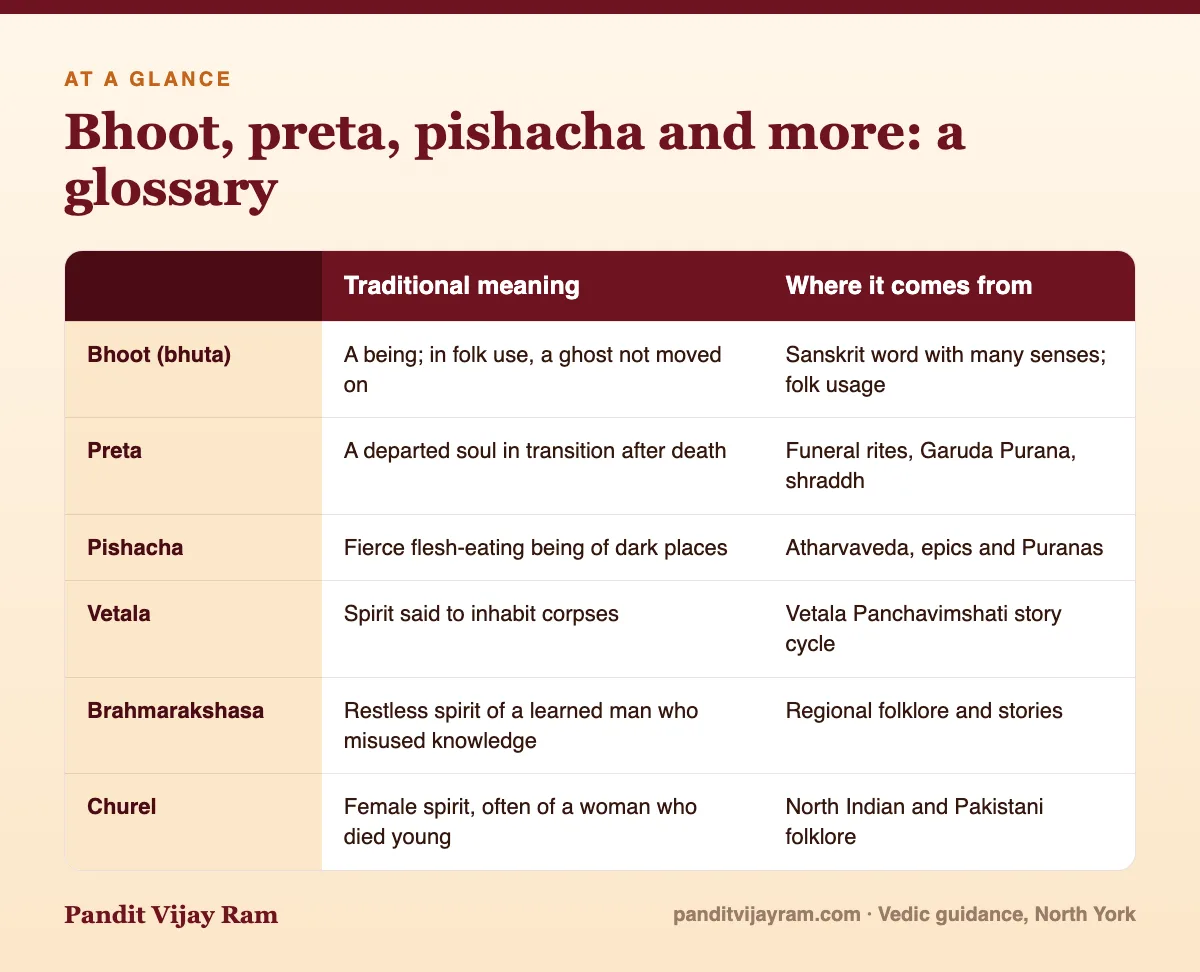
Bhoot derives from the Sanskrit bhuta, meaning something that has come into being or has been, and in everyday Hindi it means a ghost. Pret, from Sanskrit preta, means one who has gone forth, the departed. In funeral tradition preta names the soul in its transition after death, before rites unite it with the ancestors.
The word bhuta is very old and has several meanings that are worth knowing.
- A being or creature. In texts like the Bhagavad Gita, sarva-bhuta means all beings.
- An element. The pancha mahabhuta are the five great elements of earth, water, fire, air and space.
- The past. Bhuta-kala is the past tense, what has been.
- A ghost or spirit. In later folk usage, a being who belongs to the past but has not moved on.
Shiva is called Bhutanatha, lord of beings, and his attendants, the ganas, are sometimes described as bhutas. In that sense the word is not evil at all; it reminds us that even unsettled beings come under the care of the divine.
Preta has a more specific meaning. It describes a soul after death that has not yet joined the pitrs, the ancestors. The family's rites over the following days are understood to give it a subtle body and help it on its way. A preta is not a monster but a soul in need of care. The same word in Buddhist tradition is often translated as hungry ghost.
Guidance for grieving families sits in a separate article on the spirit of a deceased relative.
What does pishach mean in Hinduism?
A pishacha is a fierce, flesh-eating being described in Vedic and Puranic literature, often associated with cremation grounds, darkness and impurity. The Atharvaveda contains prayers against them. Unlike a preta, a pishacha is generally not a recently departed relative but a separate class of being in mythology and ritual texts.
Pishachas appear early. The Atharvaveda, one of the four Vedas, includes hymns asking Agni and other deities to drive away pishachas and rakshasas. In later epics and Puranas they are often listed among the lowest orders of beings, described as dwelling in desolate places and feeding on the dead.
Three related uses help show how the word moved through Indian culture:
- Paishachi was the name of a literary language or dialect in classical India. The lost Brihatkatha of Gunadhya is said to have been written in it, which is an interesting reminder that the label could also mean simply rough or outlandish speech.
- Paishacha vivaha is the eighth and most condemned form of marriage in the Manusmriti: taking a woman who is asleep, intoxicated or unable to consent. Naming it after pishachas marks it as utterly wrong.
- Folk speech uses pishach loosely for any frightening presence, or as an insult.
When a family member calls something a pishach, it usually expresses fear or disgust rather than a precise religious diagnosis. I gently ask what actually happened, because the experience matters more than the word chosen for it. The magic and entities hub gathers practical guides on those experiences.
What are vetala and brahmarakshasa?
A vetala is a spirit said to inhabit and animate corpses, famous from the Vetala Panchavimshati, the tales of King Vikramaditya and the riddling Betaal. A brahmarakshasa is believed to be the spirit of a learned Brahmin who misused knowledge or neglected his duty, and who remains restless until released. Both are stock figures in Indian story traditions.
The Vetala Panchavimshati, known in Hindi as Baital Pachisi, is a collection of twenty-five stories. A king sets out to carry a vetala hanging from a tree to a sorcerer. On the way the vetala tells him a story ending in a moral riddle, and each time the king answers wisely, the vetala escapes back to the tree. The tales are really about justice, duty and wisdom, which is why they remain popular with children and adults alike.
The brahmarakshasa carries a different lesson. Folk belief across many regions of India holds that a scholar who used learning for pride or harm may become this kind of spirit. In stories, the brahmarakshasa is often freed when someone answers its questions or performs the right rites. The moral is plain: knowledge carries responsibility.
A short list of other terms you may hear:
- Rakshasa. In the epics, a powerful race of beings, such as Ravana. Not ghosts of the dead.
- Yaksha. Nature spirits linked to trees, water and wealth, often benign; Kubera is their king.
- Dakini. In Hindu folklore an attendant of fierce goddesses; in Tibetan Buddhism a very different, revered figure.
For how these ideas meet a different religious worldview, see the comparison of ruqyah and Vedic protection, which explains why jinn and bhoot are not the same.
What is a churel and why are folk spirit beliefs sometimes dangerous?
A churel or chudail is a female spirit in North Indian and Pakistani folklore, often said to be a woman who died in childbirth or after mistreatment, sometimes pictured with backward feet. Such stories can carry grief and social memory, but labels like daayan have also been used to accuse and harm living women, which must be refused.
Folk stories about the churel are widespread and vary from village to village. Many scholars read them as a way communities remembered women who suffered or died young, especially in childbirth. In that light the stories are less about evil than about loss that was not properly honoured.
There is a serious side to this vocabulary. In parts of South Asia, women, often widows, elders or women in disputes over land, have been accused of being a daayan, or witch. Such accusations have led to beatings, exile and worse. Protecting people from that kind of harm is far more important than any belief about spirits.
So I ask families to hold three rules:
- Never label a living person as a daayan, churel or carrier of a bhoot. It can endanger them.
- Never accept a ritual that harms anyone, including beating, starving, burning or isolating them. In Canada these are crimes, whatever the motive.
- Treat sudden changes in a person as a health question first. Seizures, confusion, hearing voices and extreme moods have medical causes that need a doctor.
These safety points are explored more fully in the guides on exorcism in Hinduism and possession or mental illness.
How should we understand bhoot and pret today?
Treat these words as part of a rich religious and storytelling heritage, not as a diagnosis. When someone fears a bhoot, look first at sleep, grief, health and the home itself. Where belief remains, Hindu practice answers it with compassion: prayer for the departed, the family's rites, a lamp, and protective recitation.
Many Hindus hold these beliefs sincerely, and I respect that. Others see them as symbolic. Both groups can agree on a sober, kind approach that keeps people safe.
Here is how I suggest framing things at home:
- For a recent death in the family, think of preta as a soul in transition and focus on the rites, prayer and shraddh. The guide on pitru dosh and shraddh explains ancestral offerings.
- For fear at night, check sounds, sleep and stress first, then use a lamp and the Hanuman Chalisa, which itself says that bhoot and pishach do not come near where Hanuman's name is recited.
- For children, avoid scary stories as explanations. Reassure them, keep bedtime calm, and speak to your paediatrician if fears persist.
- For any change in a person's behaviour, see a doctor first, and add prayer alongside care.
The well-known Chalisa line, bhoot pishach nikat nahi aave, mahavir jab naam sunave, is perhaps the best summary of the tradition's attitude: these words exist, but devotion is stronger than fear.
When should I get help if I think a bhoot is troubling my family?
Get practical and medical help first: a doctor for sleep problems, panic, confusion or voices; an electrician or contractor for physical problems at home. If ordinary causes are ruled out and the family still feels disturbed, an experienced practitioner can review the situation calmly and suggest proportionate, prayer-based steps without fear or harm.
A good order of steps protects both health and peace of mind.
- Safety first. If anyone is at risk of harming themselves or others, call 911. In a mental-health crisis in Canada, call or text 9-8-8.
- Health check. Book a family doctor visit for anyone with new symptoms such as hearing voices, seizures, extreme fear or not sleeping.
- Home check. Look at wiring, carbon monoxide alarms, pests, damp and noise.
- Simple household prayer. A dusk lamp, the Hanuman Chalisa, and prayer for any recently departed relative.
- Practitioner review. If unease continues, consult someone who asks careful questions and does not frighten you.
When families come to me, I ask what happened, when it started, who in the home is affected, and what has already been checked. Very often the honest answer points to grief or exhaustion, and the most helpful remedy is rest and the family's own rites. Where more is needed, the spirit and ghost removal service explains how a careful, non-harmful approach works. Walk away from anyone who names a frightening spirit immediately and asks for money to remove it.
The bottom line
The bhoot pret meaning is clearer once the words are separated: bhoot is a general word for a ghost, preta is a soul in transition after death, and pishacha is a fierce being of Vedic and Puranic texts. Folk figures like the vetala, brahmarakshasa and churel carry stories and lessons, but labels must never be used to harm living people. Check health and home first, and meet any remaining fear with prayer, the family's rites and compassion.
Key takeaways
- Bhoot comes from Sanskrit bhuta, which also means a being, an element or the past.
- Preta means a departed soul in transition, cared for through funeral rites and shraddh.
- Pishachas are fierce beings in Vedic and Puranic texts, distinct from departed relatives.
- Never label a living person a daayan or carrier of spirits; it can put them in danger.
- Check health, sleep and the home first, then use prayer and protective recitation.