
Can Jinn Fall in Love With Humans? Folk Belief and Honest Answers

A young woman writes that she feels watched at night and that someone in her family says a jinn has fallen for her. A husband worries that his wife's distance is a spirit's jealousy. Questions about jinn love reach me often, from North York, from Mississauga and from families across Canada. They usually come wrapped in embarrassment and fear. This article treats the question honestly. You will read what the folk belief actually says, what Islamic scholars have and have not taught, which medical and emotional causes can feel exactly like a spirit's attention, and how people exploit this fear for money. I work in the Vedic tradition, not as an Islamic scholar, so the religious rulings here are summaries and your imam remains the right person to ask. In more than forty years I have noticed that people carrying this fear are often lonely, exhausted or grieving, and that being listened to is the first relief. Health care comes before any ritual.
What do people mean by an ashiq jinn?
Ashiq is an Arabic and Urdu word for a lover, so an ashiq jinn is a jinni believed to have fallen in love with a person. In folk accounts it may visit in dreams, resent a spouse or fiancé, and be blamed for broken engagements, low mood or physical discomfort.
The belief appears in Arab, Persian, Turkish, Malay and South Asian folklore, usually as a cautionary tale. Stories often describe a woman who combs her hair at night near a window, or a man who walks alone past a ruin, and draws a jinni's attention. Some accounts make the jinni male and the human female; others reverse it.
Common features in these stories include:
- vivid dreams of a stranger, sometimes romantic or sexual;
- a sense of being watched or touched in bed;
- sudden coldness toward a partner or a proposed match;
- a run of rejected marriage proposals blamed on jealousy.
Similar tales exist far from the Muslim world. Medieval Europe told of the incubus and succubus, night visitors who pressed on sleepers. Hindu folklore has stories of yakshinis and gandharvas drawn to human beauty. The wide spread of such stories tells us something about human sleep and longing, which the next sections explore.
If the central worry is a frightening presence at night rather than love, the guide to sleep paralysis and jinn is closer to your question.

Can jinn and humans marry according to Islamic scholars?
Classical scholars did discuss marriage between jinn and humans, and they disagreed. Several jurists considered it impermissible or of no legal effect, others thought it theoretically possible, and many today see it as a question without practical basis. Mainstream teaching treats it as speculation, and an imam should be consulted for any personal ruling.
Muslim jurists sometimes explored unusual hypothetical questions to test legal principles, and jinn marriage was one of them. Some argued that marriage exists for tranquillity and affection between spouses of the same kind, citing Quranic verses about spouses created "from yourselves". Others reported folk accounts but warned that claims of jinn spouses were unverifiable and open to abuse.
What most contemporary scholars stress is practical:
- No one can verify that a jinni has "married" or claimed a person.
- Such claims have been used to justify control over women and to block chosen marriages.
- Remedies offered should be ordinary Islamic devotion, not secret rituals.
- Medical care is permitted and encouraged in Islamic ethics.
That last point matters. Islam does not ask anyone to choose between prayer and a doctor. Many imams in Toronto will say the same, and some mosques have connections to Muslim counsellors who understand both sides.
For the wider teaching on what jinn are, see the meaning of jinn in Islamic and folk belief. For questions on rulings, your own imam or a qualified scholar is the right authority, not a website and not me.
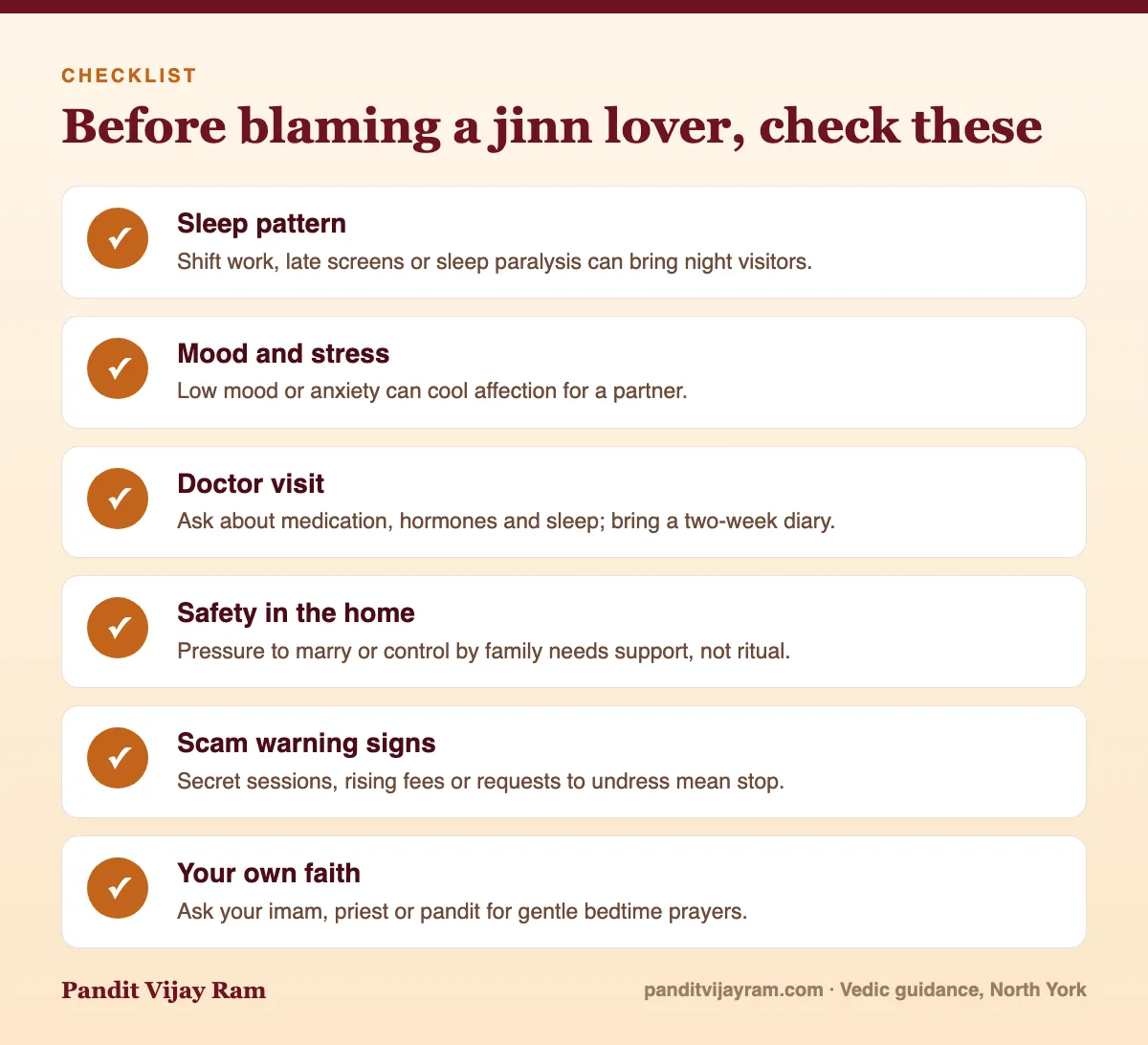
What can feel like a jinn in love but has another cause?
Many things can feel like a spirit's attention: sleep paralysis, hypnagogic images at the edge of sleep, normal erotic dreams, anxiety, depression, trauma, and in some cases psychosis or a fixed false belief. A family doctor can check sleep, medication, hormones and mood before anyone concludes that a jinni is involved.
None of these explanations are insults. They are common human experiences, and naming them can bring great relief. A rough guide helps you know what to mention to your doctor:
- Sleep paralysis: waking unable to move, often with a sense of a figure, pressure on the chest or a touch.
- Hypnagogic or hypnopompic images: vivid sights or sounds while falling asleep or waking.
- Erotic dreams: normal at any age, but they can feel shameful in strict households, which makes a spirit explanation tempting.
- Anxiety and low mood: withdrawal from a partner, tiredness, loss of interest in marriage plans.
- Trauma: past abuse can return as night fear or body sensations.
- Psychosis or erotomania: a rare but serious fixed belief that someone, seen or unseen, is in love with you.
Look for patterns. Do the experiences come after late nights, shift work or new medication? Do they ease on holiday? A sleep diary for two weeks gives your doctor something concrete.
If a person seems confused, hears voices commanding them, or speaks of self-harm, call or text 9-8-8, or 911 in an emergency. The guide on possession or mental illness covers how families can support treatment without shame.
How do scammers exploit fear of a jinn lover?
Scammers offer to "divorce" a person from a jinn husband or wife, demand repeated payments, insist on private or night sessions, request intimate photos, or tell the client to cut off family. These are warning signs of fraud and sometimes of sexual abuse, and they should be reported to police and the Canadian Anti-Fraud Centre.
Fear of a jealous jinni is a gift to anyone selling quick fixes. It is private, embarrassing and impossible to disprove, which lets a dishonest practitioner keep the client returning. Warning signs are consistent across communities:
- A diagnosis given within minutes, often by phone, with a frightening story attached.
- Fees that rise as the "jinn fights back".
- Requests to meet alone, at night, or to undress for a "bath" or "examination".
- Demands for photographs, hair, clothing or personal messages.
- Instructions to hide the treatment from parents, a spouse or a doctor.
- Threats that stopping will bring illness or death to the family.
Any one of these is reason to stop. Genuine Islamic teachers warn against exactly this behaviour, and so does every honest healer in the Vedic tradition. If you were touched without consent or pressured sexually, that is a crime; contact police. Money lost to fraud can be reported to the Canadian Anti-Fraud Centre. If the worry began with strain in a relationship, the love problem guidance page explains a prayer-based approach that never tries to override anyone's choice.
Our checklist for choosing a spiritual specialist gives questions to ask anyone before you pay or share personal details.
What spiritual support is reasonable alongside medical care?
Reasonable support is gentle and does not replace treatment: your own faith's prayers before sleep, a calm bedtime routine, honest talk with a partner, and, if wanted, a consultation for prayer and reflection. Muslims can ask their imam about evening recitations; Vedic families may use a lamp, mantra or Hanuman Chalisa.
Spiritual care works best when it lowers fear. A few principles keep it safe:
- Stay within your own faith. A Muslim who wants protective recitation should ask an imam which verses to read. A Hindu family may prefer the Hanuman Chalisa or a short Durga prayer at dusk.
- Keep it short and steady. Ten calm minutes each evening helps more than a frightening all-night ritual.
- Include the partner or family. Secrecy feeds shame; shared prayer builds trust.
- Keep the doctor informed. Treatment for sleep or mood problems and prayer sit well together.
When people from Hindu or mixed homes ask me for help, I usually begin with a kundli reading to look at timing and stress in the chart, then suggest simple prayers for their own peace. I do not perform rituals to control anyone's heart, human or otherwise. Where a relationship is struggling, the relationship compatibility consultation looks at communication honestly. Other guides on unseen beings sit in the magic and entities hub.
The bottom line
Jinn love is a real folk belief, but it is not a settled teaching, and classical scholars disagreed about it. Sleep paralysis, dreams, anxiety and other health causes can feel exactly like a spirit's attention and deserve a doctor's care first. Anyone demanding money, secrecy or intimacy to remove a jinn lover is a warning sign, not a healer.
Key takeaways
- An ashiq jinn is a folk idea of a jinni in love with a person.
- Islamic scholars debated jinn marriage and gave it no settled practical ruling.
- Sleep paralysis, dreams and mood changes can feel like a night visitor.
- Demands for secrecy, intimacy or rising fees point to fraud or abuse.
- Prayer from your own faith can sit beside medical care, never replace it.