
Sihr in Islam: Meaning, What Scholars Discuss and Protection
Families sometimes arrive at my door saying a relative has told them they are suffering from sihr. Many have never been taught what the word means, only that it frightens their elders. Getting the sihr meaning right is the first step to calm thinking about it. I speak with Muslim families in North York and across the GTA often enough to know how much they value accurate information, and how often they receive rumours instead. This guide sets out what the Quran says, how classical and modern scholars have discussed the nature of sihr, the protections taught in mainstream Islamic practice, and the cautions scholars themselves raise about accusations and paid healers. I am not an Islamic scholar; I work in the Vedic tradition, and on every ruling your own imam or a qualified scholar is the right guide. Over more than forty years I have found that knowledge reduces fear far more reliably than any ritual. Ordinary health and family causes deserve checking before anyone speaks of sihr.
What does sihr mean in Arabic and in the Quran?
In Arabic, sihr refers to sorcery, enchantment or anything whose cause is hidden and subtle. The root is also linked to the early hours before dawn. In the Quran, sihr describes the magic of Pharaoh's sorcerers, the accusation unbelievers threw at prophets, and the knowledge taught in Babylon by Harut and Marut.
Arabic lexicographers explained sihr as something that turns a thing from its true appearance, which is why the word also covers illusion and captivating speech. A related word, sahar, means the time just before dawn, when light and dark are hard to tell apart.
The Quran uses the word in several settings:
- Moses and Pharaoh's sorcerers: in Surah Ta-Ha and Surah Al-A'raf, the magicians throw ropes and staffs that appear to move, and the people's eyes are bewitched.
- Accusations against prophets: opponents dismissed prophets, including Muhammad, as sorcerers.
- Babylon: Surah Al-Baqarah describes knowledge of sihr taught by two angels, Harut and Marut.
- Seeking refuge: Surah Al-Falaq asks protection "from the evil of those who blow on knots", which commentators link to sorcerers.
Across these passages, sihr is consistently presented as real enough to deceive and harm, but always beneath God's power and ultimately defeated by truth. If you came here from a general worry about magic, the site's broader explainer, what is black magic, gives the Vedic side of the picture.

Who were Harut and Marut?
Harut and Marut are named in Surah Al-Baqarah as two angels sent to Babylon who taught people a kind of sorcery while warning, "We are only a trial, so do not disbelieve." The verse states that sihr harms no one except by God's permission, and that those who choose it gain nothing good.
The passage, verse 102 of Al-Baqarah, begins by defending the prophet Solomon: it was not Solomon who disbelieved, it says, but the devils who taught people magic. It then describes the two angels in Babylon, their warning, and people learning from them how to cause separation between a husband and wife.
Commentators have read this in several ways:
- Many classical exegetes held that Harut and Marut were real angels sent as a test, teaching only after warning.
- Some reported longer stories of the angels' fall, which other scholars rejected as unreliable material borrowed from earlier lore.
- A few interpreters read the names differently or questioned the angelic reading altogether.
Whatever the interpretation, scholars draw a shared lesson: sihr is a test of faith, choosing it is a serious wrong, and it cannot touch anyone beyond what God permits. That last point is meant to steady believers, not frighten them.
The verse's mention of separating spouses is why some families jump to sihr when a marriage struggles. Communication, counselling and family support remain the first tools; this site's marriage problem consultation works on those lines without blaming anyone.
Do Islamic scholars agree that sihr is real?
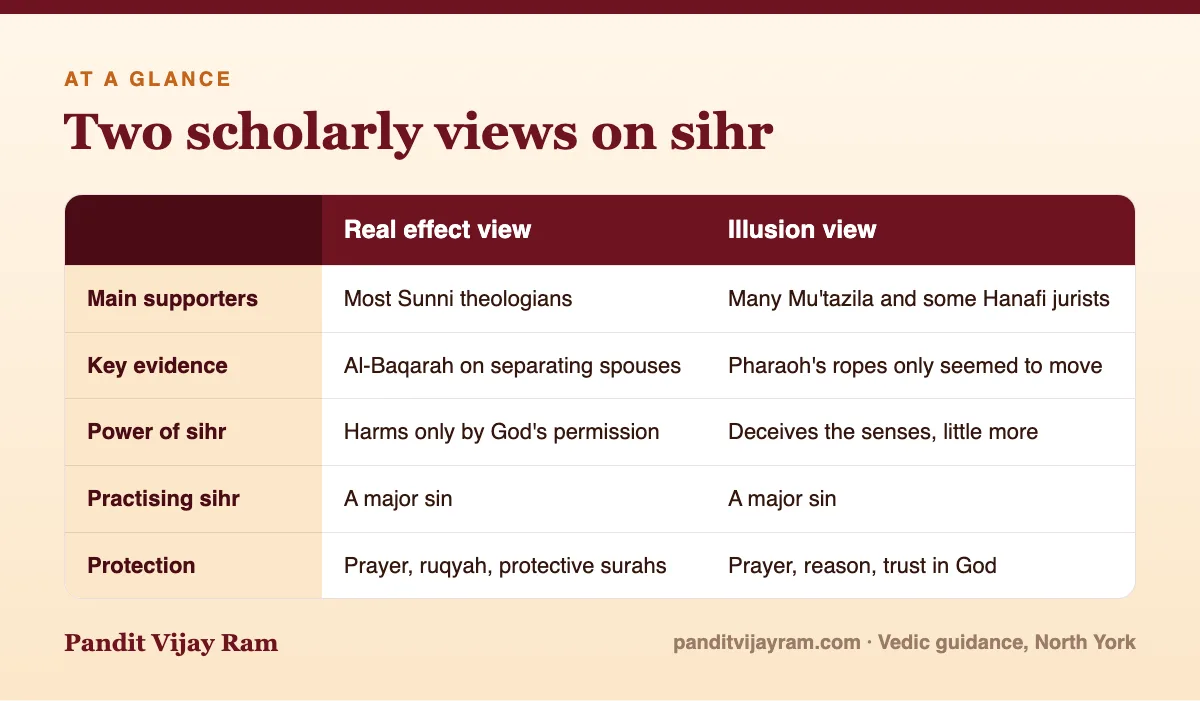
Most Sunni scholars, including the majority of the Ash'ari and Athari schools, held that sihr can have a real effect by God's permission. Others, notably many Mu'tazili theologians and some Hanafi jurists, argued it is mostly illusion and trickery. Both sides agree that practising it is forbidden and that God alone controls outcomes.
This debate is old and serious, and it helps to know it exists. Those who held that sihr has real effect pointed to the Quranic wording on separating spouses and to a hadith in the collections of Bukhari and Muslim describing a period when the Prophet was affected by sorcery and was then relieved through revelation of the protective chapters. Those who emphasised illusion pointed to the story of Pharaoh's magicians, whose ropes only appeared to move.
Several points are common ground:
- Practising sihr is a major sin; a well-known hadith lists it among seven destructive acts.
- Seeking out a sorcerer to undo sihr is also widely condemned.
- Protection and relief come through prayer, Quran recitation and trust in God.
- Accusations require extreme care, because harm to the innocent is itself a grave wrong.
Rulings about punishment and legal consequences belong to courts and qualified jurists, not to families or websites. For your own questions, please ask your imam. For a respectful look at how Islamic healing relates to Hindu practice, see the guide on ruqyah water and oil.
How do Muslims seek protection from sihr?
Mainstream scholars point to regular prayer, morning and evening remembrance, Ayat al-Kursi, the last two verses of Al-Baqarah, and the three short protective chapters: Al-Ikhlas, Al-Falaq and An-Nas. Ruqyah, recitation over oneself or by a trusted person, is the accepted remedy, rather than amulets or visits to sorcerers.
Islamic teachers usually describe protection as a daily habit rather than an emergency measure. A common pattern, as many imams teach it, includes:
- keeping the five daily prayers on time;
- reciting Ayat al-Kursi after each obligatory prayer and before sleep;
- reading the last two verses of Surah Al-Baqarah at night;
- reciting Al-Ikhlas, Al-Falaq and An-Nas three times morning and evening;
- saying Bismillah on entering and leaving the home;
- reading Surah Al-Baqarah at home, which a hadith links to driving away Satan.
Some Muslims also follow a hadith about eating seven Ajwa dates in the morning. Scholars discuss whether this applies only to dates from Medina.
Scholars also warn against amulets with unknown writing, sacrifices to anyone other than God, and healers who claim to command jinn. Those cautions come from inside the tradition. This site's ruqyah healing page explains how such families are referred respectfully, and the witchcraft and sihr page describes the Vedic support offered to those who want it.
When should someone worried about sihr see a doctor or an imam?
See a doctor first for any change in health, sleep, mood or behaviour, because many conditions feel like spiritual attack. Speak with an imam about faith questions and suitable recitations. Avoid anyone who diagnoses sihr instantly, names a relative as the cause, or asks for large or rising payments.
A careful order of steps protects both health and faith:
- Doctor: headaches, fatigue, pain, weight change, low mood, panic, or loss of interest in a spouse deserve medical attention.
- Counsellor: marriage strain, family conflict and grief are often at the root of feeling "bewitched".
- Imam: for guidance on ruqyah, prayer and Islamic rulings.
- Emergency: thoughts of self-harm mean calling or texting 9-8-8; danger to anyone means 911.
Scholars themselves caution that claims of sihr are easily misused: to control a wife, to excuse a husband's behaviour, or to turn relatives against an elderly woman. Our article on the harm caused by witchcraft accusations explains why naming a culprit is so dangerous. Related reading sits in the magic and entities hub.
When Muslim families ask me for help, I listen, encourage medical care, and point them to a trusted imam for ruqyah. I do not prepare Islamic amulets or claim religious authority I do not hold.
The bottom line
The sihr meaning in Islam is sorcery: real enough in the Quran to deceive and harm, but always beneath God's power. Scholars have long debated how much is real effect and how much illusion, while agreeing that practising it is a grave sin. Protection comes through prayer, recitation and medical care, with your imam as the guide on rulings.
Key takeaways
- Sihr is the Arabic word for sorcery, enchantment and illusion.
- Surah Al-Baqarah names Harut and Marut as angels who taught sihr as a test.
- Scholars differ on whether sihr has real effect or is largely illusion.
- Daily prayer, Ayat al-Kursi and the protective chapters are the mainstream defence.
- Accusing a relative of sihr is itself a serious harm.