
Signs of Nazar on a Person: Physical, Emotional and Household Clues

A grandmother looks at a child who was laughing at the party and is now limp and cranky, and says it at once: nazar lag gayi. Many families in North York and across the GTA grew up with that instant reading, and the signs of nazar are still talked about at every gathering. The trouble is that the same signs fit a dozen everyday problems, from a cold coming on to a week of poor sleep. In more than forty years of practice I have learned to take the worry seriously and the conclusion slowly. This guide sets out the physical, emotional and household clues tradition links to the evil eye, the ordinary causes that should be ruled out before anything else, the ways elders have read the signs, and a clear rule for when a doctor comes first. Nothing here is meant to frighten you. Most people who ask me about nazar are simply tired, stretched or unwell, and a calm look sorts that out quickly.
What are the signs of nazar on a person?
The traditional signs of nazar are a sudden change that follows praise or attention: unusual tiredness, heaviness in the head, frequent yawning, loss of appetite, a pale or dull look, irritability, or crying in a child. The timing is what families notice most, because the person seemed perfectly well just before.
Elders tend to sort the clues into three groups. None is a diagnosis; together they describe a pattern people have recognised for generations.
- Physical. Sudden fatigue, a headache that sits at the forehead or temples, heavy limbs, yawning that will not stop, a child refusing milk or food, restless sleep after a function.
- Emotional. Irritability out of character, low mood without a clear trigger, a sense of being watched or drained, losing interest in something the person was proud of a day earlier.
- Visible. The phrase chehra utar gaya, the face has fallen, describes a loss of glow. A baby who was admired for chubby cheeks may look pale and fussy.
What links these, in the folk view, is the sequence: admiration, then a dip. A student praised for top marks gets a migraine. A new bride complimented all evening wakes up exhausted. The belief is that strong attention, envious or simply admiring, lands on the person who drew it.
I would add a gentle observation. Praise usually arrives at busy moments, such as weddings, results day, a new baby, a promotion. Those are also the moments when people sleep less, eat irregularly and meet many people who carry colds. The pattern is real; the explanation is open. For the psychology behind the praise-then-illness experience, read feeling unwell after praise.

What else can cause symptoms people call nazar?
Most symptoms called nazar have everyday causes: a viral infection starting, dehydration, missed meals, poor sleep, anaemia, thyroid changes, teething in babies, stress after a big event, or low mood. These are common, treatable and worth checking first, because a remedy cannot fix a medical problem that is quietly getting worse.
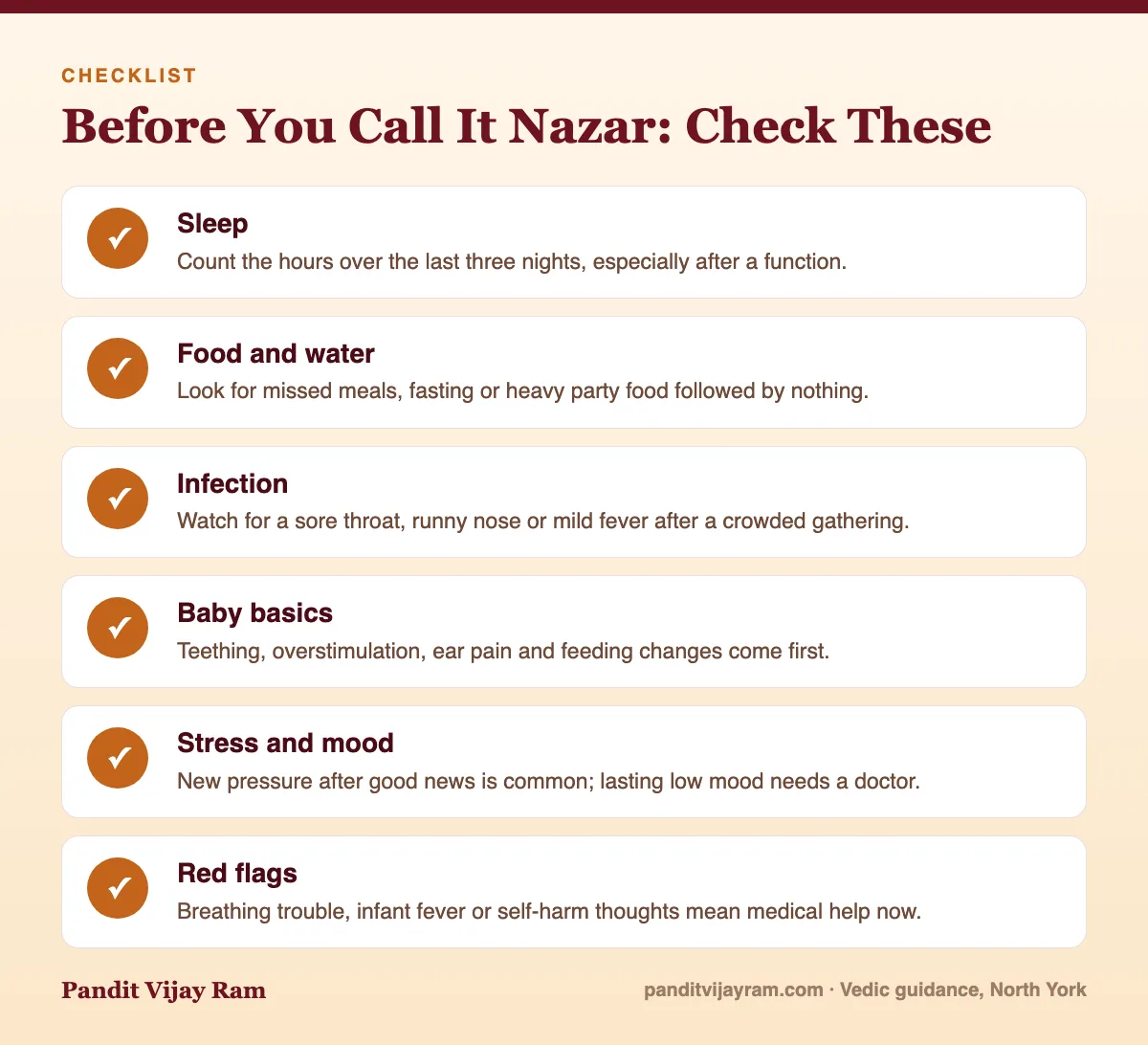
Before any custom, I ask a family to run through a short practical list. It takes ten minutes and often answers the question on its own.
- Sleep. How many hours in the last three nights? A late function, a crying newborn or night shifts explain a great deal of heaviness.
- Food and water. Long gaps between meals, fasting, or rich party food followed by nothing.
- Infection. A sore throat, runny nose or slight fever starting, especially after a crowded gathering in winter.
- Ongoing health. Low iron, thyroid problems, blood sugar swings and some medicines all cause fatigue and a dull complexion.
- Children. Teething, growth spurts, overstimulation from many hands and faces, and ear infections all make a baby cranky after visitors.
- Mind. Pressure after good news is real. A promotion brings new expectations; a wedding brings family tension. Persistent sadness, loss of interest or anxiety may point to depression, which a family doctor can assess.
If one of these fits, deal with it first. Rest, fluids, a proper meal or a doctor's appointment are not a lack of faith. Many families do both, and that is fine. The guide on negative energy or depression explores the mental-health side more fully.
How do elders tell if someone has nazar?
Elders traditionally watch how the person responds to a small ritual. Yawning or watering eyes while salt, chillies or alum are circled, chillies that burn without their usual sharp smell, or a strange shape in melted alum are all read as confirmation. These readings are customs of faith, not tests in a medical sense.
Each family has its own method, and many are tied to the remedy itself:
- The yawning sign. While an elder recites a prayer or circles something around the person, repeated yawning by either of them is read as nazar leaving. This is perhaps the most widely shared clue across Punjabi, Gujarati and Hindi-speaking homes.
- The chilli smell. Dried red chillies circled seven times are dropped in the flame. If the room does not fill with the usual coughing smoke, the family takes it as a sign the chillies absorbed something.
- The alum shape. A lump of phitkari is circled and placed on coals; the melted shape is read for a face or an eye. See phitkari for nazar for an honest look at that reading.
- Mustard seed crackle. Rai and salt crackle loudly on the fire. The full custom is in the mustard seed and salt remedy.
These signs comfort people, and the ritual itself often settles a fussy child simply because a calm, loving elder is holding them. Yet smoke changes with moisture and airflow, and alum melts into odd shapes every time. I treat these readings as a family's way of caring, not as evidence. The article on nazar tests at home explains what each one can and cannot show.
What household clues do people link to nazar?
Families sometimes read nazar on the home as well as on a person: milk boiling over again and again, a healthy plant wilting, appliances failing after a housewarming, or quarrels after a large party. Each has ordinary explanations worth checking, and it is wise to look at those calmly before blaming anyone's gaze.
The household clues tend to appear after the home itself has been admired, such as a griha pravesh, a renovation or a festival gathering.
- Kitchen mishaps. Milk boiling over, glass breaking, food burning. A busy, distracted week explains most of these.
- Plants. A tulsi or money plant drooping. Light, overwatering, a cold window and pests come first.
- Things breaking. Appliances failing soon after guests. Heavy use during a party is the obvious suspect.
- Arguments. Tension after a big event. Fatigue, money spent and old family friction surface together.
Notice that these clues are about the household, while the signs above are about a person. Tradition treats them differently: a person is given nazar utarna, while a home is given a lamp, a threshold custom or a cleansing. If the household signs are what worry you, the evil eye and curses hub gathers the home and premises guides.
One caution matters to me. Reading household mishaps as nazar can quietly turn into suspicion of a particular guest or relative. That damages relationships far more than any glance could. Protection in this tradition never requires naming anyone. A short prayer and an honest look at the practical cause are enough.
When should nazar symptoms be checked by a doctor first?
See a doctor first whenever symptoms are severe, sudden, lasting more than a few days, or involve a baby. A fever in a young infant, trouble breathing, chest pain, fainting, weight loss, dehydration or thoughts of self-harm are medical matters. Customs can be done alongside treatment, never instead of it.
Here is a simple decision rule I share with families who come to me in North York:
- Is anyone in danger right now? Breathing trouble, chest pain, confusion, a seizure, or a baby who is floppy or not feeding: call 911 or go to emergency.
- Is it a baby under three months with a fever? Contact a doctor, or Health811 in Ontario, the same day, without waiting for a remedy to work.
- Has it lasted more than two weeks, or is it getting worse? Book your family doctor. Ongoing fatigue, headaches or low mood need a proper check.
- Are there thoughts of self-harm? Call or text 9-8-8, Canada's Suicide Crisis Helpline, at any hour.
- Mild, brief and clearly linked to a tiring event? Rest, eat, drink water, and if your family wishes, do a simple nazar custom with a prayer.
That last step is where spiritual practice fits comfortably. If the mild signs keep returning after medical causes have been ruled out, a consultation through evil eye and nazar removal can look at the pattern with a birth chart and a calm conversation. I never ask anyone to stop treatment, skip a test or delay a doctor for a ritual.
The bottom line
The signs of nazar that families read, tiredness, heaviness, a dull face or a fussy child after praise, are real experiences with more than one possible explanation. Ordinary causes such as sleep, food, infection and stress deserve the first look. Babies, severe symptoms and anything lasting beyond a couple of weeks belong with a doctor, with customs done alongside if the family wishes.
Key takeaways
- Traditional signs of nazar follow a pattern of praise followed by a sudden dip.
- Sleep, food, infection, teething and stress explain most of these signs.
- Ritual readings such as yawning or alum shapes are customs of faith, not tests.
- Babies, severe symptoms or anything lasting two weeks need a doctor first.
- Protection from nazar never requires blaming a guest or relative.