
Nazar Tests With Lemon, Water or Chilli: Do Home Tests Mean Anything?

Late at night, a mother circles dried chillies over her son and drops them on a flame. There is no sharp smell, and an aunt says that proves it was nazar. Many people search for a nazar test because they want certainty before they decide what to do. Families in North York and across Toronto bring me these results every month, sometimes with photos of a darkened lemon or cloudy water on their phones. This guide walks through the common home tests, what is physically happening in each, and the tricks some paid practitioners use to make a test look alarming. I also suggest what to do instead when you are worried. In more than forty years of practice I have never used a lemon or a glass of water to tell a family something frightening, because I have seen how easily those results are produced. I respect the comfort these customs bring at home. I simply want you to read them with clear eyes.
How do people check for nazar at home?
The most common home checks are the chilli test, where dried red chillies are circled over the person and burned; the lemon test, where a lemon is left near them overnight; the water or oil test, where drops are watched in a bowl; and the coal test, where an ember is dropped into water.
Each test pairs a simple action with a reading that families pass down. Customs vary by region, but the usual versions are:
- Chilli test: seven dried red chillies, sometimes with salt and mustard seed, are circled over the head and burned. No pungent smell is read as nazar having been present and absorbed.
- Lemon test: a whole lemon is kept by the bed or circled and left out. Turning dark, shrivelling or growing spots is taken as a sign.
- Water and oil test: drops of mustard oil fall into water. Spreading or breaking apart suggests nazar; tight round drops suggest none.
- Coal test: a hot coal or a burnt clove is dropped in water. Sinking or hissing loudly is read as a heavy eye.
Alum, which melts into shapes, has its own guide on reading phitkari honestly, and the mustard-seed method is covered in rai and namak for nazar.
Notice that most of these are also remedies. The same chillies that test are believed to absorb the eye when burned. That double role is a clue: the test was never meant as a laboratory measurement. It was a way for an elder to do something caring, and then tell the family that the worry had been taken away.

What does the chilli no-smell test actually show?
Whether burning chillies smell sharp depends on how dry they are, how much heat reaches them, the air flow in the room and how used your nose already is to cooking smells. Capsaicin, the hot compound, irritates when it vaporises well. A weak smell reflects those conditions, not the presence of nazar.
I have watched the chilli test many times, and the result usually follows the setup. These factors change it:
- Moisture and age. Old, slightly damp chillies smoulder slowly and release less irritant smoke than crisp, fresh ones.
- How they burn. Dropped on a gas flame, chillies char fast at the surface. In a steel bowl with camphor they may scorch rather than release fumes.
- Ventilation. A range hood, an open window or a draughty doorway carries smoke away before anyone notices.
- Nose fatigue. In a kitchen where tadka was made an hour ago, people stop registering spice smells. Scientists call this olfactory adaptation.
- Who is sniffing. A worried parent standing back to stay calm smells less than a coughing teenager by the stove.
None of this means the custom is foolish. Burning chillies after circling is an old protective gesture with real meaning for families. The point is narrower: the absence of smell cannot tell you whether someone admired your child too much at a party.
Please also take care with fire. Use a metal container, keep children and pets back, never leave the flame unattended, and expect a smoke alarm to object. Capsaicin smoke can trigger coughing or asthma in sensitive people, so do this near an open window, not in a closed condo bedroom.
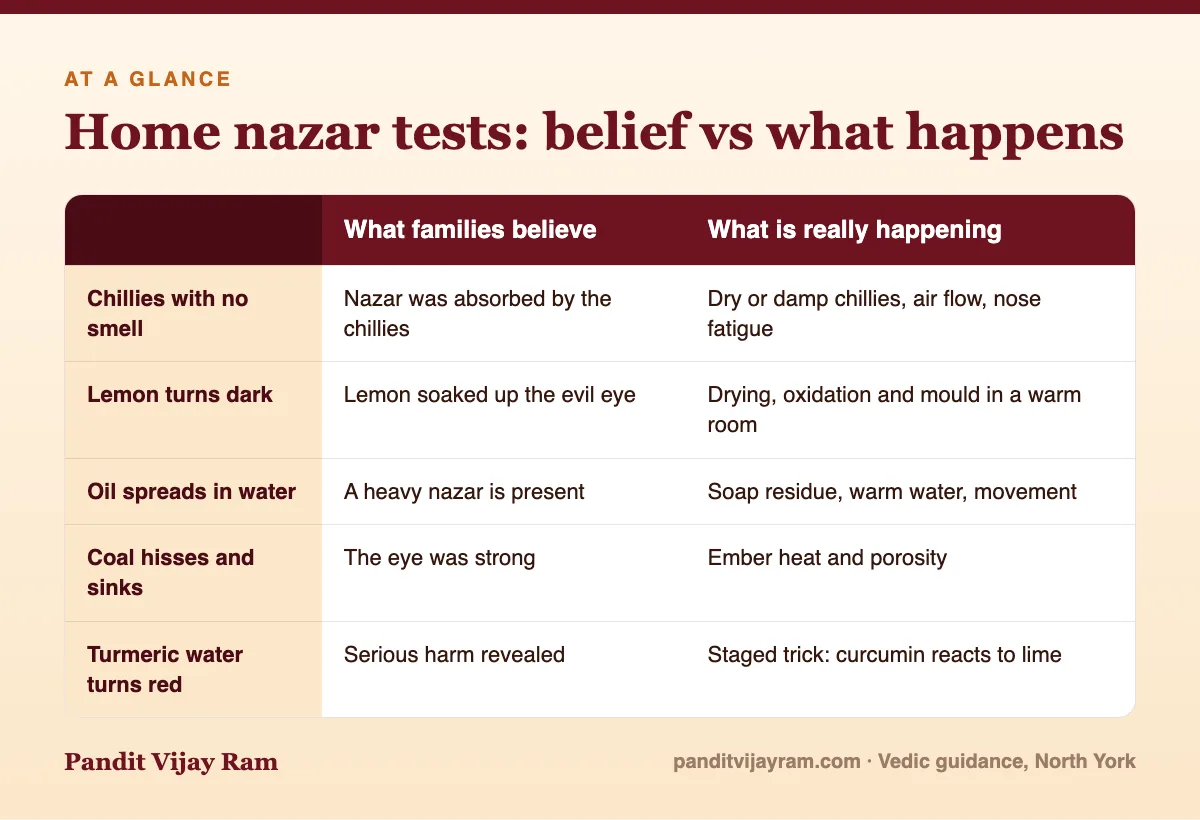
Do lemon and water tests prove anything about nazar?
No. A cut or bruised lemon darkens through oxidation and drying, and mould can appear within days in a warm room. Oil spreads on water when there is soap residue, warmth or movement in the bowl. These results are predictable from ordinary physics and chemistry, so they cannot distinguish nazar from no nazar.
A whole lemon left on a nightstand in a heated apartment loses water steadily. Its skin shrinks and spots appear, especially if it was bumped at the store. A lemon that has been pierced with cloves or pins, as some traditions do, browns faster because air reaches the flesh. Any lemon left long enough will look "sick".
The water test is just as sensitive to small details:
- A trace of dish soap on the bowl makes oil spread into a film immediately.
- Warm water and a shaky hand break drops into scattered beads.
- Different oils behave differently; mustard oil and sesame oil do not spread the same way.
The coal test reflects how hot the ember was and how deep the water is. A hotter coal hisses louder and sinks once its pores fill.
Try a simple experiment if you are curious. Run the same test on someone nobody has praised, in the same room with the same materials. Families who do this are often surprised to see the same "positive" result. That experience usually lowers the fear, which is the most useful thing a test can do.
For a wider comparison of egg and lemon readings across traditions, the egg limpia and Vedic nazar comparison explains how Latino and South Asian families read similar signs.
How do fake healers use nazar tests to scare people?
Some paid practitioners stage a test to produce a frightening result, then sell expensive rituals. Common tricks include turmeric water that turns red when slaked lime is added, eggs with hair or pins already inside, lemons that "bleed" dye, and ash slipped into water. A shocking result followed by a fee is a warning sign.
These tricks have been demonstrated by rationalist groups for decades, and they still turn up wherever fear is for sale. The chemistry behind the best-known one is simple. Turmeric contains curcumin, which turns from yellow to deep red in alkaline water. A pinch of chuna, slaked lime, hidden on a fingertip or in the bowl does the rest.
Other staged results include:
- an egg that "reveals" hair or a black clot, pre-loaded or swapped by sleight of hand;
- a lemon cut open to show red juice, from dye placed on the knife;
- water that clouds or blackens after a coin or crushed charcoal is dropped in;
- a photo of your child that "darkens" when viewed through a filtered phone camera.
The pattern that follows is the real danger. The result is described as severe, the remedy is urgent, the price rises with each visit, and you are told to keep it secret from family. Our article on warning signs of negative energy removal scams sets out nine red flags.
If you have paid someone after a test like this, you are not foolish; these methods are designed to work on loving, worried people. Keep records, stop payments, and report it to the Canadian Anti-Fraud Centre. If anyone threatens you or your family, contact the police.
What should you do instead of testing for nazar?
Skip the test and go straight to care. Check sleep, food, health and stress first, see a doctor if symptoms are physical or lasting, then do one simple protective prayer or remedy if it comforts you. A consultation can add perspective, but no result from a bowl or lemon should decide your next step.
A calmer sequence for worried families:
- Name what you actually see. Write down the symptoms and when they started. "Crying since Sunday's party" is clearer than "he has nazar".
- Look at ordinary causes. Is the person ill, short of sleep, under pressure, grieving or overstimulated?
- Get medical help where needed. Fever, pain, poor feeding or symptoms lasting a week call for a doctor.
- Do one remedy, if it brings peace. Salt or chillies circled and burned, a lamp, a prayer. Do it as a blessing, not a test.
- Set a time limit. Our guide on how long nazar lasts explains why tradition expects quick easing.
- Ask for a second view. A careful evil eye and nazar consultation listens first and does not depend on dramatic signs.
When I am asked to confirm nazar, I talk with the person, look at the birth chart if they want, and ask about the home and the past few weeks. That conversation tells me far more than smoke or water ever could. More grounded guides are collected in the evil eye and curses hub.
The bottom line
A nazar test with lemon, water or chilli can be a loving household custom, but its result reflects chemistry, air flow and expectation rather than the evil eye. Staged tests are a known fraud tool, so a frightening result followed by a fee is a reason to walk away and report it. The better path is to check ordinary causes, see a doctor when needed, and use one calm prayer or remedy as a blessing rather than a diagnosis.
Key takeaways
- Home nazar tests are comfort customs, not reliable diagnostics.
- Chilli smell depends on dryness, heat, ventilation and nose fatigue.
- Lemons darken and oil spreads for ordinary physical reasons.
- Turmeric turning red with lime is a classic staged trick.
- Check health and stress first, then use one remedy as a blessing.