
How Long Does Nazar Last? Timelines and When to Worry

A child who was cheerful at a birthday party will not settle that night, or you feel drained for days after a promotion is announced. Someone at home says it is nazar, and the next question is always the same: how long does nazar last, and when should I stop waiting? Families in North York, Scarborough and across the GTA ask me this every week. This article gives the timelines that tradition itself sets, explains why a short spell can feel endless, and draws a clear line between a passing heaviness and symptoms that need a family doctor. I also cover babies separately, because their needs are different and more urgent. In more than forty years of practice I have noticed that the elders who taught me were strict about time. They did one remedy, waited a little, and if nothing shifted they looked elsewhere. That old discipline is worth keeping, and it is the spine of the advice below.
How long does nazar usually last according to tradition?
Most South Asian households treat nazar as brief. After nazar utarna with salt, chillies or alum, people expect relief by the next morning or within two to three days. Some regional customs allow up to seven days, or three repetitions of a remedy. Beyond that, tradition itself says the cause is probably something else.
The timelines vary by region and family, but they share a pattern. Nazar is pictured as a passing weight that attaches after praise or attention, not a lasting condition. Here is how elders commonly frame it:
- Hours to one night: a baby or young child who is cranky after visitors, treated with a pinch of salt or rai circled and burned.
- One to three days: an adult who feels heavy, irritable or unlucky after a public success.
- Up to seven days: a household or shop that feels "off" after a big celebration or opening.
Many families repeat a remedy on three consecutive evenings, or on a Tuesday and Saturday, and then stop. The idea of doing nazar utarna every night for months has no support in the customs I was taught.
The specific methods are covered in their own guides, such as using phitkari for nazar and the older step-by-step guide to removing nazar at home. What matters here is the time frame. A remedy is given, the person rests, and the household watches calmly. If the trouble lifts, good. If it does not, the next step is not a bigger ritual but a clearer look at health, sleep and stress.

How long does nazar last on a baby?
Tradition treats nazar on a baby as the shortest kind, often expected to settle within a night. But babies have many ordinary reasons for crying and poor sleep, including growth spurts, gas, teething and illness. Any fever, breathing difficulty, refusal to feed or unusual sleepiness needs a doctor the same day, whatever anyone suspects.
Grandparents often notice nazar first in babies, because small children react openly to crowds, noise and passed-around cuddles. Overstimulation alone can cause a long, hard evening of crying. That is real, ordinary and usually over by the next day.
Patterns that last longer have names a paediatrician will recognise:
- Colic: long bouts of crying in an otherwise healthy baby, often in the evening, usually easing over the first few months.
- Growth spurts and cluster feeding: several unsettled days with frequent feeds.
- Teething: drooling, chewing and broken sleep over days or weeks.
Please do not wait out these signs while trying remedies:
- Any fever in a baby under three months.
- Fewer wet diapers, refusing feeds or vomiting repeatedly.
- Fast or laboured breathing, a bluish tinge or a rash that does not fade when pressed.
- Floppiness, unusual drowsiness or a high-pitched cry.
In Ontario you can call Health811 for nurse advice, and many provinces have a similar 811 line; in an emergency call 911. A gentle custom like a kala tika or a pinch of salt can sit alongside medical care, never in place of it. The tender question of whether a parent's own admiration can affect a child is handled in can a mother give her child nazar.
Why does nazar sometimes seem to keep coming back?
Nazar seems to return when the real trigger is still present: poor sleep, a lingering virus, work pressure or a tense relationship. Worry also plays a part, because once we expect harm we notice every bad moment. Repeated remedies can deepen that loop, so the feeling of nazar grows while the true cause goes untreated.
When someone tells me nazar has lasted for months, I ask three questions before anything spiritual.
- Has anything physical been checked? Anaemia, thyroid problems, vitamin D deficiency through a Canadian winter, and poor sleep all produce the tiredness and low mood people describe as nazar.
- What changed just before it began? A move, a new job, a birth or a loss often lines up with the start date better than any single compliment.
- How often are remedies being done? A nightly ritual keeps the fear in front of the family and makes every small setback look like proof.
Psychologists call the last effect confirmation bias: once we hold a belief, we remember the evidence that fits it. The related nocebo effect means expecting harm can make us feel genuinely worse. Neither means the person is imagining things. It means the mind and body are responding to stress in ways that deserve care.
The pattern of falling ill soon after praise has its own article, feeling unwell after praise, which looks at attention, stress and the traditional responses. If you have been testing for nazar again and again with lemons or water, our piece on home nazar tests explains what those results actually show.
When should lasting nazar symptoms make you see a doctor?
See a doctor when symptoms pass about one week without improvement, keep getting worse, or include pain, fever, weight change, fainting or thoughts of self-harm. For babies the window is much shorter. Seeing a doctor is not a rejection of faith; it rules out treatable causes so spiritual care can do its proper work.
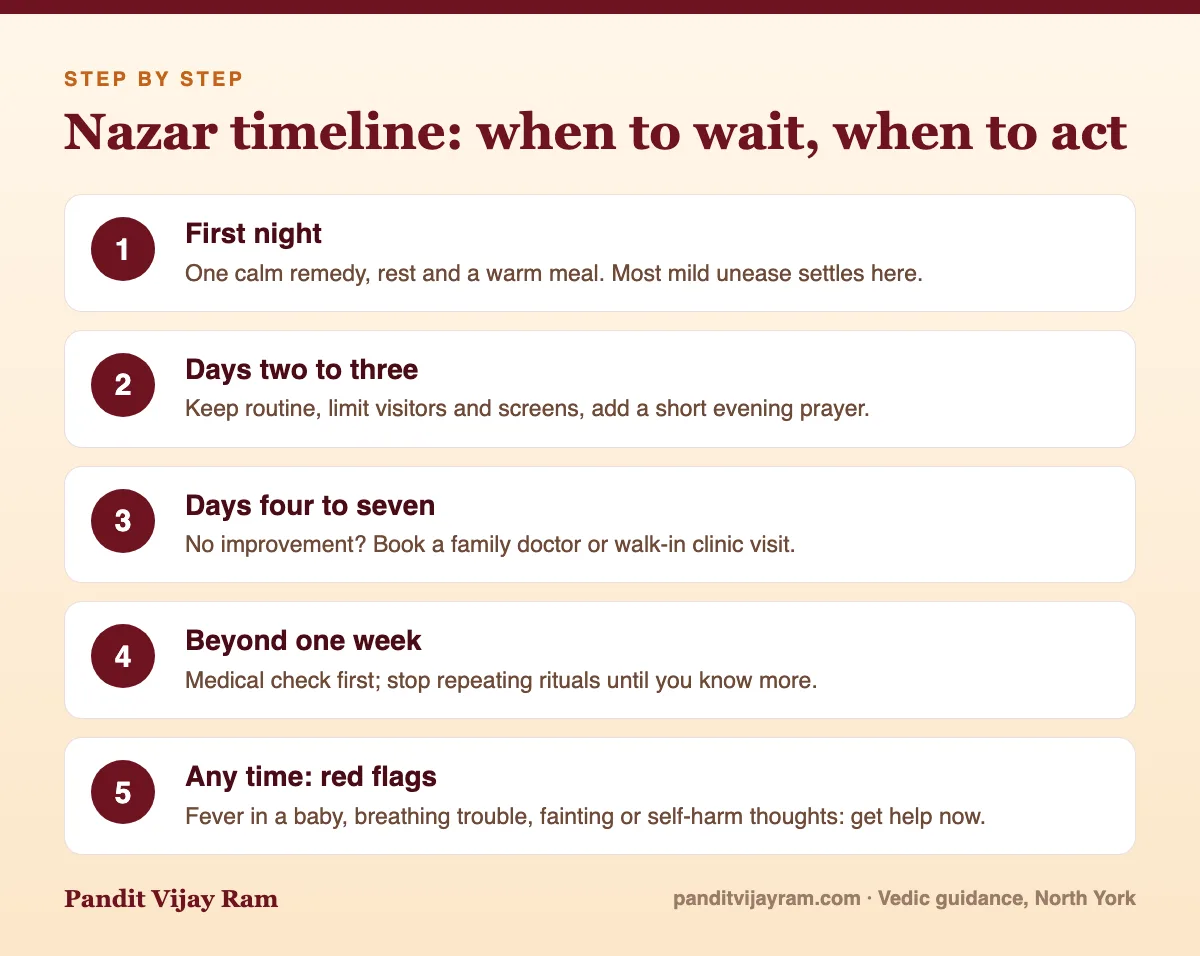
A simple decision rule helps families who feel torn between the doctor and the elders:
- Within a day or two, mild and improving: rest, routine and one traditional remedy are reasonable.
- Three to seven days, not improving: book a visit with your family doctor or a walk-in clinic and mention every symptom.
- More than a week, or getting worse: medical assessment comes first; stop repeating rituals until you know more.
- Any red-flag sign at any time: chest pain, trouble breathing, high fever, confusion, fainting or a baby who will not feed means urgent care or 911.
Mood deserves the same respect as the body. If weeks of heaviness come with hopelessness, loss of interest or thoughts of not wanting to live, please call or text 9-8-8, Canada's Suicide Crisis Helpline, at any hour.
Once a doctor has checked things, a spiritual consultation can still help. The evil eye and nazar consultation begins by asking what the doctor found, then looks at the chart and the household. You can also read the full list of traditional signs of nazar on a person alongside the ordinary explanations to rule out.
What helps nazar go away faster?
In tradition, nazar eases fastest with one calm remedy, rest and a return to routine. Do nazar utarna once or for three evenings, keep the person warm and fed, limit visitors and screens, and add a short prayer. Then stop and watch. Calm, steady care helps more than repeating rituals or searching for the person responsible.
A gentle sequence that many families find settling:
- Choose one remedy. Salt, rai or alum, done properly once, rather than three methods on the same night.
- Restore the basics. Early bedtime, a warm meal and water. Tiredness magnifies every sense of heaviness.
- Reduce attention for a few days. Fewer visitors for a baby, fewer posts about the new house or job.
- Add a short devotional practice. A lamp at dusk with the Hanuman Chalisa or Gayatri Mantra, or your own family prayer.
- Set a check-in date. Decide in advance that if nothing has improved in a week, you will see a doctor.
What slows things down is just as useful to know. Arguing over who cast the eye, buying expensive protective items in a panic, and paying anyone who says the nazar is "very deep" and needs weeks of costly rituals all feed fear rather than ease it.
If the heaviness seems tied to the home or several people at once, a consultation can look at the wider picture. More guides on protection and ordinary causes are gathered in the evil eye and curses hub.
The bottom line
How long does nazar last? Tradition expects it to ease within a night to a few days after one calm remedy, and rarely beyond a week. Babies need a much shorter window, and red-flag signs mean medical care at once. When symptoms linger, a doctor's visit protects the person and lets spiritual practice support recovery instead of delaying it.
Key takeaways
- Tradition sees nazar as brief, usually easing within one to three days.
- Babies settle fastest, but fever or poor feeding needs a doctor the same day.
- Nazar that keeps returning often points to sleep, illness or stress.
- One remedy, rest and routine help more than nightly rituals.
- Set a one-week check-in and see a doctor if nothing improves.