
Why Do I Feel Unwell After Being Praised? The Evil Eye Explained Honestly

Someone admires your weight loss, your new job or your child's report card, and by evening you have a headache and feel oddly flat. If you feel sick after compliments again and again, you may have heard an elder say, quietly, that someone's nazar has fallen on you. People in North York, Scarborough and Etobicoke describe this pattern to me more often than almost any other evil-eye worry. It is a real experience, and it deserves a real explanation rather than a frightening one. This article looks at the belief from two angles. First, what the tradition says about praise and the evil eye, and why so many cultures add a blessing when they admire. Second, what everyday psychology says about attention, expectation and stress, which often explains the timing very well. You will also find a simple routine for the days you feel drained, and clear signs that it is time to see a doctor. In over forty years of this work, I have come to see this as one of the gentlest forms of nazar, and one of the easiest to settle.
Why do some people feel sick after compliments?
In South-Asian, Middle Eastern and Mediterranean belief, admiration that is not balanced by a blessing can carry nazar, even when the person means well. The admired person may then feel tired, headachy or unlucky. Tradition does not see the admirer as wicked; it sees unguarded praise as a kind of spiritual draught.
The core idea is old and widely shared. When someone looks at your good fortune with strong feeling, whether delight, longing or a flicker of envy, that feeling is believed to touch you. A compliment is the moment that feeling becomes visible, so it is the moment families watch for.
People who describe this pattern often mention:
- A sudden headache or heaviness behind the eyes later the same day.
- Unexplained tiredness or yawning after a gathering where they were the centre of attention.
- A small mishap soon after: a dropped phone, a missed bus, a dish that burns.
- A dip in something just praised, such as a baby who was eating well and then fusses, or a plant admired by guests that droops.
Tradition treats this as mild and passing. It is not the same as black magic, which is described as deliberate, and it is not the same as a curse. The comparison is laid out in kala jadu vs nazar vs graha dosh. If you want the fuller list of what families read as nazar, see signs of nazar on a person. The rest of this page asks a different question: why the timing feels so convincing.

Is there a psychological reason you feel bad after praise?
Yes, several. Praise often arrives at a peak, and what follows a peak is usually a return to normal. Being watched raises stress hormones and self-consciousness. And if you expect harm after a compliment, that expectation alone can produce headaches and fatigue, a response researchers call the nocebo effect.
None of these explanations mocks the belief. They simply describe how minds and bodies behave, and they help explain why the pattern feels so reliable.
- The peak problem. People praise you when something is going unusually well: a great exam, a perfect batch of samosas, a baby sleeping through the night. Unusually good results tend to be followed by ordinary ones. Statisticians call this regression toward the mean. The slide back feels like a fall, and the compliment gets the blame.
- The spotlight. Attention is tiring. Being admired in a room full of relatives means smiling, performing and monitoring yourself. Many people, especially quieter ones, feel wiped out afterwards.
- Pressure to repeat. Praise can quietly raise the bar. A student told she is brilliant may freeze on the next test because she is now afraid to disappoint.
- Nocebo. When you have been taught that praise brings trouble, your body may brace for it. Tension headaches, an uneasy stomach and poor sleep can follow from that worry alone.
- Selective memory. We remember the compliment that came before a bad day and forget the hundreds that came before ordinary ones.
I share these with clients because they reduce fear. A person who understands the peak problem stops dreading kind words, and that alone often settles the symptoms. Some people turn the worry inward and fear their own pride, which is covered in can you give yourself nazar.
Why do people say Masha'Allah or nazar na lage when praising someone?
These phrases attach a blessing to admiration. Muslims say Masha'Allah, meaning God has willed it, or Tabarak Allah, so that praise points to God rather than to envy. Hindu and Sikh families say nazar na lage, may no eye touch you. Similar habits exist in Jewish, Greek and Latino homes.
Across cultures, the response to the danger of praise is not to stop praising. It is to pair praise with humility or blessing.
- Islamic practice. Muslims hold, from the hadith, that the evil eye is real. Saying Masha'Allah echoes a verse in Surah al-Kahf of the Qur'an, and the hadith encourage anyone who admires something to ask God to bless it, so admiration becomes gratitude. The fuller teaching is explained respectfully in nazar in Muslim tradition.
- Hindu and Sikh homes. Elders say nazar na lage or bhagwan bhala kare, and sometimes tap the child's cheek lightly or apply a small kala tika.
- Jewish homes. Many Yiddish-speaking families add keyn eyn hore, no evil eye, after mentioning good news.
- Latino families. In many households, a person admiring a baby is asked to touch the child, which is believed to cancel mal de ojo.
- Greek and Mediterranean families. A playful pretend spit, ftou ftou, after a compliment.
What these share is wisdom about envy. A blessing reminds both people that good fortune is a gift, not a trophy. If you often receive praise and feel uneasy, you can quietly say your own blessing in reply. It costs nothing and changes the feeling of the exchange.
What should I do if I feel drained after being complimented?
Treat the body first: water, food, a short rest and fresh air. Then, if it comforts you, use a brief traditional reset such as salt-water hand and foot washing, a lamp with a short prayer, or a family elder's nazar utarna. If the feeling keeps returning, look at stress and sleep before anything else.
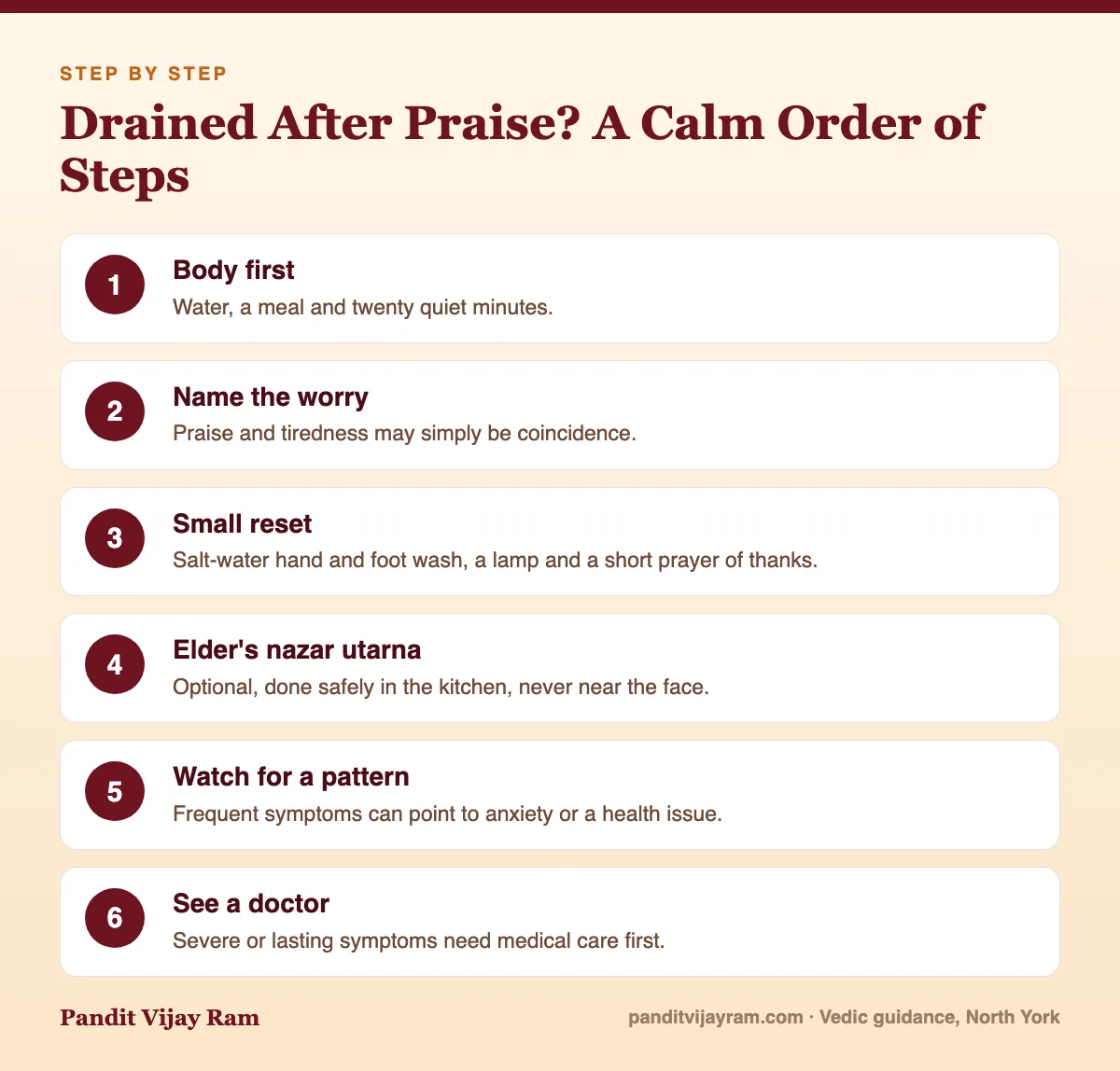
Here is the order I suggest, from simplest to more involved. Most people never need to go past step three.
- Check the basics. Did you skip lunch, stay up late or spend hours in a loud room? Eat something, drink water, and sit somewhere quiet for twenty minutes.
- Name the thought. Say to yourself: I was praised, I am tired, and those two things may simply be coincidence. Naming the worry often loosens it.
- A small reset. Wash your hands, face and feet with water and a pinch of salt. Light a lamp or a candle, sit for a minute, and say a short prayer of thanks for what was praised.
- Ask an elder, if you like. A mother or grandmother circling salt and chillies, or mustard seeds, over your head is gentle and harmless when done safely in the kitchen.
- Look for a pattern. If it happens after almost every gathering, the issue may be social exhaustion, anxiety or a health matter rather than nazar.
- Get a proper look. If something still feels wrong after weeks, a consultation through the evil eye and nazar removal service can look at your chart and circumstances calmly.
What I do not suggest is avoiding people, hiding good news from everyone or snapping at those who compliment you. That turns a small worry into isolation.
When does feeling unwell after praise need a doctor?
See a doctor if symptoms last more than a few days, recur after many ordinary situations, or include fever, chest pain, fainting, vomiting or severe headaches. Persistent anxiety, panic or low mood around social events also deserves medical or counselling support. Spiritual practice can sit alongside care but never replaces it.
Nazar, in every tradition I know, is described as mild and short-lived. When symptoms are strong, lasting or getting worse, that description no longer fits, and the honest response is medical.
Make an appointment with your family doctor if you notice:
- Headaches that are new, severe, or come with vision changes, numbness or confusion.
- Fatigue that lasts beyond a week or keeps returning regardless of events.
- Racing heart, breathlessness or dizziness in social settings, which can point to anxiety or a heart rhythm issue.
- Loss of appetite, weight loss or disturbed sleep over several weeks.
- Dread of gatherings strong enough that you avoid family, work or school.
Social anxiety is common and treatable, and it often hides behind the language of nazar in our communities. A doctor can refer you to counselling. If you ever feel unsafe or overwhelmed, call or text 9-8-8 for the Suicide Crisis Helpline, any time.
Once health questions are answered, there is still room for faith. Many people find that a short daily prayer and a little humility make compliments easier to receive. More on the wider theme is gathered in the evil eye and curses guides.
The bottom line
If you feel sick after compliments, you are describing something many cultures have noticed and named as nazar. Psychology offers equally real explanations: praise lands at peaks, attention is tiring, and expecting harm can create symptoms. A blessing in return, basic rest and a small prayer usually settle it, while lasting or severe symptoms belong with a doctor.
Key takeaways
- Many cultures link praise to the evil eye and answer it with a blessing.
- Praise often comes at a peak, so an ordinary day afterwards can feel like bad luck.
- Expecting harm can produce real headaches and tiredness through the nocebo effect.
- Rest, food and a short prayer are the first and usually the only steps needed.
- Severe, lasting or recurring symptoms need a doctor, not more rituals.