
Rai and Namak: The Mustard Seed and Salt Nazar Remedy

Few sounds are as familiar in a desi kitchen as mustard seeds popping in a hot pan. In many homes that sound has a second meaning, because using mustard seeds for nazar, together with a pinch of salt, is one of the oldest ways families protect a child or a tired adult after a crowded day. People in North York often ask me whether they are doing it right, whether a quiet pan means something is wrong, and whether it is safe in a small condo kitchen. These are good questions. Across more than forty years of guiding families, I have found that this remedy works best when it is understood clearly: a short, prayerful custom done with care, not a test with a frightening result. Below you will find what rai and namak each represent, the step-by-step practice, how Punjabi, Marathi, Tamil and Bengali homes vary it, what the crackle is believed to mean and what it does not prove, plus safety and disposal for Canadian homes.
Why are mustard seeds and salt used for nazar?
Mustard seeds are small, sharp and fiery, and salt is the oldest purifier in the kitchen. Folk tradition treats both as substances that absorb or burn away harmful attention. Rai is often linked with protection from troublesome forces, while namak, usually coarse or rock salt, is used for cleansing across almost every South-Asian community.
The pairing makes sense from inside the tradition. Each ingredient carries its own association:
- Rai or sarson. Brown or black mustard seed is pungent, hot and lively. When heated it jumps and snaps, which feels like something being driven out. In many regions it is also scattered at thresholds or kept in a knotted cloth as a guard against unwanted influence.
- Namak. Salt preserves food and draws out moisture. Across Hindu, Sikh and Muslim households alike it is used to wash floors, to circle around children and to settle a home after visitors. Rock salt, sendha namak, or plain coarse salt is preferred over fine table salt.
- Dried red chillies. Many families add two to seven whole chillies, making it a trio of rai, namak and mirch.
The idea is simple: these ingredients take on whatever bad eye has landed on the person, and fire or water then carries it away. You do not need a priest or a special day. It is a folk custom, passed hand to hand, with as many versions as there are grandmothers.
If you are deciding between this and the alum method, the companion guide on phitkari for nazar explains that custom. Both sit within the wider family of practices gathered in the evil eye and curses hub.
How do you do rai namak nazar utarna step by step?
Take a small handful of mustard seeds and coarse salt, with a few dried red chillies if your family uses them, in the right fist. Circle it around the seated person's head or whole body seven times while praying, then tip it onto a hot steel pan or into a contained fire and step back.
A careful version that suits most homes:
- Measure modestly. About a tablespoon of mustard seeds, a teaspoon or two of coarse salt and, if you like, two to seven chillies. More does not mean stronger.
- Seat the person. They sit quietly, ideally facing east or towards the home shrine. Hold a baby on your lap and circle around both of you.
- Circle with intention. Seven rounds clockwise is the commonest count. Some families start at the head and sweep down to the feet on each round; others circle only around the head.
- Pray as you circle. A short name of Hanuman, Durga or your family deity, or simply a line asking that any bad eye leave. You can find focused options in the guide to mantras for evil eye protection.
- Release it. Tip the mixture onto a preheated dry steel kadhai or tawa, or onto glowing coals in a metal pot. Cover loosely with a lid if the seeds start jumping.
- Close calmly. Wash hands, and offer the person a sip of water.
Some families never burn it at all. They wrap the circled mixture in paper and flush or discard it, or drop it in flowing water. The heat is a regional habit, not the heart of the practice.
How does the mustard seed remedy differ by region?
Every community has its own version. Punjabi homes often use sarson, salt and red chillies thrown in the fire. Marathi families call it drishta kadhne and may add bread or lemon. Tamil households speak of drishti and frequently combine salt and chillies with camphor. Bengali homes also prize mustard as protective.
A few patterns you may recognise from your own family:
- Punjab and North India. Sarson, rock salt and whole red chillies circled over the head and dropped on the chulha or tawa. The sneezing, coughing smoke from burning chillies is part of the expected result, which is why many people now open a window first.
- Maharashtra. In drishta kadhne, salt and mustard seeds may be circled with a slice of bread, a piece of lemon or some rice, then thrown away from the house. It is common after a child returns from a function.
- Tamil Nadu and South India. Drishti removal often uses salt and red chillies, sometimes with camphor burned on a plate afterwards, or a pumpkin smashed at a new building. Mustard appears in some households, not all.
- Bengal and the east. Mustard, shorshe, is a long-trusted protective seed, kept in small amounts for children and used in household customs.
- Gujarat and Sindh. Salt is often the main ingredient, circled and dissolved in water or flushed, without any burning.
None of these is the correct version. Each is a family's way of saying, we noticed, and we are looking after you. If your household blends customs from both sides of a marriage, that is entirely in keeping with tradition. Latino readers will notice a kinship with the limpia, described in egg cleansing and Vedic nazar compared.
What does it mean if mustard seeds crackle loudly?
Folk belief says loud, long crackling means heavy nazar was absorbed, and quiet seeds mean there was little or none. In plain physics, mustard seeds and salt crystals hold small amounts of water that turn to steam and burst when heated. How loud they pop depends on heat, freshness and moisture, not on the person.
Anyone who makes tadka knows that mustard seeds pop every time the oil is hot enough. Salt crystals also snap and jump on a dry pan, because tiny pockets of water inside them expand. So the crackle tells you about the pan and the seeds:
- Hotter pan, louder crackle. A pan heated for two minutes pops far more than one heated for thirty seconds.
- Damp seeds pop more. A jar kept near the sink behaves differently from one in a dry cupboard.
- Coarse salt snaps more than fine salt. Larger crystals trap more moisture.
- Burnt chillies smell sharp. If they do not, they may be old or the heat low.
I do not say this to mock the custom. Many families find real reassurance in hearing the seeds go, and that reassurance helps people rest. The trouble comes when a silent pan is read as a sign of something worse, or when someone uses a dramatic crackle to sell rituals. Neither reading is supported by what is happening in the pan.
A better way to judge the remedy is to watch the person over the next day. Did they sleep, eat and seem themselves again? If not, consider ordinary causes using the checklist in signs of nazar on a person, and see a doctor if symptoms continue.
Is the rai namak remedy safe for children and small kitchens?
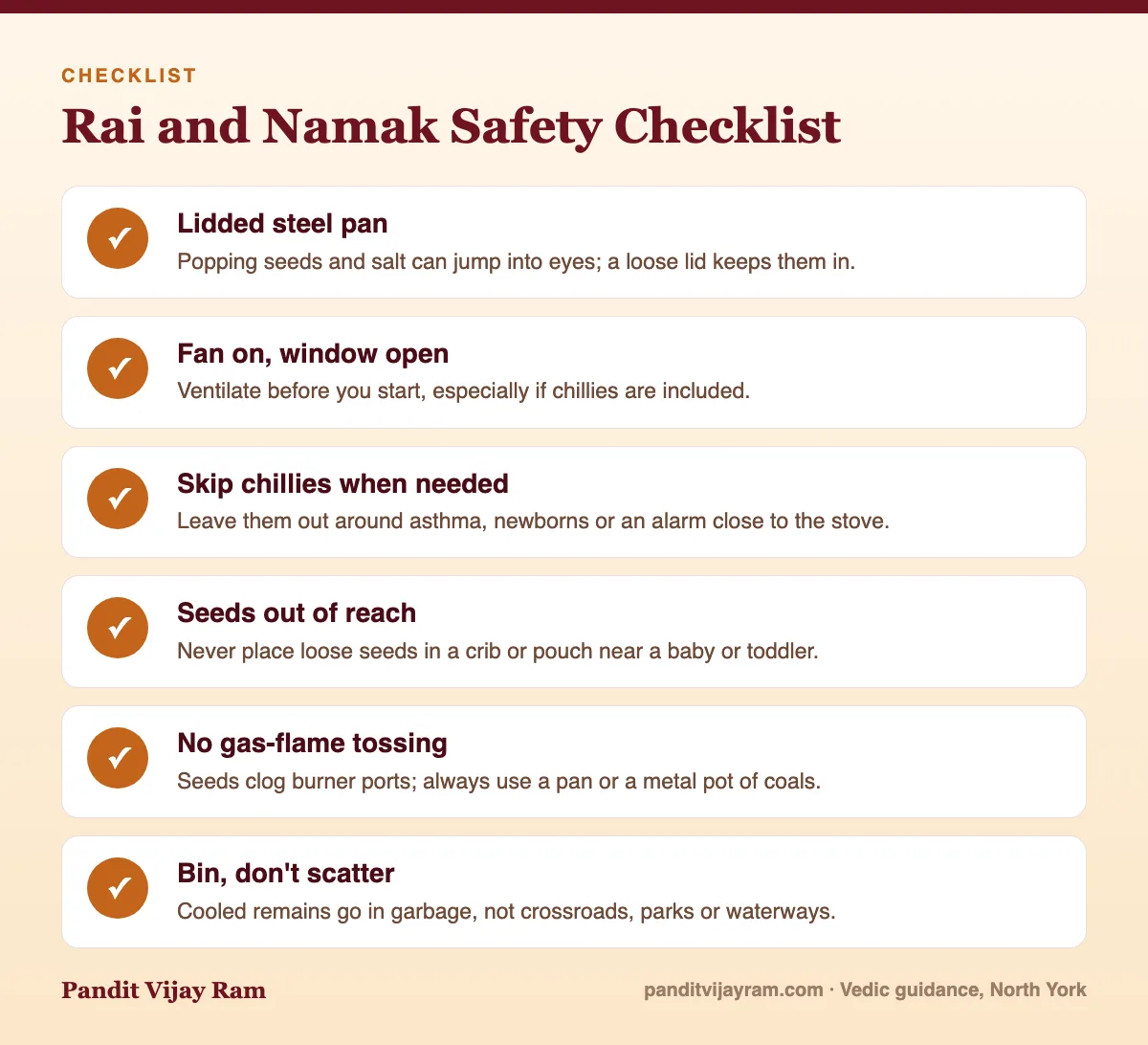
It is safe with sensible care. Popping seeds and salt can jump into eyes, and burnt chilli smoke irritates babies and anyone with asthma. Use a deep steel pan with a loose lid, ventilate, keep children out of the kitchen, never leave loose seeds where a toddler can reach them, and bin the cooled remains.
A few points that matter in GTA homes and condos:
- Eyes first. Hot mustard seeds can fly a surprising distance. Stand back and use a lid.
- Chilli smoke. Skip the chillies if anyone in the home has asthma, if a newborn is present, or if your smoke alarm is close to the stove. Rai and salt alone are fine.
- Choking hazard. Loose seeds in a pouch under a baby's pillow or in a crib are a real danger. Keep any protective seeds well out of reach.
- No gas-burner tossing. Throwing seeds directly into a gas flame clogs the burner ports. Always use a pan.
- Disposal. Let everything cool, sweep it into paper and put it in the garbage. Avoid crossroads, parks and waterways.
If you find you are doing this every few days because a family member keeps feeling unwell, please pause and look further. Recurring tiredness or low mood deserves a doctor's attention. When medical causes have been ruled out and the pattern still bothers you, a calm consultation through evil eye and nazar removal can look at the birth chart and suggest a steadier approach than repeating the custom without end.
The bottom line
Using mustard seeds for nazar, with coarse salt and sometimes red chillies, is a short folk custom that families across South Asia adapt in their own ways. The crackle comes from moisture inside seeds and salt, so it should comfort rather than frighten, and it proves nothing about the person. With a lidded pan, good ventilation, children kept clear and a doctor consulted for lasting symptoms, rai and namak remains a gentle, safe household practice.
Key takeaways
- Rai and namak circles mustard seeds and coarse salt around a person seven times.
- Regional versions add chillies, bread, lemon or camphor; none is the only right way.
- Crackling is steam escaping from seeds and salt, not a measure of nazar.
- Use a lidded steel pan, skip chillies around asthma or newborns, and keep seeds from toddlers.
- Repeated need for the remedy is a cue to check health and routine first.