
Phitkari (Alum) for Nazar: What the Custom Says and How It Is Done
Many of us remember an aunt or nani taking a crystal of phitkari from the kitchen shelf, circling it over a fussy child and dropping it on the stove while everyone watched it bubble. Using phitkari for nazar is one of the most common household totkas in Punjabi, Hindi and Urdu-speaking homes, and families in North York still ask me how to do it properly. The questions are usually practical: how many times to circle, what to say, what the strange white shape means and how to get rid of it in a condo. Over four decades of guiding families I have watched this remedy calm many anxious households, and I have also seen it stir up needless fear when someone claims to see a face in the alum. This guide covers what alum is, why it became a nazar remedy, the step-by-step method, what the melted shape can and cannot tell you, fire safety, disposal under Canadian conditions, and when to look beyond a home remedy.
What is phitkari and why is it used for nazar?
Phitkari is alum, usually potassium aluminium sulphate, a clear crystal sold in South-Asian grocery stores. It has long been used to clear muddy water, as an astringent after shaving and in pickling. That reputation for drawing out and purifying is the likely root of the folk belief that alum can draw out nazar.
Alum is an old household staple across India and Pakistan. Barbers rubbed it on a nick after a shave. Villagers swirled a lump in a pot of river water and watched the silt sink. Mothers kept a piece near the bathing area. A substance seen to clean, tighten and settle naturally picked up a protective meaning.
In folk practice phitkari appears in several forms:
- Nazar utarna with alum. The method described below: circling, then heating.
- A lump at the threshold or shop counter. Some families keep a piece in a small bowl or tied in black cloth near the entrance, replaced from time to time.
- Alum with red chillies or mustard seeds. In parts of Punjab and Uttar Pradesh, alum is circled together with dried chillies, combining two remedies in one round.
This is a folk totka, not a Vedic rite. You will not find it in a puja manual, and no priest needs to perform it. That matters, because it means there is no single correct version and no danger in doing it differently from your neighbour. For a sister custom that uses seeds and salt, see the rai and namak remedy. For the wider family of nazar practices, the evil eye and curses hub brings them together.

How is the phitkari nazar remedy done at home?
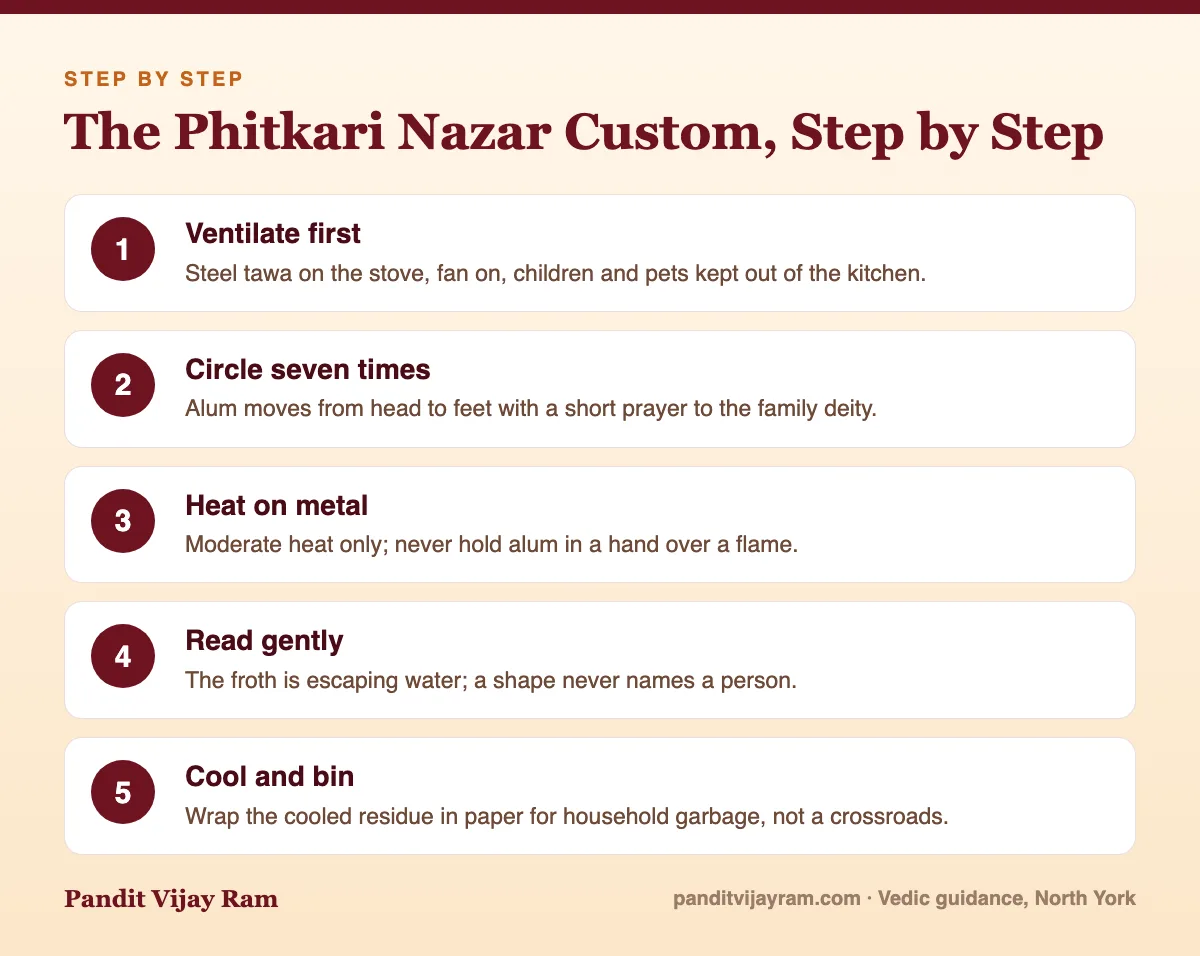
Seat the person facing east, hold a walnut-sized lump of alum in the right hand and circle it around them from head to feet seven times while reciting a short prayer. Then place the alum on a hot steel tawa or a lit coal in a metal pot, and let it melt and froth until it settles.
Details vary by family. Here is the common shape of the custom, with the variations you are likely to hear about.
- When. Often at dusk, or soon after the person returns from a function. Tuesday and Saturday are popular because of their link with Hanuman and Shani, though any day is fine.
- The circling. Seven rounds is the most common count; some families do three or twenty-one. Most circle clockwise from the head down to the feet. A few households circle in the opposite direction, saying it pulls the nazar away.
- The words. Many recite the Hanuman Chalisa's closing lines, a short Om Hanumate Namah, or simply ask the family deity to remove any bad eye. Muslim households may recite Ayat al-Kursi or the last three surahs instead.
- The person. They sit still and quiet. Babies are best held on a parent's lap, well back from the stove.
- The heating. Traditionally the alum went into a chulha or onto cow-dung coals. Today most families use a dry steel tawa on a gas or electric burner.
Afterwards, the person washes hands and face, and the one who performed the custom does the same. Nothing else is required. If the person still feels unwell the next day, that is a signal to look at ordinary causes, not to repeat the custom again and again.
What does the shape of burnt alum mean?
Families read the melted alum for an eye, a face or a human figure and take it as a sign of where the nazar came from. Chemically, alum holds water inside its crystals; when heated it melts in that water, froths and dries into a puffy white mass. Some odd shape forms every time.
Here is what is actually happening in the pan. Potassium alum carries a large share of water locked into its crystal structure. As it warms, it softens and melts at a fairly low temperature, then the water boils off in bubbles. What remains is a light, porous, chalky mass called burnt alum, full of bumps, holes and ridges.
Those bumps and holes are exactly what the human eye loves to turn into faces. Psychologists call this pareidolia, the same instinct that finds faces in clouds or electrical sockets. The size of the lump, the heat of the pan and how long it sits all change the result, so no two shapes match.
I ask families to keep three points in mind:
- Never use the shape to identify a person. Seeing a woman's profile and deciding it is your sister-in-law has broken families. The custom does not need a culprit.
- A strange shape is not a bad sign. Every lump looks strange. It does not mean the nazar is severe or that more remedies are needed.
- Watch for anyone selling the reading. A practitioner who points at the alum and announces a curse that needs costly rituals is using chemistry to frighten you. The guide to home nazar tests covers this trick.
If the ritual brings calm, let that be its meaning. The shape is simply alum doing what alum does.
How do you burn phitkari safely and dispose of it?
Heat alum only on a metal surface over the stove or on a coal in a metal pot, with the fan on and children and pets well back. Never hold it in your hand over a flame. Let the residue cool fully, wrap it in paper and put it in the household garbage.
Molten alum looks harmless but stays very hot and sticks to skin. A few practical rules keep the custom safe in a modern kitchen:
- Use a dry steel tawa or an old steel bowl, never a non-stick pan, glass dish or plastic.
- Keep the heat moderate. High heat for a long time can release sharp-smelling fumes. Turn on the range hood or open a window.
- Expect the smoke alarm. In condos and newer homes, alarms near kitchens are sensitive. Never disable one; ventilate instead.
- Keep children an arm's length back. The froth can spit. Hold a baby in another room until the alum has cooled.
- Do not let anyone taste it. Alum is a strong astringent and irritates the mouth and stomach.
- Never leave the burner unattended.
For disposal, families in South Asia often threw the residue at a crossroads, into running water or into the fire's ashes. In the GTA, a crossroads disposal is simply litter, and rivers and lakes are not for ritual waste. Once cool, wrap it in newspaper and put it in the garbage, then wash the tawa and your hands. Some families add a short prayer as they close the bag, which feels like a proper ending. The guide to cleansing a home with camphor has more on flame safety indoors.
Does phitkari really remove nazar, and when is it not enough?
Phitkari is a gentle custom of faith that many families find comforting, especially for mild signs after a gathering. It cannot treat illness, settle a real conflict or fix a financial problem. If symptoms are strong, keep returning or affect a baby, see a doctor and then consider a proper spiritual consultation.
I have no wish to take away a remedy that grandmothers trusted. Its value is real: an elder's attention, a quiet prayer, a moment where the whole family slows down for one person. Children often settle simply because they are being held and soothed.
What phitkari cannot do is stand in for care that the situation needs. Here is how I suggest families think about it:
- Mild and brief. A tired, cranky evening after a party. The alum custom with rest and water is reasonable.
- Repeating every week. If you find yourself burning alum constantly, step back. Look at sleep, diet, work stress and family friction. Constant ritual can feed anxiety instead of easing it.
- Strong or lasting symptoms. Fever, pain, weight loss, ongoing low mood or a baby who will not feed. See a doctor first, without waiting.
- A deeper pattern. When medical causes are ruled out and the setbacks still cluster, a reading of the birth chart and a structured approach may help. That is the work of evil eye and nazar removal in a consultation.
A home remedy is a starting point, not a test you must keep passing. If you are unsure whether the signs you are seeing fit nazar at all, read signs of nazar on a person first.
The bottom line
Phitkari for nazar is a loving folk custom: alum circled with a prayer, heated, and set aside. The frothy shape it leaves is the result of water escaping from the crystal, so it should never be used to blame anyone or justify fear. Done on a metal surface with ventilation, children kept back and the residue binned once cool, it is a safe household practice alongside proper medical care.
Key takeaways
- Phitkari is potassium alum, a household astringent long linked with purifying.
- The custom circles alum seven times with a prayer, then heats it on metal.
- Every lump melts into an odd shape; it never identifies a person.
- Use a steel tawa, ventilate, keep children back and never leave the flame.
- Lasting or strong symptoms need a doctor, not more alum.