
Black Thread on the Ankle or Wrist: Meaning, Rules and Safety
Look around any GTA mall and you will see it: a plain black cord on an ankle, a wrist, or tucked under a baby's vest at the waist. Some people wear it because a grandmother insisted, some for style, and some because an astrologer told them Saturn would be kinder. Questions about the black thread on ankle customs come up constantly among families in North York, especially around which leg is correct and whether it clashes with a red kalava. This guide explains what the kala dhaga means in folk tradition, where it is worn on the body and why, and the astrology claims that have grown around it, with an honest note on which are classical and which are modern. It also covers safety, because a thread that seems harmless can cause real problems on swollen ankles, diabetic feet, sensitive skin and, above all, on babies. In more than forty years of practice, I have tied many threads and loosened a good number of tight ones too. The custom is gentle when it is kept sensible, and it never needs to frighten anyone.
What does a black thread on the ankle mean?
In South-Asian folk practice, a black thread on the ankle is a guard against nazar, the harm believed to come from envious or admiring eyes. Black is associated with absorbing negativity and with breaking the gaze. Some also wear it as a Saturday observance for Shani, or simply as a family habit and fashion choice.
The kala dhaga belongs to a large family of black-coloured protections: the kala tika on a child's cheek, kajal behind the ear, black beads in a mangalsutra and the black cord under a taweez. The idea behind all of them is similar. Something slightly imperfect or dark draws the eye away from what is admired, so envy has nowhere to settle.
Why the ankle in particular? Families give several reasons:
- Feet touch the ground and are believed to pick up whatever is on the path, so protection is placed low.
- It is discreet. An ankle thread can be hidden under trousers at work.
- It stays on. Unlike a wrist thread, it rarely catches on tools or keyboards.
For many young people in Canada it is also simply style, often worn with a small charm. That is fine. Meaning comes from the intention you bring to it.
The black thread is a different custom from the red and yellow kalava tied during puja, which the post on the kalava or mauli thread explains. The kala tika custom is covered in the guide to the black dot against nazar.
Which leg should a black thread be tied on?
The most common custom is the left ankle for women and girls, and the right ankle for men and boys. Some families tie it on the left for everyone, and others leave it to personal choice. No scripture fixes the rule. Follow your family's custom, and do not worry if friends do it differently.
The left-for-women custom follows a wider pattern in Hindu practice, where the left side is linked with Shakti and with the wife's place beside her husband. The right-for-men custom matches the usual practice for ritual threads. These are associations, not commandments.
Common variations you may hear:
- Wrist. A black thread on the left wrist for women or right wrist for men, often for children who will not keep an ankle thread on.
- Waist. Babies in many communities wear a black thread round the waist, known as a kamar dhaga in the north and by other names in the south, sometimes with small bells.
- Neck. A black cord carrying a pendant or taweez. Never for sleeping infants.
When should it be tied? Saturday is the most popular choice because of the link with Shani. Tuesday is chosen by Hanuman devotees. Many tie it after a bath, with a short prayer or a mantra such as Om Sham Shanaishcharaya Namah or the Hanuman Chalisa.
Some people buy threads blessed at a temple, especially a Bhairav or Shani shrine. A simple cotton thread tied with sincere prayer at home serves the same devotional purpose.
Does a black thread really help with Saturn or Rahu?
Black is the colour traditionally linked with Saturn and, in some texts, Rahu, so many astrologers suggest it during Shani periods. The thread custom itself is not prescribed in classical texts such as the Brihat Parashara Hora Shastra. It is best seen as a devotional reminder, not a planetary remedy that changes a chart.
Popular astrology has built many rules around the kala dhaga. Here is an honest view of the common ones:
- It strengthens you during Sade Sati. Folk belief, not classical. The traditional Shani remedies are discipline, charity, service to labourers and the elderly, and prayer. A thread can remind you of those.
- It calms Rahu. Also folk belief. Classical remedies for Rahu involve mantra, charity and worship of Durga or Bhairav, not threads.
- Aries and Scorpio should never wear black. This is a modern rule based on Mars ruling those signs. You will not find it in the classical texts. If wearing black thread makes you uneasy, simply do not wear it.
- Never combine it with red thread. Another popular rule without a classical source. Many people wear both without trouble.
If you suspect a Shani period is behind a hard stretch, it is better to check your chart than to rely on a thread. The guide to Sade Sati versus a curse explains how that period is calculated, and the post on Saturday mustard oil remedies for Shani covers the traditional practice. A kundli reading shows whether Saturn is a real factor.
Is it safe to wear a black thread on babies and in pregnancy?
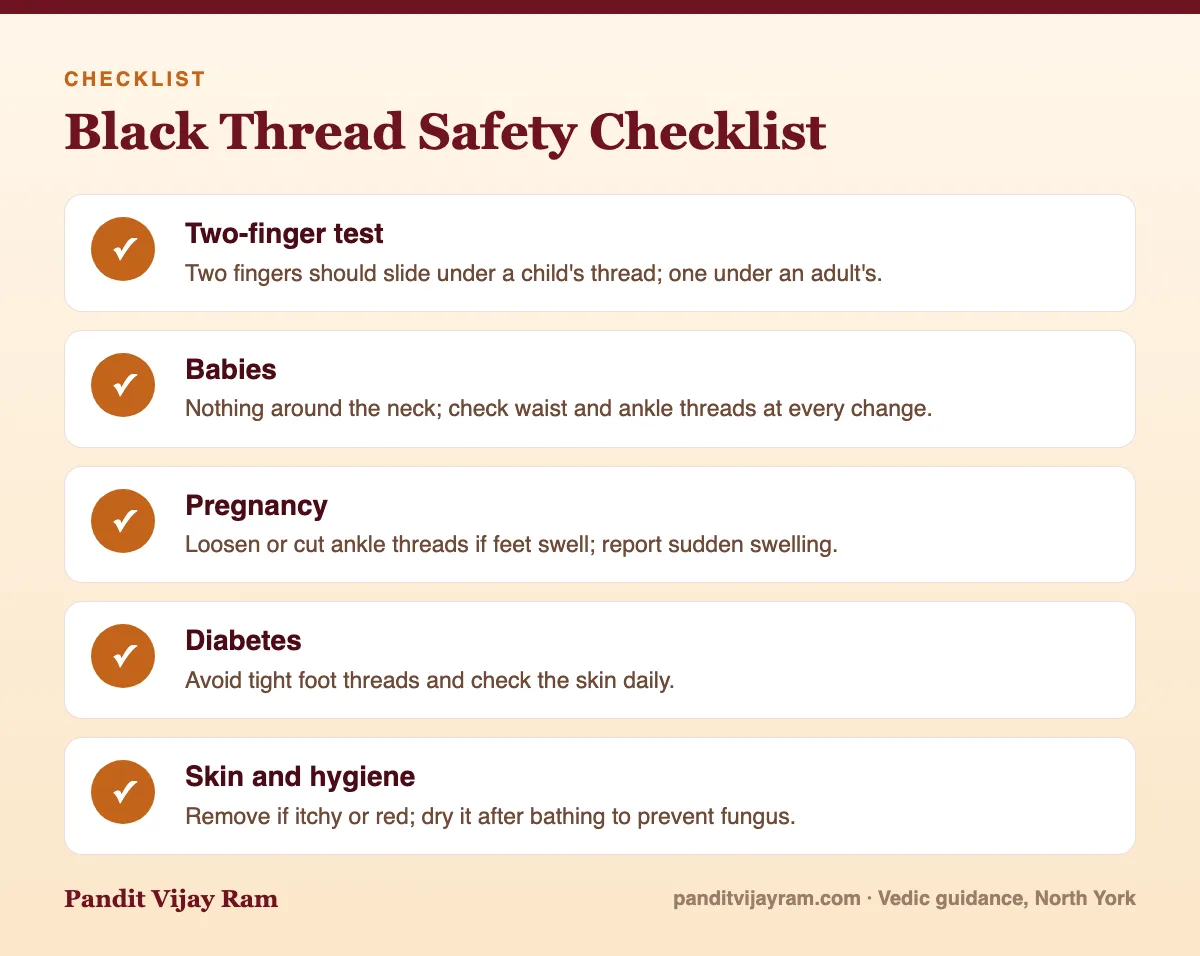
Only with care. Never tie anything around a baby's neck, and check waist, wrist and ankle threads daily for tightness, as threads can cut into growing skin. In pregnancy, ankles often swell, so loosen or remove ankle threads. People with diabetes should avoid tight foot threads and check their skin regularly.
A thread is harmless only when it stays loose and clean. Practical safety rules:
- Two-finger test. You should be able to slide two fingers under any thread on a child. On an adult, one finger at least.
- Babies. Nothing around the neck at any time. Waist threads must be loose and checked at every diaper change. Remove threads for sleep if they could tangle with fingers or toes.
- Pregnancy. Swelling in the feet and ankles is common in later months. A thread that fitted in spring can dig in by summer. Cut it off if it leaves a mark, and tell your doctor or midwife about any sudden swelling.
- Diabetes. Reduced feeling in the feet means a tight thread or a sore can go unnoticed. Check daily or skip ankle threads.
- Skin reactions. Cheap black dye can cause itching or a rash. Choose undyed cotton dipped in natural colour, or remove it and let the skin heal.
- Hygiene. A thread that stays wet can hold sweat and fungus. Dry it after bathing.
A hospital or clinic may cut a thread off for a procedure. That is no spiritual loss. Tie a new one afterwards if you wish.
For other gentle newborn customs, see the guide to protection for babies and new mothers.
When should you change or remove a black thread?
Change it when it is frayed, discoloured, too tight or has been wet for long, and remove it at once if it irritates the skin. Many people renew it on a Saturday. If it breaks on its own, there is no bad omen: thank God for the protection it gave and tie a fresh one if you like.
A broken thread frightens some people, who believe it took a hit of nazar meant for them. Others believe it means the thread did its job. Either way, the response is calm: let it go and replace it if you wish.
A simple way to retire one:
- Cut it, do not tear. Use clean scissors to avoid pulling on the skin.
- Say a short thanks. A sentence of gratitude or one recitation of your chosen prayer.
- Dispose respectfully. Bury it in garden soil, or place it at the foot of a tree or plant. Many families avoid throwing threads in kitchen waste.
- Tie a fresh one if wanted. On a day that suits your custom, after a bath.
You do not need to wear a thread for life, and stopping does not invite harm. If you find yourself checking it constantly or panicking when it breaks, that anxiety deserves attention more than the thread does.
People who want a more lasting protective item sometimes choose an evil eye protection consultation or a written taweez. More guides on nazar customs are listed in the evil eye and curses hub.
The bottom line
A black thread on ankle, wrist or waist is a folk guard against nazar, usually tied on the left for women and the right for men, though customs vary. Its links to Saturn and Rahu are popular rather than classical, so a chart reading is the better guide for planetary concerns. Keep every thread loose, clean and dry, take special care with babies, pregnancy and diabetes, and replace it calmly whenever it wears out.
Key takeaways
- The kala dhaga is a folk protection against nazar, not a scriptural rule.
- Left ankle for women and right for men is common but not fixed.
- Saturn and Rahu claims, and sign-based bans, are modern folk ideas.
- Use the two-finger test and never put a cord on a baby's neck.
- A broken thread is not an omen; replace it calmly if you wish.