
Kalava (Mauli) Thread After Cleansing: Meaning and When to Replace It
Almost everyone who has sat through a puja has held out a wrist for the priest to tie a red thread. Days later, the questions begin. Which hand was right? How long should it stay on? Is it bad luck if it falls off in the shower? The kalava thread is one of the simplest protective customs in Hindu life, and also one of the most misunderstood. Families in North York often ask me about it after a cleansing or a griha pravesh, and the answers are kinder and more flexible than many people fear. This guide explains what the mauli means and where it comes from, which wrist it is tied on and why customs differ, and the raksha sutra mantra that is recited as it is tied. It also covers how long to keep it, how to take it off respectfully, and how to dispose of it in a Canadian home. In more than forty years of tying these threads, I have noticed that people relax as soon as they understand that the kalava is a reminder of a prayer, not a fragile charm.
What is a kalava thread and what does mauli mean?
Kalava is a cotton thread dyed red and yellow, sometimes with saffron or green strands. Mauli means crown or top, a name linked with Shiva, who wears the moon on his head. Tied during a puja, it marks the person's sankalp, the vow made in the ritual, and acts as a raksha sutra, a protective thread.
The thread appears throughout Hindu ritual. It is tied around the neck of the kalash, the sacred water pot. It is wound around the trunk of a banyan tree during Vat Savitri. It is tied on wedding guests and the couple, on new account books, and on the wrists of everyone present at a havan or katha.
Its colours carry meaning. Red is linked with Shakti, energy and auspiciousness. Yellow is linked with Brihaspati, wisdom and blessing. Together they speak of protection and good fortune.
The most famous form of the raksha sutra is the rakhi, tied by a sister on her brother's wrist during Raksha Bandhan. The kalava is its everyday cousin, tied by a priest or elder rather than a sibling.
The kalava is different from the janeu, the sacred thread given in the upanayana ceremony, which is worn across the body for life and has its own rules. It is also different from the plain black thread some people wear on the ankle or wrist against nazar, which our evil eye removal page explains.
For people who want a more lasting protective item, a written taweez or kavach serves a longer purpose than a thread that wears out in weeks.
Which hand should the kalava be tied on?
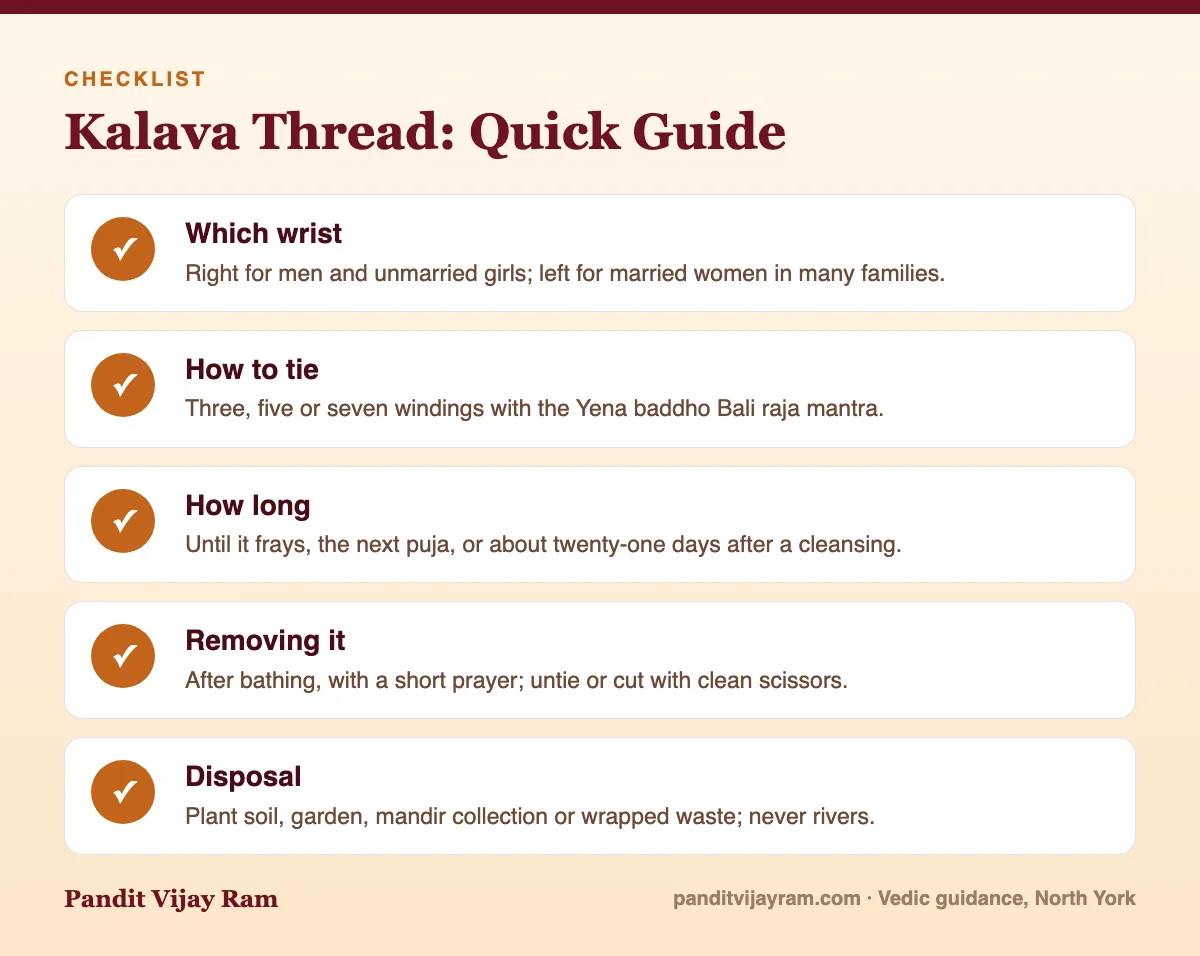
The most common custom is the right wrist for men, boys and unmarried girls, and the left wrist for married women. Many families now tie it on the right for everyone. Both are accepted. Follow the custom of your family or the priest performing the puja, and do not worry if it differs elsewhere.
The right hand is generally used for giving, receiving prasad and performing ritual actions in Hindu practice, which is why it is the default for the kalava. The custom of a married woman wearing it on the left links her with the left side of her husband, as in the Ardhanarishvara image of Shiva and Parvati, where Parvati forms the left half.
Regional practice varies:
- In many North Indian homes, the split between right for men and left for married women is followed closely.
- In other communities, every person present at the puja receives the thread on the right wrist.
- Some priests simply ask which hand you prefer, especially if you wear a watch or work with your hands.
A simple rule: if the priest ties it on a particular wrist, keep it there. If you are tying it yourself at home after a cleansing, use the right wrist unless your family custom says otherwise.
Being left-handed is no spiritual problem. If the thread catches on tools or gets dirty quickly, ask for the other wrist.
For children, a loose, well-knotted thread on the wrist is fine, but check it often so it never becomes tight or wet for long periods.
How is a kalava tied, and what mantra is recited?
The person holds out a closed fist, often holding a coin, rice or a flower, and rests the other hand on the head. The priest winds the thread three, five or seven times around the wrist and recites Yena baddho Bali raja, the raksha sutra mantra, before tying it with a firm knot.
The sequence is short and has been followed for generations:
- Sankalp first. The thread is usually tied after the sankalp of a puja or havan, so it carries the intention made in the ritual.
- Fist and head. You hold out your wrist with the fist closed, often around a little rice, a coin or a flower, and place your other hand gently on your head.
- Windings. The priest or elder winds the thread around your wrist an odd number of times, most often three.
- The mantra. The verse recited is: Yena baddho Bali raja danavendro mahabalah, tena tvam anubadhnami rakshe ma chala ma chala. It means: with the same thread that bound the mighty King Bali, I bind you; O protection, do not waver.
- Knot. The thread is knotted firmly but not tight. You should be able to slide a finger underneath.
- Offering. The coin or rice in your fist is offered to the deity or given as dakshina.
The Bali verse refers to the story of Vishnu's Vamana avatar and King Bali, and to Lakshmi tying a protective thread on Bali's wrist. That story is one of the traditional roots of Raksha Bandhan.
The kalava is tied at nearly every ceremony described on our puja, havan and anushthan page. You can also tie one at home after a simple cleansing, reciting the same verse yourself.
How long should you wear a kalava before replacing it?
There is no single rule. Many people wear it until it frays, fades or falls off, often a few weeks. Others replace it at the next puja, on a festival, or on a Tuesday or Saturday. Some keep it for twenty-one days after a cleansing. Change it before it becomes dirty or smells.
Here is a practical guide that respects both tradition and hygiene:
- After a cleansing or removal ritual: many practitioners suggest keeping it for at least the first week, and up to twenty-one days, as a reminder of the vow.
- After a general puja: keep it until the next puja, festival or family ceremony, then let the new one replace it.
- When it frays or loses colour: replace it. A worn thread has done its job.
- When it gets wet often: if your work keeps your hands in water, such as cooking, nursing or cleaning, a damp thread can irritate skin. Replace it more often or wear it on the other wrist.
- Before surgery or a scan: hospitals may ask you to remove it. Do so without fear and tie a new one afterwards.
Tuesday and Saturday, linked with Hanuman, are popular days for changing it. If the thread falls off by itself, that is not a bad omen. It simply means it was ready to come off.
Watch your skin. The red dye in some threads runs when wet and can stain clothing or cause a rash in sensitive people. If you notice itching, remove it and choose an undyed or better-quality thread next time.
How do you remove and dispose of an old mauli thread?
Remove the kalava gently with a short prayer, untying it or cutting it with clean scissors. Place it in the soil of a plant pot or garden, under a tree, or with your old puja items for respectful disposal. In Canada, avoid dropping threads into lakes or rivers, which was the village custom.
Removing it with care honours the prayer it carried.
- Choose a calm moment. After bathing is traditional. Many people choose a Tuesday or Saturday.
- Say thank you. A short prayer such as Om Namah Shivaya or simply a word of thanks to your family deity.
- Untie or cut. Use clean scissors if the knot is tight. There is no rule against cutting it.
- Dispose respectfully. Choose one of the options below.
Disposal options in a Canadian home:
- Bury it in the soil of a houseplant or in the garden. Cotton breaks down naturally.
- Tie it loosely around a tree branch in your yard, if you have one.
- Keep it in a small box with other used puja items, such as old flowers and threads, and dispose of them together. Our guide to cleaning the puja room and home mandir explains respectful ways to handle old offerings.
- Many mandirs accept old threads and puja items. Ask before leaving them.
Avoid throwing it in a lake, river or storm drain. Synthetic threads in particular do not break down, and the old custom of flowing water does not suit urban waterways. Placing it in household waste wrapped in paper with a prayer is also acceptable if nothing else is possible.
Does a red thread really protect you from negative energy?
A kalava protects in the way a vow does: it reminds you of a prayer, a ritual and the people who blessed you. It is not a physical shield, and it cannot stop illness, accidents or another person's actions. Its strength comes from the faith and conduct of the person wearing it.
Red threads appear in many cultures. Some Jewish communities tie a red string associated with Rachel's Tomb, and many Buddhist traditions use blessed threads. These practices have their own meanings and deserve respect on their own terms. In the Hindu tradition, the kalava is a sign of the sankalp made during puja and of the protection of the deity invoked.
The thread helps by making the vow visible, a small reminder that can steady you on hard days.
It has limits, and it helps to name them plainly:
- It does not replace medical care, safety planning or legal help.
- It does not need to be guarded anxiously; accidents with it carry no curse.
- A thread tied by someone who frightened you into paying a large sum carries no special power.
If you feel you need more than a thread, look first at ordinary causes, then at simple daily practice. A mala can be a longer-lasting companion, as explained in our guide to rudraksha and tulsi mala. The cleansing and protection hub gathers other gentle routines.
If worry about negative energy is affecting your sleep, work or mood, please also speak with your family doctor.
The bottom line
The kalava thread is a raksha sutra that carries the vow of a puja and a reminder of the deity's protection. Men usually wear it on the right wrist and married women often on the left, though family custom decides. Keep it until it frays or until the next puja, replace it with a short prayer, and dispose of it in soil or with puja items rather than in rivers. Its strength lies in remembrance, not in fear.
Key takeaways
- Kalava, mauli and moli are names for the same red and yellow protective thread.
- Right wrist for men and unmarried girls, left for married women is common, but customs vary.
- The raksha sutra mantra Yena baddho Bali raja is recited while tying it.
- Replace it when it frays, at the next puja, or after about twenty-one days following a cleansing.
- Dispose of old threads in soil or with puja items, never in lakes or storm drains.