
Negative Energy Removal for Babies and New Mothers: Gentle Traditions

A new baby brings joy, a stream of visitors and, in many South-Asian homes, an elder who says the child has caught nazar. Parents in North York often hear this when a calm baby suddenly cries through the evening. Nazar on babies is one of the oldest worries in our tradition, and it deserves a gentle, sensible answer rather than fear. In this guide you will learn what customs like the kala tika, chhathi and the forty-day rest were meant to do, which of them are safe for a newborn's delicate skin and lungs, and which should be skipped. You will also find clear signs that mean a call to the doctor, not a ritual. Over forty years I have blessed many newborns, and I have also sent many worried parents straight to their paediatrician. Both actions come from the same care. A grandmother's wisdom and modern medicine can work together beautifully when safety is the first rule. Let us look at the customs one by one.
Can a newborn baby really get nazar?
In South-Asian, Middle Eastern and Mediterranean belief, yes: infants are thought to be especially open to the evil eye because they are new, admired and fragile. Medically, most fussiness in the early weeks has ordinary causes like hunger, gas, tiredness or overstimulation. Hold both views, and let medicine lead.
The idea is easy to understand. A newborn is the centre of attention, and every visitor praises the plump cheeks or bright eyes. Elders say that praise without blessing, especially from someone who longs for a child, can "land" on the baby. That is why many families add mashallah, nazar na lage or a quick prayer after a compliment.
Doctors see the same baby differently. In the first months, many infants have a period of intense evening crying that peaks around six to eight weeks and then eases. Wind, reflux, a growth spurt, a stuffy nose or simply too many arms holding them can all explain a rough day.
Things families often blame on nazar but that usually have plain causes:
- Crying after a busy day of guests.
- Refusing the breast or bottle during a growth spurt.
- Startling and waking more after a long car trip.
- Redness or rash on the face.
Protective customs can soothe the household, and a calmer household often means a calmer baby. For the general home method many families already use, see how to remove nazar at home, adapted gently for an infant.

Is kala tika safe for babies?
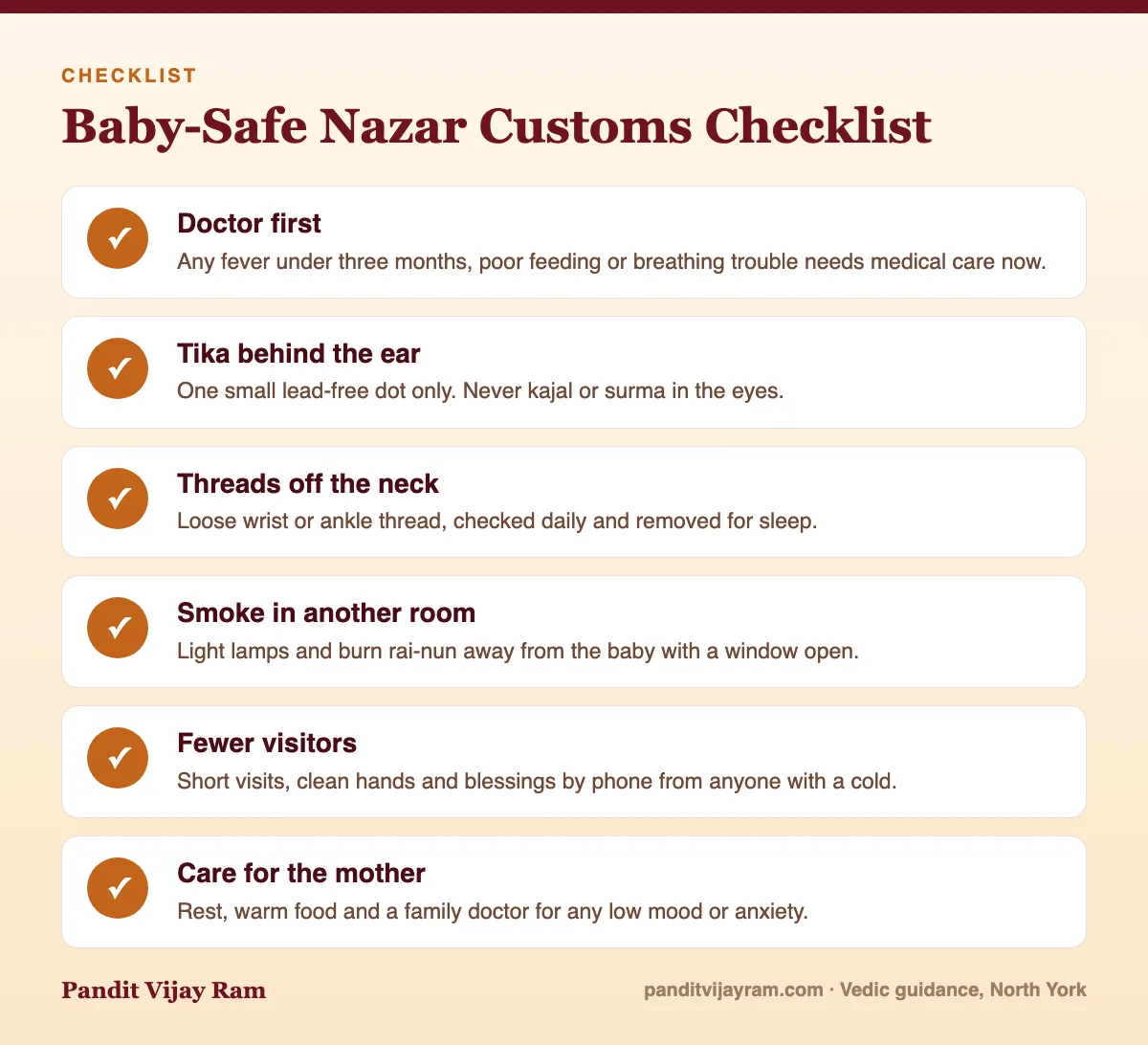
A tiny dot behind the ear or on the sole of the foot is the gentlest form. Never line a baby's eyes with kajal, surma or kohl, because many traditional products have been found to contain lead. Choose a product labelled safe for infant skin, or use a thread or prayer instead.
The kala tika, also called the nazar tika or dhithona, is a small black mark meant to spoil perfection so envious eyes slide away. Grandmothers traditionally place it on the forehead, cheek, behind the ear or under the foot.
Safety comes first here. Kohl and surma have long been linked with lead content, and babies absorb lead easily through skin, eyes and hand-to-mouth contact. Eye application also risks infection and scratching the cornea. A safer approach:
- Skip the eyes completely, whatever an elder insists.
- Use only a product that clearly states it is lead-free and suitable for infants, or ask your pharmacist.
- Place one small dot behind the ear, where the baby cannot rub it into the eyes.
- Wash it off at bath time and watch for redness.
- If unsure, replace the mark with a whispered prayer, which carries the same intention.
Black threads on the wrist or ankle are another common custom. Keep them loose, check the skin daily and remove them for sleep. Nothing should ever go around a baby's neck, and small beads or charms are a choking hazard. Our guide to the kalava protective thread explains the meaning of the thread for older children and adults.
What is the chhathi ceremony and what does it protect?
Chhathi is a celebration held on or around the sixth day after birth in many North Indian families. Prayers go to Shashthi Devi, or Chhathi Maiya, a mother goddess believed to guard young children. It welcomes the baby, thanks the mother and asks blessing for health. It is a blessing, not a removal ritual.
Customs vary by region and family. In some homes the baby wears new clothes for the first time, and the mother is honoured with a special meal. In others, a lamp is lit, a simple puja is done for Shashthi Devi, and elders bless the child. Some families combine it with the naming ceremony, namkaran, which is often held later, around the eleventh or twelfth day.
Spiritually, the sixth day marks the baby's first threshold. Families pray that the child's life, health and fortune are protected from that point on. Many also see it as a chance to bless the mother, who has carried the greatest effort.
Keep it gentle in practice:
- Hold the lamp and any incense well away from the baby, ideally in another room, since newborn lungs are sensitive to smoke.
- Limit the guest list. Fewer visitors means fewer infections and a less tired mother.
- Ask visitors with coughs or colds to send blessings by phone.
- Keep the ceremony short so feeding and sleep continue normally.
If your family wants a fuller blessing, a short Ganesha puja for new beginnings can be done for the household without disturbing the baby. Vijay Ram ji can also suggest a simple mantra parents can say at feeds.
Why do new mothers rest for 40 days after birth?
Many cultures keep a postpartum rest of about forty days, called sava mahina in Hindi, chilla in many Muslim homes and la cuarentena in Latino families. It protects the mother while she heals, feeds and bonds. Spiritually it is a time of shelter. Practically, it is rest, warm food and help.
The forty-day rest is one of the wisest customs we inherited. The mother stays mostly at home, eats warm, nourishing food, receives few visitors and is excused from household work. Relatives cook, clean and hold the baby so she can sleep.
Traditional reasons and modern reasons line up well:
- Healing. The body needs weeks to recover from birth, whether vaginal or caesarean.
- Feeding. Rest and calm help breastfeeding become established.
- Infection. Fewer visitors protects a baby with an immature immune system.
- Bonding. Time together steadies both mother and child.
Some old rules no longer serve families, such as never bathing, avoiding all water or drinking too little. Ask your midwife or doctor before following strict restrictions. In Canada, many families no longer live with grandparents, so the forty days can feel lonely. Lean on friends, neighbours, public health nurses and community groups.
Watch the mother as closely as the baby. Low mood, tearfulness, anxiety or feeling disconnected can be postpartum depression or anxiety, which is common and treatable. Please see your family doctor. Our article on negative energy or depression explains why medical care must come first, and in a crisis call or text 988.
What gentle protection can parents use at home?
The safest protections need no smoke, fire or substances near the baby: a whispered prayer after praise, a calm feeding corner, a lamp lit in another room and a short mantra recited by the parents. Elders' rai-nun and chilli customs should be done far from the baby, or skipped.
Here is a simple, baby-safe routine many families find comforting:
- Bless after praise. When a guest admires the baby, a parent quietly adds a blessing, such as "may God protect you".
- Morning lamp. Light a ghee diya in the puja corner, not in the nursery, and say Om Namah Shivaya or the Gayatri mantra.
- Feeding prayer. Some mothers recite a short line of Hanuman Chalisa or a family prayer at the first feed of the day. Muslim parents often recite the final two surahs of the Qur'an over the child.
- Evening reset. Dim lights, fewer visitors and a warm bath often settle a baby better than any charm.
Customs to adapt with care:
- Rai-nun. Mustard seeds and salt circled over the child and then burned create sharp smoke. Circle the baby, then burn them outside or in another room with a window open.
- Dried red chillies. The fumes irritate small airways. Better skipped.
- Oil massage. Ask your paediatrician which oil suits your baby's skin, and keep oil out of the nose and ears.
If you want a practitioner's view on a family's protective routine, Vijay Ram ji's evil eye and nazar service focuses on prayer for the household rather than anything applied to the infant. More cleansing articles sit on the cleansing and protection hub.
When should a crying baby see a doctor instead of having nazar removed?
Call a doctor or seek urgent care at once for fever in a baby under three months, poor feeding, fewer wet diapers, yellowing skin, breathing trouble, unusual sleepiness, a weak cry or crying that will not stop. These are medical signs. Prayer can continue, but it must never delay care.
This is the most important section of the article. Infants can become seriously unwell quickly, and the signs can look like the restlessness elders associate with nazar. A simple decision rule helps:
- Call 911 or go to emergency if the baby is struggling to breathe, turning blue or grey, is floppy, very hard to wake, or has a seizure.
- Get same-day medical advice for any fever in a baby under three months, vomiting that keeps returning, refusing several feeds, very few wet diapers or skin turning yellow.
- Book a doctor's visit for crying that has changed in pattern, a rash that worries you or a feeling that something is wrong.
In Ontario, you can also call Health811 to speak with a registered nurse at any hour. Other provinces have similar nurse lines.
Trust your instinct. Parents know their child, and "he just isn't himself" is a valid reason to call. No genuine practitioner will ever tell you to wait for a ritual to work on a sick infant. When a family brings a crying baby to me, my first question is whether the doctor has seen the child. Only after that do we talk about blessings.
The bottom line
Nazar on babies is an old and loving belief, and its customs work best when they are gentle. Keep smoke, kohl and anything around the neck away from a newborn, and choose prayer, calm and fewer visitors instead. Honour the forty-day rest by truly helping the mother, and watch her wellbeing as closely as the baby's. Above all, let a doctor assess any fever, feeding trouble or unusual crying before any ritual is considered.
Key takeaways
- Most newborn fussiness has ordinary causes such as hunger, wind, growth spurts or overstimulation.
- Never put kajal, surma or kohl in a baby's eyes, and keep threads off the neck.
- Chhathi is a blessing for the child and mother, best kept short and smoke-free.
- The forty-day rest protects the mother, and postpartum low mood needs a family doctor.
- Fever under three months, breathing trouble or poor feeding means medical care immediately.