
Kala Tika Against Nazar: Meaning, Where to Apply and Safety

A newborn going out for the first time, a bride stepping onto the stage, a toddler dressed up for Diwali: in countless South-Asian homes, someone reaches for the kajal and adds one small black dot. The kala tika is among the gentlest customs against nazar, and families in North York and across the GTA still ask me where it should go and whether it is safe. Those two questions belong together. In more than forty years of advising families I have seen this custom carried lovingly from one generation to the next, and I have also learned how often the kajal used for it comes from an unknown source. This guide explains what the black dot means, the placements used for babies, brides and adults in different communities, why some kohl, kajal and surma products carry a lead risk, the safer alternatives that keep the meaning intact, and what the custom can and cannot do. My aim is simple: keep the tradition, lose the risk.
What does a kala tika mean in Indian tradition?
The kala tika, also called dithona in Hindi or drishti pottu in Tamil, is a deliberate small blemish. Tradition holds that nazar falls on what is perfect and admired, so a dark mark breaks that perfection and catches the eye first. It is an act of humility and love rather than a religious rite.
The logic is close to that of the nimbu mirchi at a shop door or the black-faced nazar battu on a new building. Something is placed where the eye will land, so that admiration or envy settles on the mark instead of on the person. A chubby, glowing baby is exactly the sort of sight that draws comments, which is why infants are the most common wearers.
The custom crosses religious lines. Hindu, Sikh and Muslim families in Punjab, Uttar Pradesh, Bihar, Bengal and Pakistan all use it, and South Indian families have their own name for it. In many homes the grandmother applies it with the little finger after the morning bath, sometimes with a quiet line of prayer.
Three points help families hold it in proportion:
- It is a folk practice. There is no scriptural rule on size, side or timing.
- The meaning is modesty. It says, in effect, do not praise too much. Many elders pair it with saying nazar na lage after a compliment.
- It is optional. A child without a tika is not unprotected or unloved.
For the broader set of baby customs, such as chhathi and the forty-day rest, see negative energy, babies and new mothers. Other nazar guides are gathered in the evil eye and curses hub.

Where should a kala tika be applied on a baby or an adult?
For babies, the most common places are behind the left ear, at the side of the forehead near the hairline, on the cheek or chin, or on the sole of a foot. Brides often wear it hidden behind the ear. Adults who use it choose a discreet spot under the hairline or behind an ear.
Placement varies by family more than by scripture. These are the patterns I hear most often:
- Behind the ear. Probably the most widespread for babies and the standard for brides and grooms, because it stays hidden in photographs. Left is the usual side; some families do both.
- Side of the forehead. Just inside the hairline at the temple, rather than the centre, where a bindi or tilak might go.
- Cheek or chin. A visible beauty-spot style dot, popular in Punjabi and Hyderabadi homes.
- Sole of the foot or under the big toe. Chosen by parents who want the custom without anything showing on the face.
- Navel area or wrist. Less common, used in some rural traditions.
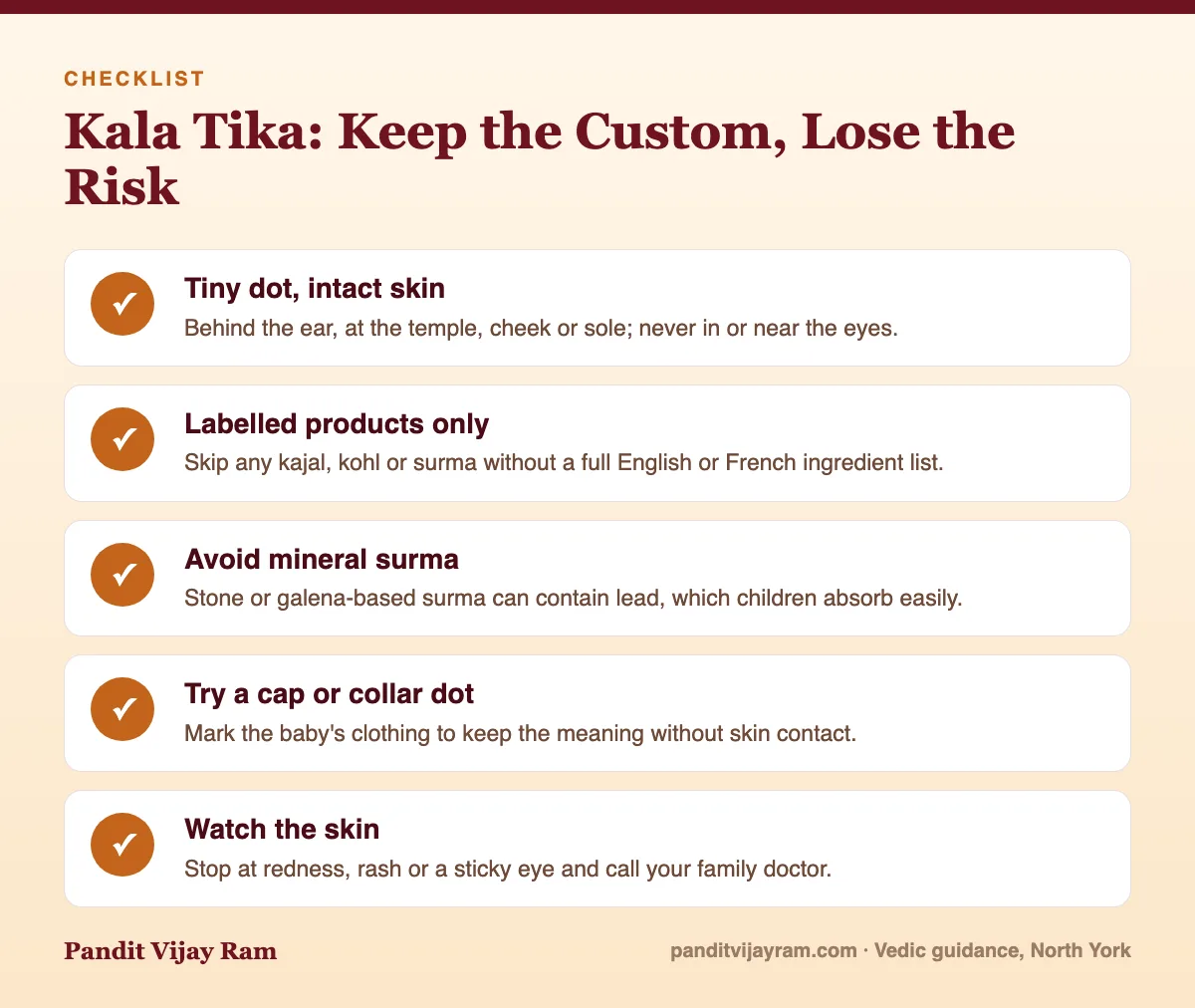
What families agree on is that the dot should be small and placed away from the eyes, nose and mouth. Never line a baby's eyes with kajal, an older habit some grandparents remember. The eye is easily irritated and can become infected, and an infant rubs whatever is near it.
For weddings, where elders also do nazar utarna on the couple, the article on nazar at weddings covers the full set of customs. For a thread-based alternative some parents prefer, see black thread on the ankle or wrist.
Is kajal or surma safe to use for a kala tika?
Not always. Some traditional kohl, kajal and surma products, especially those bought abroad or from unlabelled sources, have been found to contain lead. Lead is toxic, and babies absorb it easily through skin contact, hand-to-mouth habits and their eyes. A carefully chosen product, or a non-kajal alternative, removes that worry.
Surma and some kohl preparations were traditionally made from ground minerals, and certain ones are based on galena, a lead ore. Products with high lead levels still turn up in markets and in suitcases brought back by relatives. Because the packet looks just like the safe ones, families cannot tell by sight.
Why this matters most for children:
- Small bodies absorb more. Young children take up lead more readily than adults.
- Fingers go to mouths. A baby touches the tika, then sucks a thumb.
- Effects are quiet. Lead exposure can affect a child's development without obvious early signs.
A practical rule I share with parents:
- Avoid any kajal, kohl or surma without a full ingredient list in English or French.
- Do not use products a vendor describes as made from stone or mineral powder.
- Homemade lamp-soot kajal avoids lead but is still a fine particle mixed with ghee; use only a tiny dot on intact skin and never near the eyes.
- Stop immediately if you see redness, a rash or irritation.
- If you have used an unknown product often on a young child, mention it to your family doctor, who can decide whether a blood test is sensible.
Public health agencies, including the US Food and Drug Administration, have warned about lead in some imported kohl and sindoor, and the same caution applies to sindoor and other colourants from unverified sources. None of this is a reason to abandon the tradition. It is a reason to choose the material carefully.
What are safe alternatives to a kajal tika for nazar?
You can keep the meaning with a dot from a labelled cosmetic eyeliner pencil sold in Canada, a tiny mark on the baby's cap or clothing, a black thread kept loose and checked often, or a nazar bead fixed securely to a stroller out of reach. Prayer and modest speech carry the custom too.
The point of a kala tika is the intention behind it, not the chemistry of the kajal. That leaves plenty of room for safer choices:
- A labelled eyeliner pencil. A black pencil from a regular Canadian pharmacy or retailer, with a full ingredient list. Patch-test on a small area first and use the lightest touch.
- Mark the clothing, not the skin. A small black dot stitched or drawn on the inside of a cap, the hem of a frock or the collar of a kurta. Many grandmothers accept this happily once the reason is explained.
- A loose black thread. On the wrist or ankle of an older baby, tied with room for two fingers and checked daily. Remove it at bedtime for infants, as any cord poses a risk during sleep.
- A nazar bead on the stroller or car seat canopy. Fixed firmly so it cannot come loose, out of the baby's reach, and never inside the crib.
- Words and attitude. Saying Mashallah, nazar na lage or Bhagwan bhala kare after a compliment is itself the oldest protection.
For adults, a small dot behind the ear with a cosmetic pencil, a mangalsutra with black beads, or a simple daily prayer can all serve. If a family member insists on traditional surma, have a respectful conversation about where it was bought; most elders are glad to switch once they understand the lead question.
Can a kala tika really stop nazar, and when is more help needed?
A kala tika is a symbol of care and humility, and many families find peace in it. It cannot prevent illness, colic or developmental problems. If a baby is unwell, a doctor comes first; if an adult feels a lasting pattern of setbacks despite simple customs, a proper spiritual consultation can look deeper.
I would never tell a grandmother her tika is pointless. A small act of love, done every morning, shapes how a family pays attention to a child. That attention is valuable.
Yet it helps to be clear about limits. A black dot does not stop teething pain, an ear infection or reflux. It does not explain why a toddler is not speaking yet or why an adult is exhausted for weeks. When parents tell me their baby still cries constantly despite the tika, I gently ask whether the doctor has checked feeding, weight and ears, because those answers matter far more.
Signs that call for medical help rather than another custom:
- Fever in a baby under three months, poor feeding or fewer wet diapers.
- Rash, swelling or redness where the tika was placed, or a red or sticky eye.
- Ongoing fatigue, low mood or weight change in an adult.
When health is in order and someone still feels the weight of repeated envy or setbacks, a consultation through evil eye and nazar removal can review the birth chart and suggest steady protective practice. For the tender question of whether a loving parent can unintentionally cast nazar, read can a mother give her child nazar.
The bottom line
The kala tika is a small black dot with a large meaning: humility in the face of admiration and a family's watchful love. Placement behind the ear, at the temple, on the cheek or on the foot is a matter of family custom, while keeping it away from the eyes is a matter of safety. Because some kajal and surma contain lead, choose a labelled product or mark clothing instead, and let a doctor guide any health concern.
Key takeaways
- A kala tika is a deliberate flaw meant to catch an admiring or envious gaze.
- Common spots are behind the ear, the temple, cheek, chin or sole of the foot.
- Never line a baby's eyes with kajal or place the dot near eyes or mouth.
- Some kohl, kajal and surma contain lead; avoid unlabelled or mineral-based products.
- A dot on clothing or a cap keeps the custom's meaning without skin contact.