
Sade Sati or a Curse? Why Saturn Periods Get Mistaken for Bad Luck

Saturn has a reputation no other planet can match. Say Sade Sati at a family gathering and someone will tell a story about a lost job, an illness or a business that collapsed during those years. So when your own life slows down, responsibilities pile up and effort seems to bring less than it should, the fear of a curse can creep in. The question of sade sati vs curse comes up again and again among families in North York, often after a relative has warned them in advance. This guide explains what Sade Sati actually is and how it is calculated from the Moon sign, its three phases, and the shorter Saturn period called dhaiya. It looks at why these years so often feel like a curse, why some people barely notice them, and which remedies tradition recommends. It also marks the point where practical help, from a doctor, a financial counsellor or a career adviser, matters more than any planet. In more than forty years of practice, I have seen many people look back on their Sade Sati as the period that made them who they are.
What is Sade Sati and how is it calculated?
Sade Sati, meaning seven and a half, begins when Saturn enters the sign before your natal Moon sign and ends when it leaves the sign after it. Saturn spends about two and a half years in each sign, giving three phases. It is calculated from the sidereal Moon sign, not the Western Sun sign.
Saturn takes about twenty-nine and a half years to travel around the zodiac. That means Sade Sati returns roughly every thirty years, and most people pass through it two or three times in a lifetime: perhaps once in youth, once in mid-life and once in later years. Each round tends to feel different because life is different.
To find yours:
- Know your Moon sign. In Vedic astrology, this is your rashi, the sidereal sign the Moon occupied at birth. It often differs from the sign you read in a Western horoscope column.
- Find Saturn's current sign. Any Vedic panchang or ephemeris shows it.
- Count. If Saturn is in the sign just before your Moon sign, on it, or just after it, you are in Sade Sati.
Saturn sometimes turns retrograde and steps back into a previous sign, so the start and end can feel uneven. An accurate birth time and chart make the dates precise. The free tools on the astrology calculators page can help you find your Moon sign.
The name Sade Sati is a popular Hindi term. Classical transit teachings describe Saturn's passage through the 12th, 1st and 2nd houses from the Moon as testing, and the folk name grew around that teaching.

What are the three phases of Sade Sati and what is dhaiya?
The rising phase, with Saturn in the 12th from the Moon, often touches expenses, sleep and letting go. The peak phase, over the Moon, weighs on mood and personal responsibility. The setting phase, in the 2nd, touches family, money and speech. Dhaiya is a separate two-and-a-half-year Saturn transit through the 4th or 8th from the Moon.
Each phase carries its own typical themes, though the actual experience depends on the chart.
- Rising phase. Expenses may rise, travel or relocation may come up, and sleep can be lighter. Many people let go of old habits, places or relationships during this time.
- Peak phase. Saturn over the Moon is usually felt most strongly. People describe emotional heaviness, more duty, closer attention to health and a sense of being tested. It is also when real maturity is built.
- Setting phase. Focus shifts to family finances, savings, speech and food habits. Pressure usually eases toward the end.
Dhaiya, sometimes called the small panoti, is Saturn's two-and-a-half-year transit through the 4th or the 8th sign from the Moon. The 4th, known as kantak Shani, often touches home, property, mother and inner peace. The 8th, ashtama Shani, is linked with sudden change, health checks and hidden matters. People sometimes confuse dhaiya with Sade Sati because both bring Saturn's slow pressure.
None of these phases is a punishment. Saturn is the planet of time, discipline and earned results. His transits tend to show where life needs firmer structure.
Why is Sade Sati mistaken for a curse or bad luck?
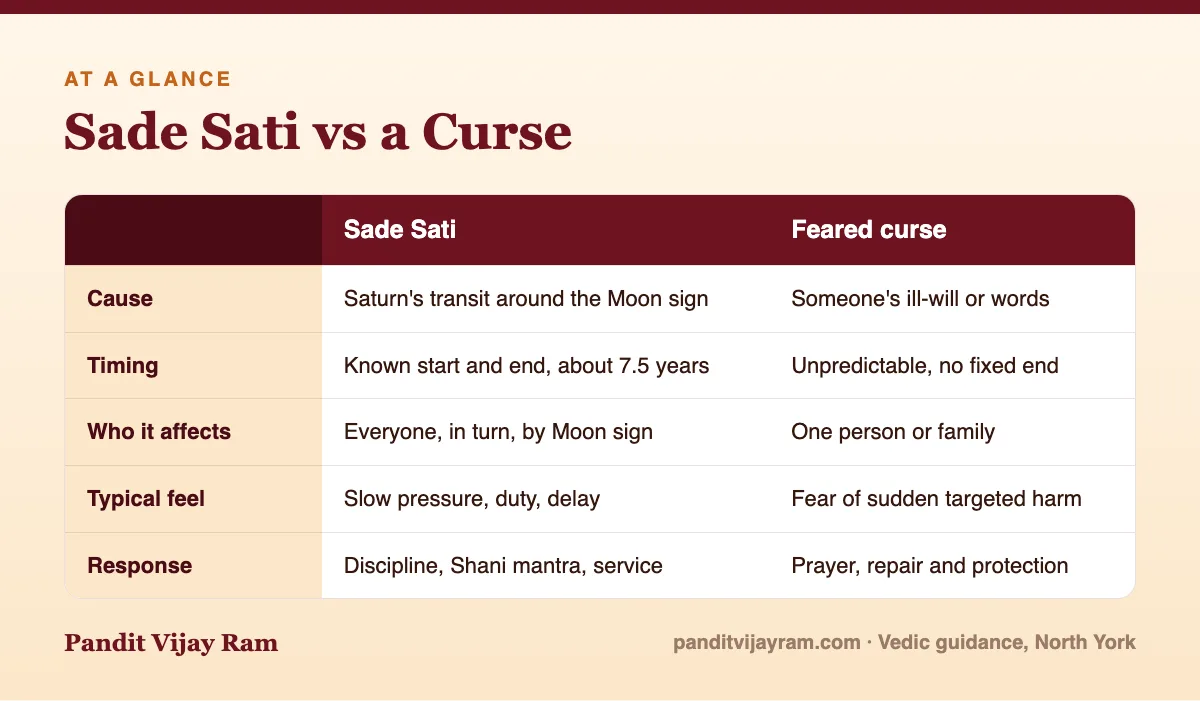
Saturn's effects are slow, heavy and cumulative, much like the feeling of being cursed. Delays, added duties, distance from others and older relatives' illnesses often coincide with these years. Because the period is well known and feared in advance, people tend to notice every setback and credit it to Saturn or to someone's ill-will.
A few patterns explain much of the confusion.
- Life stages line up. The second Sade Sati often falls in mid-life, when careers plateau, children are growing and parents age. Those pressures arrive regardless of Saturn.
- Expectation shapes perception. If you have been told for years that this period will be terrible, every problem gets filed under it, while good events go unnoticed.
- Saturn removes shortcuts. Things that worked through luck or connections may stop working. That feels like an invisible block, but it often pushes toward steadier choices.
- Isolation. Saturn's themes include solitude. A lonely stretch can make anyone wonder whether something is wrong.
The difference from a curse matters. A curse, in tradition, is unpredictable and tied to someone else's intent. Sade Sati has a known start and end, follows the same rules for everyone and is read through your own chart.
It also varies a great deal from person to person. Saturn is a yogakaraka, a strongly beneficial planet, for Taurus and Libra ascendants. Many astrologers find the period milder for Moon signs ruled or favoured by Saturn, such as Capricorn, Aquarius and Libra. The dasha running at the time often shapes the experience more than the transit itself. A kundli reading puts these together, and the guide to Rahu and Ketu periods covers the other planets most often mistaken for curses.
What are the best Shani Sade Sati remedies?
Traditional remedies include Hanuman worship on Saturdays and Tuesdays, the Shani mantra Om Sham Shanaishcharaya Namah, the Dashratha Shani Stotra, Shiva worship, and charity of black sesame, urad dal, blankets or iron to people in need. Above all, Saturn is said to respond to discipline, honesty, patience and service to labourers and the elderly.
A simple, sustainable routine works better than an intense burst of ritual.
- Saturday prayer. Light a sesame or mustard oil lamp and recite the Hanuman Chalisa. The story of Hanuman freeing Shani from Ravana's captivity is why devotees believe Shani eases pressure on Hanuman's worshippers.
- Daily mantra. One mala of Om Sham Shanaishcharaya Namah, or the beej mantra Om Praam Preem Praum Sah Shanaishcharaya Namah, at a steady pace.
- Stotra. The Dashratha Shani Stotra, traditionally said to have been composed by King Dasharatha, is recited on Saturdays by many families.
- Service. Help elderly neighbours, tip and thank workers, volunteer at a food bank or donate warm blankets in a Toronto winter. Saturn is the karaka of labour and old age.
- Discipline. Keep regular sleep, honest dealings and steady work. Avoid shortcuts, debt-driven gambles and alcohol excess.
The Saturday mustard-oil practice of chaya daan is covered in detail in the guide to mustard oil and Shani on Saturdays. For families who want a formal ritual, a Hanuman puja and havan can be arranged.
Blue sapphire, neelam, is often pushed during Sade Sati. It is a strong stone that suits only some charts, so wear it only after a full reading and a careful trial.
When is a hard Sade Sati a sign to seek practical help?
Seek practical help when debt is mounting, health symptoms persist, work has stalled for months or low mood is affecting daily life. Saturn's lesson is to deal with things directly. See your family doctor for health or mood, a non-profit credit counsellor for money, and a career adviser or settlement agency for work.
Remedies support you through Sade Sati. They do not replace the actions the period is asking for. When someone tells me Saturn has cursed them, I ask what one practical step they have been putting off. There usually is one.
Where to turn:
- Health. Fatigue, joint pain, sleep problems and low mood are common complaints during these years, and all of them deserve medical attention. In a crisis, call or text 988.
- Money. Non-profit credit counselling services in Canada help with budgets and debt plans. Saturn rewards a written budget more than any gemstone.
- Work. Employment Ontario, settlement agencies and professional associations offer job search and retraining support.
- Family. If caring for ageing parents is wearing you down, ask siblings to share duties and look into caregiver supports.
Watch for fear-selling. Being told Sade Sati will ruin your marriage, or that an expensive ritual must be done this week, is not honest guidance. Our post on the kaal sarp pattern covers similar warning signs around another feared label.
When the transit ends, many people notice relief they had stopped expecting. The guide to signs that a heavy period is easing helps you judge that change honestly. More guides are gathered in the evil eye and curses hub.
The bottom line
The answer to sade sati vs curse is clear: Sade Sati is a predictable seven-and-a-half-year Saturn transit around the Moon sign, with three phases and a defined end, while a curse is neither predictable nor rule-based. Its slow pressure is easily mistaken for bad luck, especially when life stages and expectation add weight. Steady remedies such as Hanuman worship, the Shani mantra and service, along with practical help for health, money and work, carry most people through it well.
Key takeaways
- Sade Sati is Saturn's transit through the 12th, 1st and 2nd signs from the Moon.
- It returns roughly every thirty years, so most people meet it two or three times.
- Dhaiya is a separate Saturn transit through the 4th or 8th from the Moon.
- Its effects vary with the ascendant, Moon sign, Saturn's strength and the dasha.
- Hanuman worship, the Shani mantra, service and discipline are the core remedies.