
Mustard Oil and Shani: Saturday Cleansing Rituals Explained

Few planets cause as much worry as Shani. A relative mentions sade sati, a friend says Saturn is ruining your career, and suddenly every delay feels like a sentence. People in North York often come to me with a bottle of mustard oil already in their bag, asking what to do with it. The mustard oil remedy for Shani is old, simple and meaningful, but it works best when it is understood rather than done out of fear. This guide explains why mustard oil is linked with Saturn, how to perform chaya daan correctly, how to light a peepal lamp when the nearest peepal tree is in a temple rather than your street, and what Saturday charity actually means. Most importantly, it shows how to tell whether your chart genuinely points to Shani or whether a hard season has other causes. In more than forty years of reading charts, I have learned that Shani is a teacher of patience and honest work, not a punisher. The remedies are a way of showing him that you are willing to learn.
Why is mustard oil offered to Shani on Saturday?
Saturday, Shanivara, is Saturn's day, and dark, heavy materials such as mustard oil, black sesame and iron are linked with him. A popular legend says Hanuman soothed Shani's injuries with oil, so oil became his offering. Offering it is a way of easing Saturn's pressure through humility and service.
In Vedic astrology, Shani is the son of Surya, the sun, and Chhaya, whose name means shadow. He governs time, discipline, hard work, old age, servants and labourers, and the slow results of karma. His colour is dark blue or black, his metal is iron, and his grains are black urad and black sesame.
Mustard oil fits this picture: dark, pungent and warming, and long used in North Indian homes for lamps, cooking and massage. Offering something so everyday reminds us that Shani is pleased by plain, honest effort rather than display.
The legend most families know comes from the Ramayana tradition. Hanuman is said to have freed Shani, who was hurt, and rubbed oil on his wounds. Grateful, Shani promised not to trouble Hanuman's devotees. This is why many people also recite the Hanuman Chalisa on Saturdays and why our Hanuman puja is often suggested during difficult Saturn periods.
The point of the offering is not to bribe a planet. It is to accept Shani's lessons, such as patience, responsibility and care for those with less, and to act on them.

How do you do chaya daan with mustard oil?
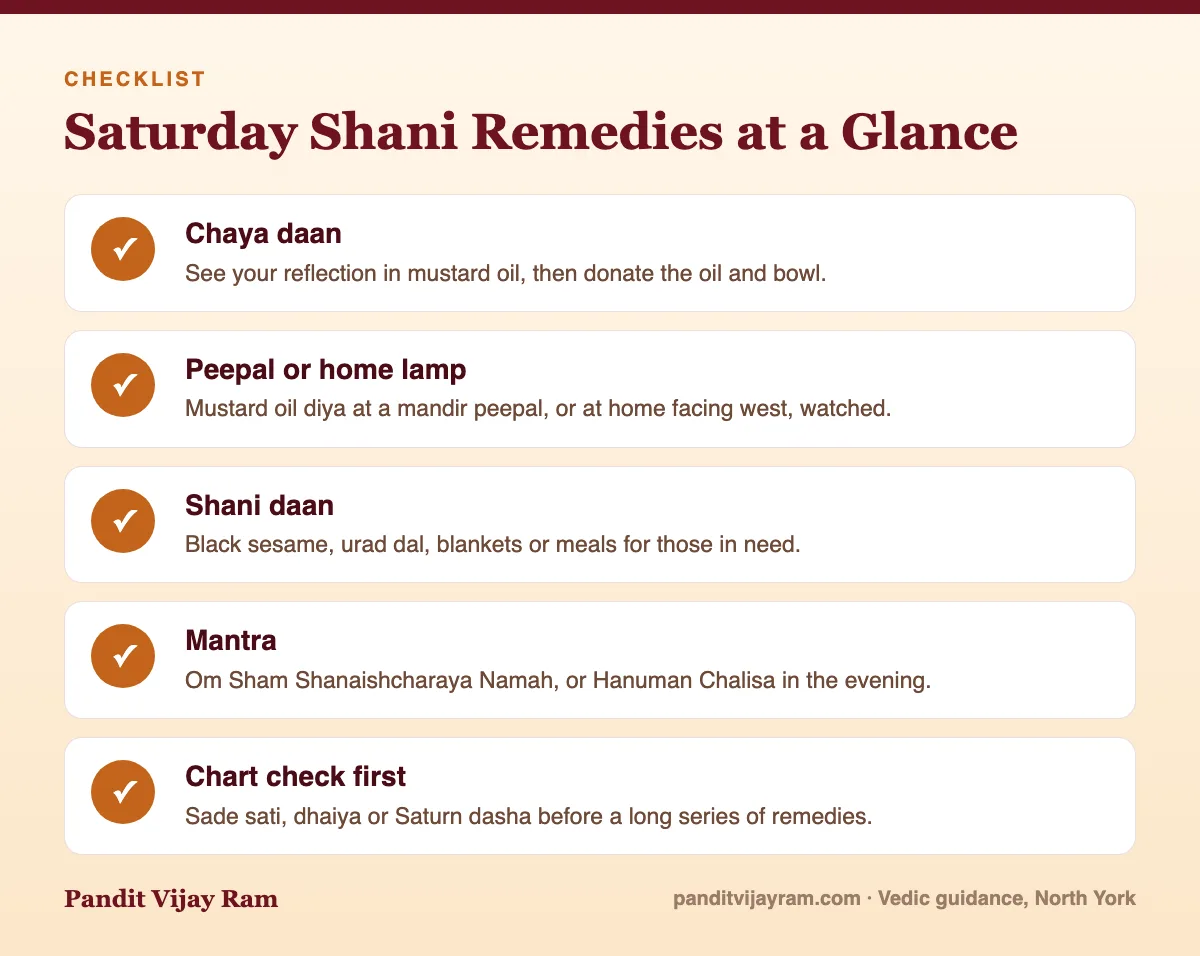
Pour mustard oil into a steel or iron bowl on a Saturday, look at your reflection in it while praying to Shani, then donate the bowl of oil, usually at a Shani shrine or to someone who can use it. Chaya means shadow, so you symbolically give away your heaviness with the reflection.
- Choose the time. Saturday morning after bathing, or Saturday evening after sunset. Avoid rahu kaal if you follow a panchang.
- Prepare the bowl. Use a small steel or iron katori and fill it with mustard oil. Some families add a coin or a few black sesame seeds.
- Sankalp. Sit facing west, Shani's direction, and say your name and the help you are asking for.
- See your reflection. Look into the oil calmly for a few moments. Chant Om Sham Shanaishcharaya Namah eleven or twenty-one times.
- Give it away. Take the bowl to a Shani shrine at a mandir, or give the oil, bowl and coin to a person or worker who can use them. Some temples collect it at a fixed spot.
- Do not reuse it. Once you have looked into the oil, it is not used for your own cooking or lamps.
Practical notes: carry the bowl in a sealed container to avoid spills on transit or in the car. Never pour leftover oil down a sink or storm drain, where it clogs pipes and harms waterways. If you cannot reach a temple, give unopened oil to a food bank and do the reflection prayer at home with a small amount that you then wipe up with paper and place in household waste.
How do you light a peepal tree lamp for Shani if you live in Canada?
Traditionally, on Saturday evening a mustard oil diya is lit under a peepal tree and the devotee walks around it seven times. In Canada, outdoor peepal trees are rare, so people use a peepal at a mandir, light the lamp at home facing west, or offer the lamp at a Shani or Hanuman shrine.
The peepal, or sacred fig, is honoured in Hindu and Buddhist tradition. Shastric lore says Shani is pleased when a lamp is lit at its roots on Saturday evening. The full custom is:
- Light a clay diya with mustard oil and a cotton wick at the base of the tree.
- Offer water, a little black sesame and a flower.
- Walk around the tree clockwise seven times, chanting a Shani or Hanuman mantra.
- Pray, then leave quietly without looking back.
In the GTA, few people have a peepal tree nearby. Here are honest alternatives:
- Temple peepal. Some mandirs keep a sacred fig indoors or in a sheltered area. Ask the pujari whether lamps are allowed there.
- Shani or Hanuman shrine. Offering the lamp at either is widely accepted.
- At home. Light the diya on a metal plate facing west, recite the Shani mantra, and keep the lamp in view until it goes out.
Fire safety: never leave an oil lamp unattended, especially near curtains, children or pets. In condos and apartments, check smoke alarm rules and keep the lamp on a heat-safe tray.
What charity should you give on Saturday for Shani?
Shani daan traditionally includes black sesame, black urad dal, mustard oil, iron items, dark blankets, footwear, or food given to labourers, elderly people, the poor or animals. The heart of the remedy is service to people Shani rules over: workers, the old, the sick and those who struggle.
Shani is linked with people who do hard, unseen work. That is why charity to them is his strongest remedy. Common Saturday offerings include:
- Food. Black urad dal khichdi, black sesame sweets, or simply a meal for someone in need.
- Warmth. Dark blankets, socks or boots, especially useful during a Canadian winter.
- Animals. Feeding crows, a black dog, or donating to an animal shelter.
- Time. Volunteering at a seniors' home, a shelter or a food bank.
- Respect. Thanking cleaners, drivers and labourers properly, and paying workers fairly and on time.
In the GTA, a food bank or winter coat drive is a direct form of Shani daan; the item need not be black.
Fasting on Saturdays is also part of some families' practice. If you choose to fast, our guide to fasting as spiritual cleansing explains safe levels and who should avoid fasting.
Be wary of anyone who asks you to give the charity to them personally, or who sets a large figure for Shani daan. Charity should go to those in need, chosen by you, not to the person recommending it.
How do you know if your chart really points to Shani?
A chart points to Shani when Saturn is transiting close to your natal moon in sade sati or dhaiya, when you are running a Saturn dasha or antardasha, or when Saturn sits weak or afflicting key houses. A hard month alone is not evidence. A proper kundli reading checks these factors before remedies.
These are the main Saturn factors an astrologer checks:
- Sade sati. Saturn passing through the sign before your moon sign, your moon sign, and the sign after. It lasts about seven and a half years in total.
- Dhaiya, or small panoti. Saturn transiting the fourth or eighth sign from your moon, for about two and a half years.
- Shani dasha or antardasha. The Saturn period in the Vimshottari system, which can bring slow, demanding years.
- Natal placement. Saturn debilitated, combust, or aspecting the moon or ascendant closely.
Even then, the effect depends on the whole chart. Sade sati can bring promotion after hard work as easily as tiring duties.
A decision rule: if none of these factors is active, look elsewhere first, at work, health, money habits or relationships. If one is active, simple remedies such as chaya daan, Hanuman Chalisa and charity are reasonable. If several are active and life feels very heavy, a fuller kundli reading or a planned graha shanti is sensible. Our article on clearing a run of bad luck with graha shanti explains that process.
Blue sapphire, neelam, is often pushed for Saturn. It should be worn only after careful chart review. Our gemstone consultation page explains why.
Can Shani remedies fix job loss, debt or illness?
Shani remedies support patience, discipline and good conduct during a hard period. They do not replace job searching, budgeting, legal advice or medical care. Use them alongside practical steps, and treat any promise of quick relief from Saturn's effects with caution. Shani rewards steady effort, not shortcuts.
Saturn periods are often linked with job changes, debt and health worries. Remedies have a real role: they give structure to the week, turn anxiety into action, and remind you to stay honest and kind under pressure.
Practical support matters just as much:
- Work. Update your resume, ask for references and use employment services offered by your province.
- Money. A non-profit credit counsellor can help you plan debt repayment.
- Health. Chronic pain, joint problems and fatigue, often linked with Saturn in astrology, deserve a proper visit to your doctor.
- Mood. If a long hard stretch has left you hopeless, please see your family doctor. In crisis, call or text 9-8-8.
Fear-selling around Shani is common. Warning signs include being told that something terrible will happen unless you pay for an expensive ritual immediately, or being asked to keep remedies secret from family. Shani himself stands for honesty and fair dealing, so remedies sold through fear go against his nature.
For other simple, low-cost practices that support a heavy season, see the cleansing and protection hub.
The bottom line
The mustard oil remedy for Shani is a humble Saturday practice of chaya daan, a peepal or home lamp, and charity to those who work hard and have little. It works best when the chart actually shows Saturn pressure through sade sati, dhaiya or a Saturn dasha. Keep fire safety and oil disposal in mind, and never let fear push you into costly rituals. Shani rewards patience, honesty and service.
Key takeaways
- Mustard oil, black sesame and iron are linked with Shani and his Saturday.
- Chaya daan means looking at your reflection in oil and then donating it.
- A peepal lamp can be offered at a mandir or replaced with a watched lamp at home facing west.
- Shani daan is service to workers, elders, the poor and animals.
- Check sade sati, dhaiya and dasha before assuming Saturn is the cause.