
Vimshottari Dasha Explained: How Planetary Periods Shape Your Life

People often come to an astrologer saying they are in Rahu or in Saturn, and they say it the way someone might mention a long winter. What they are describing is their current mahadasha, a period in the Vimshottari dasha system. Vimshottari dasha is the main timing tool of Parashari astrology, and it explains why the same chart can feel very different across the decades of a life. Families in North York regularly ask me what their printout's column of planet names and dates actually means. This article explains the 120-year cycle, the fixed order and length of the nine periods, and the simple arithmetic that uses your Moon's birth star to place you inside it. It also covers how a period is read and where the method has real limits. In more than forty years of practice, I have found that understanding the dasha calms people down. A period is a season with themes, not a sentence handed down from the sky.
What is Vimshottari dasha in Vedic astrology?
Vimshottari means one hundred and twenty in Sanskrit, the total length of the cycle in years. The system divides a life into mahadashas, major periods ruled in turn by the Sun, Moon, Mars, Mercury, Jupiter, Venus, Saturn, Rahu and Ketu. The planet ruling the current period brings its own house matters and nature to the foreground.
The word dasha means condition or state. A dasha system answers a question that a static birth chart cannot: when will a particular promise in the chart tend to show itself?
Classical texts describe many dasha systems. The Brihat Parashara Hora Shastra describes many, including Ashtottari, Yogini and Kalachakra, and the Jaimini school uses sign-based chara dashas. Vimshottari is by far the most widely used today, and Parashara gives it pride of place among them.
Three features make it distinctive:
- It is lunar. The starting point comes from the Moon's position, not the rising sign or the Sun.
- It is fixed in sequence. The nine planets always follow the same order, so knowing one period tells you which comes next.
- It nests. Each mahadasha divides into nine antardashas, and those divide again into pratyantar dashas, all in the same proportions.
A human life rarely runs the full 120 years, so most people live through five to seven mahadashas. Which ones you meet depends entirely on where you entered the cycle.
Vimshottari is a timing frame laid over the birth chart. It does not replace the chart. A Jupiter period in a chart where Jupiter is weak and rules difficult houses will feel very different from one where Jupiter is strong and well placed, a point our guide to reading the twelve houses helps explain.

What is the order of mahadashas and how long is each one?
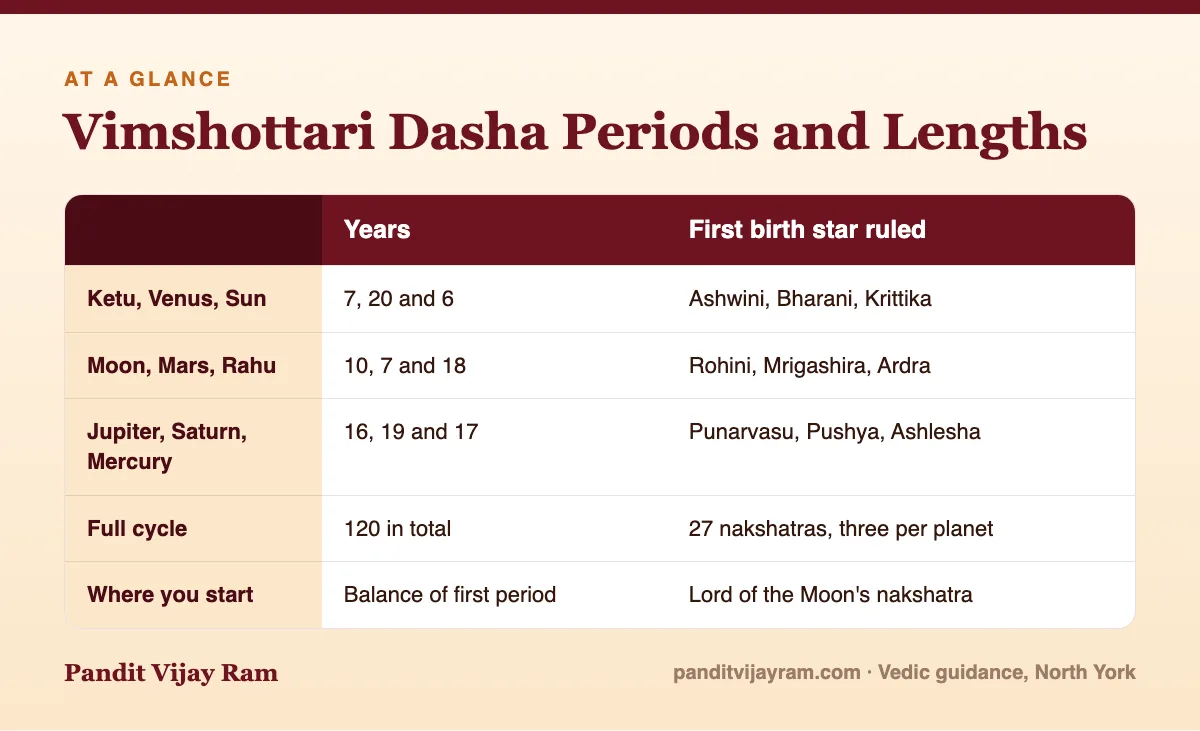
The fixed order is Ketu 7 years, Venus 20, Sun 6, Moon 10, Mars 7, Rahu 18, Jupiter 16, Saturn 19 and Mercury 17, adding up to 120. After Mercury the cycle returns to Ketu. Venus has the longest period and the Sun the shortest. You start somewhere in this sequence and move forward through it.
The sequence follows the lords of the twenty-seven nakshatras. Starting from Ashwini, the first birth star, the lords run Ketu, Venus, Sun, Moon, Mars, Rahu, Jupiter, Saturn and Mercury, and then repeat twice more. That gives each planet three nakshatras spaced evenly around the zodiac.
- Ketu, 7 years: Ashwini, Magha, Mula.
- Venus, 20 years: Bharani, Purva Phalguni, Purva Ashadha.
- Sun, 6 years: Krittika, Uttara Phalguni, Uttara Ashadha.
- Moon, 10 years: Rohini, Hasta, Shravana.
- Mars, 7 years: Mrigashira, Chitra, Dhanishta.
- Rahu, 18 years: Ardra, Swati, Shatabhisha.
- Jupiter, 16 years: Punarvasu, Vishakha, Purva Bhadrapada.
- Saturn, 19 years: Pushya, Anuradha, Uttara Bhadrapada.
- Mercury, 17 years: Ashlesha, Jyeshtha, Revati.
Why these particular lengths? The texts state them without a full explanation, and later writers have offered various theories. It is more honest to say the numbers are traditional than to claim a proven astronomical basis.
Each period has its own feel in the classical descriptions. Saturn's long stretch is associated with work, responsibility and patience, which our article on Saturn mahadasha covers. Venus brings relationships and comfort to the fore. Rahu and Ketu, the lunar nodes, are often misread as frightening, as discussed in our guide to Rahu and Ketu periods.
How is the starting dasha calculated from the birth nakshatra?
Find the nakshatra holding your natal Moon; its lord rules your first mahadasha. Then measure how much of that nakshatra the Moon still had to cross. That remaining fraction, multiplied by the lord's full years, gives the balance of dasha at birth. The periods that follow run in the fixed order at full length.
Each nakshatra spans thirteen degrees and twenty minutes of the zodiac. The arithmetic is simple once you see it in one worked example.
Example: Moon at 15 degrees Taurus.
- Identify the star. Rohini runs from 10 degrees to 23 degrees 20 minutes of Taurus, so the Moon is in Rohini. Its lord is the Moon, so the first mahadasha is the Moon's.
- Measure what is used up. The Moon has travelled 5 degrees into Rohini's 13 degrees 20 minutes, which is three-eighths of it.
- Find the balance. Five-eighths remain. Five-eighths of the Moon's 10 years is 6 years and 3 months.
- Continue the sequence. After that balance come Mars for 7 years, Rahu for 18, Jupiter for 16, and so on in order.
Software does this instantly, but understanding the steps lets you check a printout. A few technical choices can shift the dates slightly:
- Ayanamsa: a different sidereal correction moves the Moon by a fraction of a degree.
- Year length: some programs use a 365.25-day year, while others use a 360-day traditional year. Over a long period the difference adds up to months.
- Birth time: the Moon moves roughly half a degree an hour, which changes the balance.
Because the Moon's star drives the calculation, the guide to nakshatras is useful companion reading.
How do you read a mahadasha in your own chart?
A mahadasha is read through the planet's role in your chart: the houses it rules from the lagna, the house it occupies, its sign strength, its associations and aspects, and the lord of the nakshatra it sits in. Its natural significations add colour. The same planet's period can therefore mean very different things for different people.
A simple reading order, which an astrologer will refine with experience:
- Houses ruled. Count from your lagna. For a Cancer ascendant, Mars rules the fifth and tenth and is a strong helper. For a Gemini ascendant, Mars rules the sixth and eleventh, which brings effort, competition and gains.
- House occupied. A dasha lord in a kendra or trikona usually acts more openly and helpfully than one in the sixth, eighth or twelfth.
- Dignity. Own sign, exaltation or a friendly sign supports the period. Debilitation can be eased by cancellation rules.
- Company and aspects. Planets joining or aspecting the dasha lord shape how it delivers.
- Nakshatra lord. Many astrologers say a planet gives results of the star lord it sits in, adding another layer.
- Natural meaning. Jupiter brings learning and children into focus, Venus relationships, Saturn duty and endurance.
Then the sub-periods come in. The first antardasha in any mahadasha belongs to the mahadasha lord itself, and the rest follow the same fixed order. How those combinations work is the subject of our article on antardasha sub-periods.
Transits matter too. Most astrologers say a transit delivers its results mainly when it involves the current dasha planets. The months around a change of mahadasha, called dasha sandhi, are often described as transitional and unsettled.
How accurate is Vimshottari dasha, and what are its limits?
There is no scientific evidence that dashas predict events, and astrologers themselves disagree on calculation details. What the system offers is a structured way to reflect on life seasons. Its usefulness depends on an accurate birth time and careful reading. It should never be used to forecast illness, death or a guaranteed fortune.
Here are the practical limits I explain to every client.
- Birth time sensitivity. A one-hour error moves the Moon about half a degree. In a Venus nakshatra that can shift every later date by close to ten months.
- School differences. Ayanamsa, year length and nakshatra boundaries vary between programs and traditions, so two printouts may disagree by weeks or months.
- Tendencies, not events. A Mercury period may emphasise study, trade or communication. It does not tell you which job you will get.
- Other dasha systems exist. Some astrologers cross-check with Yogini or Jaimini chara dasha, and results can differ.
- Fear is not a method. Beware anyone who says a coming period will ruin you unless you pay for a ritual now.
A healthier way to use the dasha is as a calendar of attention. During a Saturn period you might ask what responsibilities need patient work. During a Jupiter period you might ask what you want to learn. That is reflection, not fortune-telling.
Health, legal and financial questions still need your family doctor, a lawyer or a licensed adviser. If you want your current mahadasha and the next one explained clearly against your own chart, Vijay Ram ji's kundli and horoscope service includes a plain-language dasha table. For prayer-based support during a difficult stretch, see the guide to graha shanti.
The bottom line
Vimshottari dasha is a 120-year cycle of nine planetary periods in a fixed order, from Ketu's 7 years to Mercury's 17. Your starting period and its balance come from the Moon's position within its birth nakshatra. Each mahadasha is read through the houses its planet rules and occupies in your own chart, so the same period differs from person to person. Used with an accurate birth time, it describes life seasons for reflection, not fixed predictions.
Key takeaways
- Vimshottari dasha totals 120 years across nine planets.
- Venus has the longest period at 20 years; the Sun the shortest at 6.
- The Moon's nakshatra sets your first period and its balance.
- A period is read through the planet's houses and strength in your chart.
- Calculation details vary, and dashas show tendencies, not events.