
Saturn Mahadasha: What Nineteen Years of Shani Can Bring

Few phrases cause as much worry in an astrology consultation as Shani ki mahadasha. People arrive having been told that nineteen years of hardship lie ahead, and some have already been quoted an expensive ritual. Saturn mahadasha does ask for effort, but its effects depend heavily on the chart. For some ascendants Saturn is the most helpful planet in the horoscope. Families in North York often bring me a parent's or child's chart with this exact fear attached. This article explains what Shani represents, how his period reads for each rising sign, how placement changes the picture, and why a mahadasha is not the same thing as Sade Sati. It closes with steady, inexpensive remedies drawn from tradition. In more than forty years of practice, I have seen Saturn periods build careers, homes and character. I have also seen them be hard. In both cases, the people who did best kept to a routine and refused to be frightened.
What is Saturn mahadasha in Vedic astrology?
Saturn mahadasha is the period ruled by Shani, lasting nineteen years, the second longest after Venus. Saturn signifies discipline, labour, service, endurance, elders, structure and the passage of time. During his period these themes come forward, often bringing more responsibility. Results tend to arrive slowly but last, especially for people willing to work steadily.
In the Vimshottari sequence, Saturn's period follows Jupiter's and comes before Mercury's. Many people meet it once in a lifetime, and some never reach it at all, depending on where in the cycle they were born.
Classical associations of Shani include:
- Work and service: labour, routine, employment, people who work with their hands.
- Time and endurance: delay, patience, maturity and things that take years to build.
- Structure: rules, institutions, land, construction and long commitments.
- Longevity: Saturn is the traditional ayushkaraka, the significator of lifespan.
- Detachment: simplicity, solitude and a sober view of life.
These are significations, not events. A Saturn period might highlight responsibility in the form of a demanding job, caring for an elderly parent, paying down a mortgage or completing a long training. None of these is a curse. Each is the kind of slow work Saturn is said to reward.
Saturn is exalted in Libra and debilitated in Aries. It owns Capricorn and Aquarius, with Aquarius as its moolatrikona sign. A Saturn in its own or exalted sign in a kendra forms Shasha yoga, one of the five classical yogas of great people, a placement often linked to organisational ability.
For how any major period is calculated and placed, see the overview of the Vimshottari dasha.

Is Shani mahadasha good or bad?
It is neither by default. For Taurus and Libra ascendants Saturn is a yogakaraka, ruling both a kendra and a trikona, and its period is often among the most productive of life. For Capricorn and Aquarius it is the lagna lord. For ascendants where it rules difficult houses, the period usually asks for more effort and care.
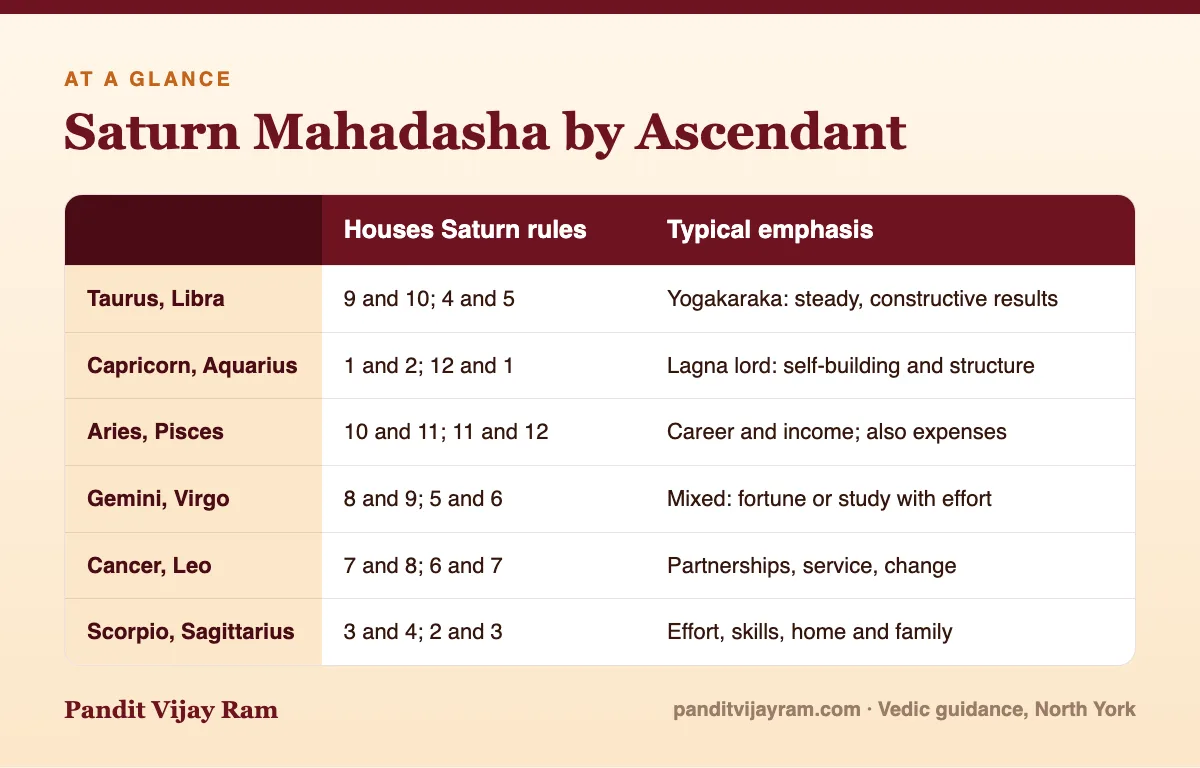
The most useful first step is to see which houses Saturn rules from your rising sign. This list covers all twelve:
- Aries: 10th and 11th, career and gains.
- Taurus: 9th and 10th, yogakaraka; fortune joined to work.
- Gemini: 8th and 9th, change together with fortune and faith.
- Cancer: 7th and 8th, partnerships and transformation.
- Leo: 6th and 7th, competition, service and partners.
- Virgo: 5th and 6th, study and children together with daily work.
- Libra: 4th and 5th, yogakaraka; home, property and intellect.
- Scorpio: 3rd and 4th, effort, skills and home.
- Sagittarius: 2nd and 3rd, family resources and initiative.
- Capricorn: 1st and 2nd, the self and savings.
- Aquarius: 12th and 1st, the self together with expenses and distance.
- Pisces: 11th and 12th, income and outgoings.
A practical decision rule: if Saturn rules a kendra and a trikona, or the lagna, start from the expectation of a constructive period. If it rules the sixth, eighth or twelfth, expect more effort, but look at its sign and placement before drawing conclusions. Difficult house rulership is common and is softened by many other factors.
The word bad also hides a lot. A period that demands hard work, as for many Cancer and Leo ascendants, can still leave people better established than before. The guide on exalted and debilitated planets explains how sign strength changes these readings.
How does Saturn's placement change its mahadasha?
Beyond rulership, Saturn's house, sign, company and aspects shape its period. Saturn is traditionally strong in the third, sixth and eleventh houses, where its persistence pays off, and dignified in Libra, Capricorn and Aquarius. In the eighth or twelfth, or debilitated in Aries without cancellation, its period tends to involve more inner work, endurance and change.
Here is how astrologers commonly sketch Saturn's period by house, always to be checked against sign, aspects and the rest of the chart:
- In a kendra, houses 1, 4, 7 or 10: prominent and demanding. In the tenth, a period of serious career building is a classic description.
- In a trikona, houses 5 or 9: discipline applied to study, belief or parenting; sometimes delays that turn into depth.
- In the upachayas, houses 3, 6 or 11: often favourable. Effort brings results, rivals are outlasted, income grows gradually.
- In the second: careful money habits and sober speech; family responsibilities.
- In the eighth: research, endurance, inheritance or insurance matters; inner transformation.
- In the twelfth: expenses, distance, retreat, sometimes work abroad or in institutions.
Other factors to weigh:
- Aspects. Saturn casts special aspects on the third and tenth houses from itself, as well as the usual seventh. Those houses also feel its period.
- Company. Saturn with Jupiter is often read as balanced discipline; with Mars, as strain that needs patience.
- Nakshatra. The star lord Saturn sits in colours how it delivers.
The antardashas inside the period then add their own texture. Our article on antardasha sub-periods lists all nine within Saturn and their approximate lengths.
Is Saturn mahadasha the same as Sade Sati?
No. Saturn mahadasha is a nineteen-year dasha period fixed at birth by the Moon's nakshatra. Sade Sati is a transit, roughly seven and a half years when Saturn passes through the signs before, on and after your Moon sign. They can overlap, but they are calculated differently and many people meet one without the other.
The two are often confused because both involve Shani and both have a fearsome reputation online.
- Source. A mahadasha comes from your birth chart's dasha table. Sade Sati comes from where Saturn is moving in the sky now, relative to your natal Moon.
- Length. A mahadasha lasts nineteen years. Sade Sati lasts about seven and a half, because Saturn spends roughly two and a half years in each of three signs.
- Who has it. Everyone meets Sade Sati about every three decades. Not everyone lives through a Saturn mahadasha; it depends on where their cycle began.
- How it is read. A mahadasha is judged by Saturn's natal houses, sign and strength. Sade Sati is judged largely by the transit's relationship to the Moon, modified by the natal chart.
When both run together, astrologers usually read the combination as a time of heightened responsibility. Even then, a well-placed natal Saturn tends to steady the experience.
To check whether you are in Sade Sati, you need the current position of Saturn from a current ephemeris or a Toronto panchang, compared with your Moon sign. The phases and their common misreadings are covered in our separate guide to Sade Sati and why it is mistaken for a curse.
What are the remedies for Shani mahadasha?
Traditional remedies are steady and modest: a daily Shani mantra, Hanuman Chalisa on Saturdays, charity such as black sesame, oil or warm clothing, and service to elders and workers. Practical discipline matters just as much, from regular sleep to honest budgeting. A blue sapphire is recommended only when the chart supports it, after careful trial.
Saturn is said to respond to patience, honesty and service more than to spending. A balanced routine might include:
- A short daily mantra. Om Sham Shanaishcharaya Namah, recited slowly, often in counts of 108 with a mala, ideally at the same time each day.
- Saturday devotion. Hanuman Chalisa or a visit to a temple. Traditional stories link Hanuman with protection from Shani's harshness. The Hanuman puja and havan page describes a fuller observance.
- Charity. Black sesame, mustard oil, blankets or warm food given to people who need them. Our guide to the mustard oil Shani ritual explains chaya daan and related customs.
- Service. Helping elderly neighbours, labourers or people with disabilities is considered the most fitting offering to Saturn.
- Practical structure. A realistic budget, a regular sleep schedule, steady work habits and keeping promises. These are Saturn's own values.
On gemstones: blue sapphire, neelam, is Saturn's stone and is suggested only when Saturn is a functional benefic for your lagna. Traditionally it is tried for a short period first. Our article on blue sapphire covers suitability and fraud cautions.
If a heavy period is affecting sleep, mood or health, see your family doctor first; remedies are spiritual support alongside that care. In a crisis, call or text 988 in Canada.
The bottom line
Saturn mahadasha is a nineteen-year period of work, responsibility and slow results, and its tone depends on the houses Saturn rules from your lagna. For Taurus and Libra ascendants it is a yogakaraka period, and for Capricorn and Aquarius Saturn is the chart's own lord. It is calculated from your birth chart and is not the same as the Sade Sati transit. Steady remedies, service and practical discipline suit Shani best.
Key takeaways
- Saturn mahadasha lasts nineteen years, second only to Venus.
- Saturn is a yogakaraka for Taurus and Libra ascendants.
- Saturn in houses 3, 6 or 11 is traditionally productive.
- A dasha comes from the birth chart; Sade Sati is a transit.
- Service, routine and a daily mantra are the classic remedies.