
Nakshatras Explained: The 27 Lunar Mansions and Your Birth Star
Ask an elder in many South Asian families what your star is and they will answer with a nakshatra, not a zodiac sign. Rohini, Swati, Mula: these names carry more personal meaning for many people than Taurus or Libra ever will. Yet most people raised outside India were never told what a nakshatra actually is. Here are the nakshatras explained in plain language, for families in North York and the wider diaspora. You will learn how the 27 mansions divide the sky, what the four padas are, how each star's ruling planet sets the order of your planetary periods, why nakshatras guide baby names, and how they are grouped for matching. A comparison chart near the end sums up the main groupings. In more than forty years of practice I have found that once someone understands their birth star, the rest of the kundli suddenly makes more sense. It is the thread that ties the chart together.
What is a nakshatra in astrology?
A nakshatra is a segment of the sky the Moon passes through in about a day. Vedic astronomy divides the 360-degree zodiac into 27 equal nakshatras of 13 degrees 20 minutes each, named after star groups along the Moon's path. Older texts also mention a 28th, Abhijit, still used in some muhurat calculations.
The Moon completes a sidereal circuit of the zodiac in a little over 27 days. Ancient observers noticed that it lodged near a different star group each night, and named those lodgings the nakshatras, often translated as lunar mansions. Many other cultures developed similar systems, which is why the general idea appears in Chinese and Arabic astronomy too.
Each nakshatra has a name, a presiding deity, a symbol and a ruling planet. A few examples show the flavour:
- Ashwini, the first, is ruled by Ketu, presided over by the twin healers, the Ashvins, and symbolised by a horse's head.
- Rohini, ruled by the Moon, is linked to growth and beauty, with a chariot or ox cart as its symbol.
- Pushya, ruled by Saturn, is associated with nourishment and is popular for auspicious beginnings.
- Revati, the last, is ruled by Mercury and linked to safe journeys.
Nakshatras run in sequence starting from zero degrees of sidereal Aries. Because 27 multiplied by 13°20' equals 360°, they fit the zodiac exactly, overlapping the twelve signs in a fixed pattern: every sign contains two and a quarter nakshatras.
Nakshatras are one layer of the chart, alongside signs and houses. For the house layer, see our tour of the twelve houses of a kundli.

What are the 27 nakshatras and their ruling planets?
The nakshatra lords follow a repeating sequence of nine planets: Ketu, Venus, Sun, Moon, Mars, Rahu, Jupiter, Saturn and Mercury. Starting from Ashwini, the cycle runs three times to cover all 27. So Ashwini, Magha and Mula are ruled by Ketu, while Ashlesha, Jyeshtha and Revati are ruled by Mercury.
Here is the full list, grouped by the ruling planet. Each row gives the three stars that share a lord.
- Ketu: Ashwini, Magha, Mula.
- Venus: Bharani, Purva Phalguni, Purva Ashadha.
- Sun: Krittika, Uttara Phalguni, Uttara Ashadha.
- Moon: Rohini, Hasta, Shravana.
- Mars: Mrigashira, Chitra, Dhanishta.
- Rahu: Ardra, Swati, Shatabhisha.
- Jupiter: Punarvasu, Vishakha, Purva Bhadrapada.
- Saturn: Pushya, Anuradha, Uttara Bhadrapada.
- Mercury: Ashlesha, Jyeshtha, Revati.
The lord shapes how a planet placed in that nakshatra behaves. A planet in Swati, for instance, is said to carry some of Rahu's restless, independent quality, whatever sign it sits in. This is why two people with the same Moon sign can feel quite different: one has the Moon in Krittika's Taurus portion, ruled by the Sun, the other in Rohini, ruled by the Moon itself.
Spellings vary across regions. Mrigashira may appear as Mrigasira, Dhanishta as Shravishtha, Shatabhisha as Satabhishak. Tamil and Telugu calendars use their own forms, such as Thiruvonam for Shravana. They are the same stars. If you want to find your own, the free astrology calculators can show the Moon's nakshatra from your birth details.
What is a nakshatra pada?
Each nakshatra is split into four quarters called padas, each 3 degrees 20 minutes wide, making 108 padas in the zodiac. Every pada corresponds to one navamsa sign, so padas link the birth chart to the D9 chart. Each pada also carries a traditional sound used to choose a first syllable for a baby's name.
Padas add a finer level of detail. Twenty-seven stars times four quarters gives 108, a number that also appears in the beads of a mala. Each pada maps onto one sign in the navamsa, the ninth divisional chart. The first pada of Ashwini is Aries navamsa, the second Taurus, and so on through the zodiac nine times. Our post on the navamsa chart explains why that matters for marriage and dharma.
Naming by pada. Many Hindu families use the pada of the Moon at birth to pick a first syllable for a child's name. Ashwini's four padas, for example, are traditionally given the sounds Chu, Che, Cho and La. A baby born with the Moon in the fourth pada of Ashwini might be given a name starting with La.
This custom is optional and regional. Some families follow it strictly, some use it for a private 'rashi name' kept alongside an everyday name, and many skip it. A name chosen for love and family meaning is not wrong because it does not match a pada.
Birth-time sensitivity. The Moon moves through a pada in about six hours. A birth time off by an hour rarely changes the nakshatra, but it can change the pada, which in turn changes navamsa placements and the exact dasha balance at birth.
How does your birth nakshatra decide your dasha?
The Vimshottari dasha begins with the period of your birth nakshatra's ruling planet. If the Moon was in a Saturn-ruled star, life begins in Saturn's dasha. How far the Moon had travelled through that nakshatra decides how much of the first period was already used up at birth, called the dasha balance.
This is where nakshatras become practical. The Vimshottari system gives each of the nine planets a fixed period, and they follow the same order as the nakshatra lords: Ketu, Venus, Sun, Moon, Mars, Rahu, Jupiter, Saturn, Mercury. The total is 120 years.
A worked example makes it clear. Suppose the Moon was at 6°40' of Taurus at birth. That point lies in Krittika, which runs from 26°40' Aries to 10°00' Taurus and is ruled by the Sun. The Moon has covered 10 of Krittika's 13°20', or three quarters. The Sun's period is six years, so three quarters of it, four and a half years, is treated as already passed. The child begins life with a year and a half of Sun dasha left, followed by the full ten-year Moon dasha.
That arithmetic is why small changes in the Moon's degree matter. An error of a degree shifts the whole sequence of periods by months. Our guide to the Vimshottari dasha covers the period lengths in full.
Nakshatras also feature in other timing work: the daily nakshatra is part of every panchang, and a muhurat is often chosen to avoid certain stars. A kundli consultation brings these strands together for one person.
How are nakshatras grouped for matching and character?
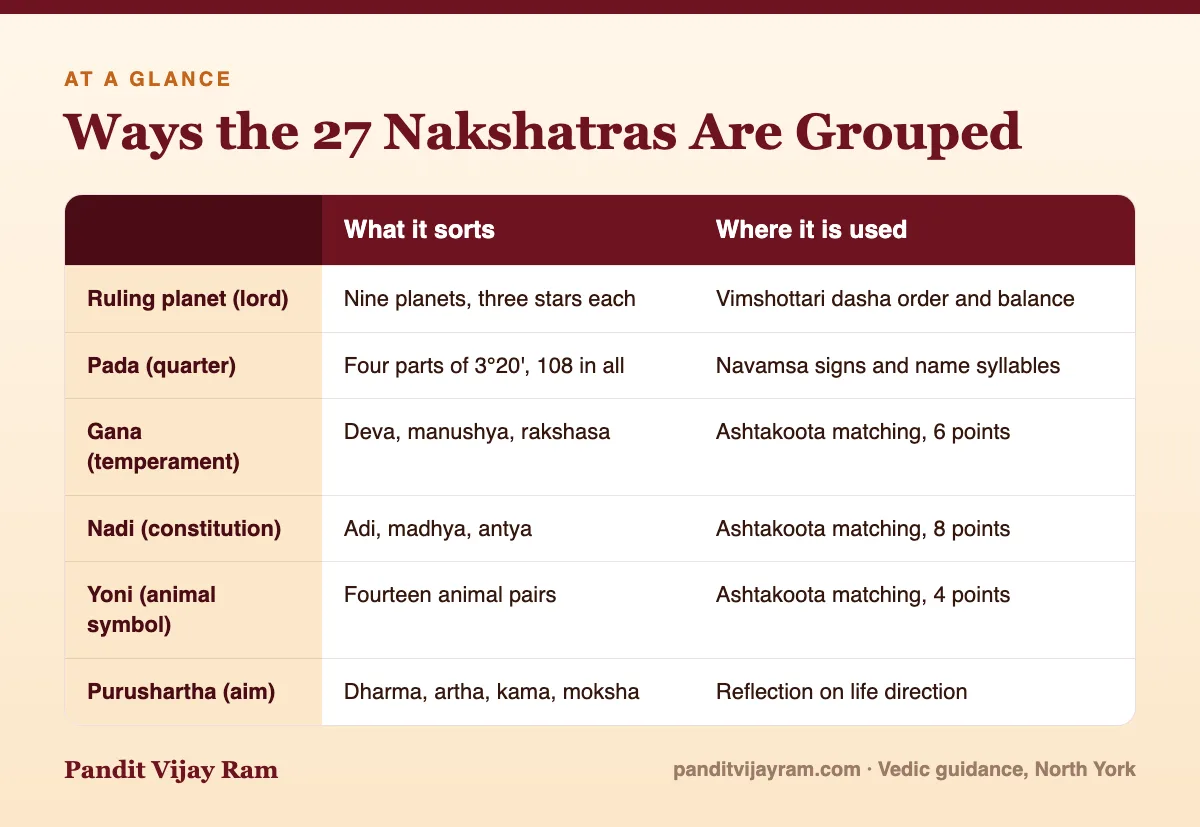
Nakshatras are grouped in several overlapping ways. Gana sorts them into divine, human and fierce temperaments. Nadi sorts them into three constitutional types used in kundli matching. Yoni pairs them with animal symbols, and purushartha links each to one of life's four aims. Each grouping answers a different question, and none is a verdict.
These groupings matter most in Ashtakoota matching, the 36-point system many families use before marriage. Gana, nadi and yoni are three of its eight factors.
- Gana (temperament): nine stars each fall into deva, manushya and rakshasa. Rakshasa does not mean 'demonic person'; it describes an intense, independent temperament.
- Nadi (constitution): adi, madhya and antya, nine stars each. Same-nadi couples score zero on this factor, which is covered in our post on nadi dosha and its cancellations.
- Yoni (instinct): fourteen animal symbols, such as horse, elephant and serpent, used to gauge physical and emotional compatibility.
- Purushartha (aim): dharma, artha, kama or moksha.
- Nature: classical muhurat texts also sort stars as fixed, movable, sharp, gentle and so on, to pick days for particular tasks.
A word of caution. Nakshatra character descriptions online are often written as if they were personality tests. In practice, the birth star is one ingredient. The sign, house, aspects and strength of the Moon, plus the lagna and its lord, all shape temperament. Use the descriptions as prompts for reflection, not as labels for yourself or a future spouse.
The bottom line
Nakshatras explained in one line: they are 27 equal lunar mansions, each with a ruling planet, deity and four padas. Your birth star sets where your Vimshottari dasha begins and how much of the first period remained at birth. Groupings such as gana, nadi and yoni are useful in matching, but the nakshatra is one thread of the chart, not a label for who you are.
Key takeaways
- The zodiac holds 27 nakshatras of 13°20', each split into four padas of 3°20'.
- Nakshatra lords repeat in the order Ketu, Venus, Sun, Moon, Mars, Rahu, Jupiter, Saturn, Mercury.
- Your birth star's lord rules the first dasha, and the Moon's degree sets the balance left.
- Each pada links to a navamsa sign and a traditional naming syllable.
- Gana, nadi and yoni groupings are used in matching but are never verdicts on character.