
Clearing a Run of Bad Luck: Graha Shanti and Practical Steps

People who ask how to remove bad luck spiritually usually reach me after a hard stretch: a job lost, then a car repair, then a visa delay, then an argument with a sibling, all within months. From North York to Mississauga, the story is often the same. Each setback alone would be manageable, but together they feel like a pattern, and the mind starts to wonder whether something larger is at work. This article offers a balanced path. It starts with a practical audit, because many runs of bad luck have causes you can fix this week. It then explains how a Vedic astrologer reads timing through the dasha system and slow transits such as Sade Sati, and how graha shanti, the pacification of a planet, is chosen and performed. It closes with honest limits. In more than forty years of practice I have learned that remedies work best for people who are also making careful decisions. A planet can describe a difficult season, but you still steer through it. Nothing here is about objects in the home; that is a separate question with its own guide.
Is a run of bad luck spiritual or just coincidence?
Often it is a mix of coincidence, stress and connected causes, where one problem triggers the next. Before looking for a spiritual reason, list each setback and ask what caused it. If most have clear practical roots, start there. If they cluster in one area of life without clear cause, a chart check is reasonable.
Human minds are pattern finders. After two or three bad events, we notice every small irritation and connect it to the story. That does not make the difficulty imaginary. It means we need a clear look before deciding what kind of help fits.
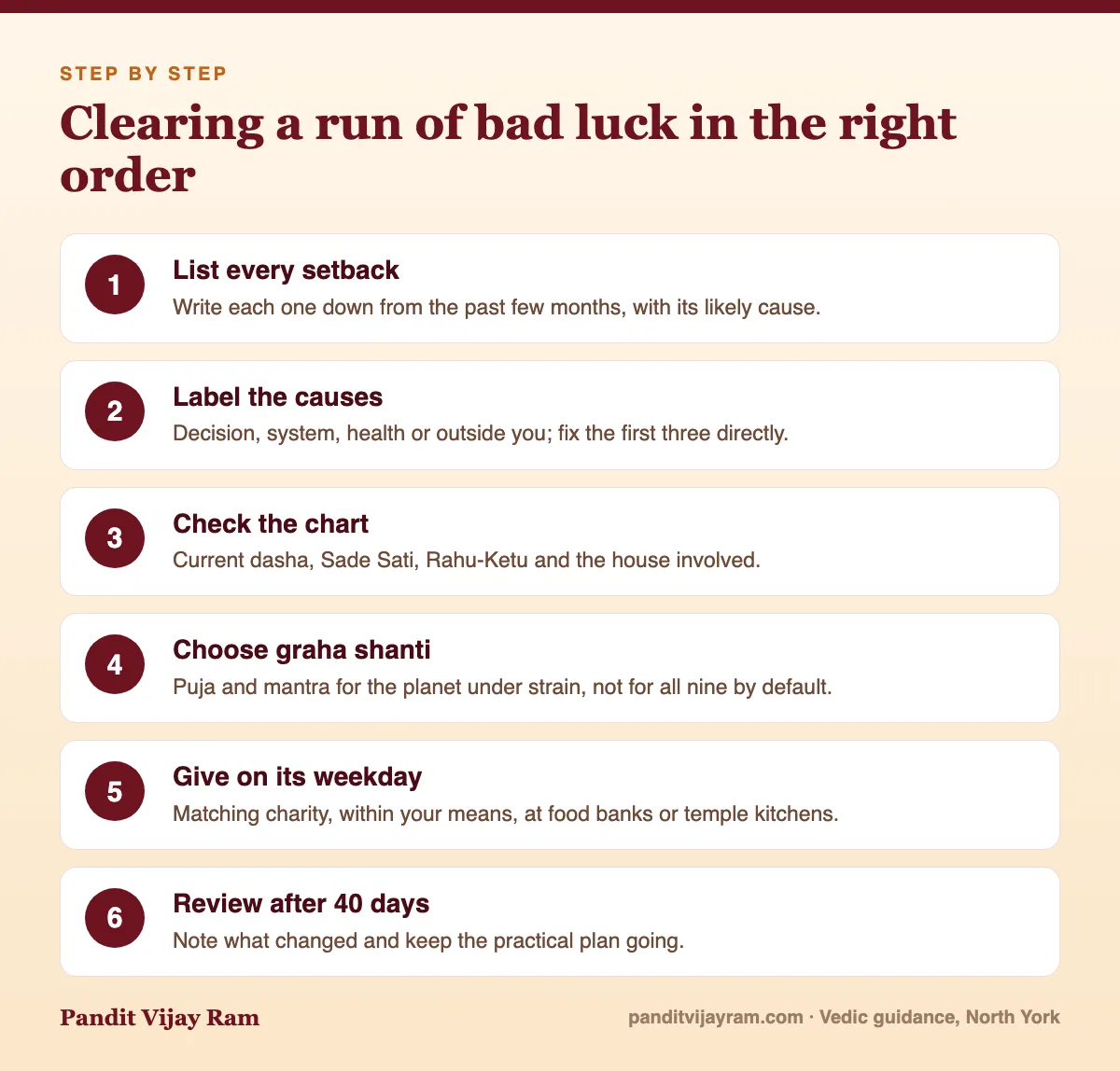
Use this audit. Take a sheet of paper and list each setback from the past few months. Beside each, write one of four labels:
- Decision. It followed a choice made in a hurry, under pressure or without advice.
- System. A deadline, paperwork error, unpaid bill or maintenance task that slipped.
- Health or energy. Poor sleep, illness or exhaustion made a mistake more likely.
- Outside you. Weather, a layoff across the company, a stranger's action, a policy change.
Now look at the pattern. If most items are decisions and systems, the most effective remedy is rest, a calendar and a trusted person to consult before big choices. If health keeps appearing, see your family doctor. If the outside column dominates and the events cluster around one theme, such as career, money or relationships, a reading becomes more useful.
Honest audits also reveal knock-on effects. A job loss creates money stress, which disturbs sleep, which leads to an argument. Fixing the first link often settles the rest.

Which planets cause bad luck in Vedic astrology?
No planet is simply unlucky, but Saturn, Rahu and Ketu are most often linked with delays, confusion and sudden change, and a weak or afflicted Sun, Moon or Mars can add strain. What matters is which planet's period you are running, where it sits in your chart and how slow transits are moving over sensitive points.
Vedic astrology reads time through the Vimshottari dasha system. Each person moves through planetary periods, each with sub-periods called antardashas. A planet that is well placed in your chart tends to give steady results in its period. One that is weak or afflicted can bring friction in the areas it rules.
A practitioner checks a few things:
- The current mahadasha and antardasha. Which planets are active, and which houses do they rule and occupy?
- Sade Sati. Saturn's transit through the sign before, the sign of and the sign after your natal Moon, roughly seven and a half years. It is known for pressure and responsibility, though not every Sade Sati is hard.
- Rahu and Ketu transits. They move backwards through the zodiac and can unsettle the houses they pass through.
- Ashtama Shani. Saturn transiting the eighth from the Moon, traditionally a demanding stretch.
- The house involved. Tenth for career, second and eleventh for money, seventh for partnership, sixth for disputes and health.
When the timing of your setbacks lines up with one of these, the chart offers a reason and a focus for remedies. When it does not, I say so, and we look elsewhere. Some people find it helpful to look first at the free astrology tools and calculators, then bring the results to a full kundli reading.
What is graha shanti puja and how is it done?
Graha shanti is a ritual to pacify a planet under strain in your chart. It usually includes a Ganesh invocation, a sankalp naming you and the purpose, worship of the planet with its colour, grain and flowers, recitation of its mantra a set number of times, a havan with offerings, and charity linked to that planet.
There are two common forms. A single-graha shanti focuses on one planet, such as Shani shanti during a tough Saturn period. A Navagraha shanti honours all nine planets together, often chosen at major life transitions or when several factors are mixed.
A typical sequence:
- Ganesh puja to remove obstacles from the ritual itself.
- A sankalp stating your name, gotra, birth star and the intention for peace with the planet.
- Kalash sthapana and invocation of the planet on its yantra or an image, with the matching colour of cloth and grain.
- Japa of the planet's beej mantra. Traditional counts differ by planet; Shani's, for example, is assigned twenty-three thousand repetitions, usually spread over days or shared among priests.
- A havan in which a tenth of the japa count is offered with ghee and the planet's samidha, the specific wood associated with it.
- Purnahuti, the final offering, followed by aarti.
- Daan, charity, on the planet's weekday.
Families can also do a smaller version at home: the planet's mantra on its weekday for forty days, a lamp, and steady charity. For Saturn in particular, the guide to the mustard oil Saturday ritual describes the chaya daan and peepal lamp practices in detail.
What charity is given for each planet as a bad luck remedy?
Each planet has a weekday and traditional gifts. Sun: wheat and jaggery on Sunday. Moon: rice and milk on Monday. Mars: red lentils on Tuesday. Mercury: green moong on Wednesday. Jupiter: chana dal and turmeric on Thursday. Venus: white rice or sugar on Friday. Saturn: black sesame and mustard oil on Saturday.
Charity, daan, is one of the gentlest planetary remedies and one of the easiest to keep up. The table-like list below follows common North Indian practice; families from other regions may use different items.
- Sun, Sunday: wheat, jaggery, copper vessels; respect for father and elders.
- Moon, Monday: rice, milk, white cloth; care for mother and calm water near the home.
- Mars, Tuesday: red lentils, red cloth; service to soldiers, first responders or siblings.
- Mercury, Wednesday: green moong, green vegetables, books for children.
- Jupiter, Thursday: chana dal, turmeric, yellow cloth; support for teachers and students.
- Venus, Friday: white rice, sugar, curd; help for women in need.
- Saturn, Saturday: black sesame, mustard oil, black urad, blankets; help for labourers, the elderly and the disabled.
- Rahu: black or blue items, often on Saturday; support for marginalised people.
- Ketu: a multi-coloured blanket; feeding dogs, or a donation to an animal shelter.
In the GTA, food banks, gurdwara langars, temple kitchens and shelters are natural places to give. Give within your means. Charity that strains your rent defeats its own purpose. If repeated setbacks are mainly in your work or shop, the business and career service pairs these remedies with a practical review of the business itself.
What are the honest limits of bad luck remedies?
Remedies can steady the mind, encourage discipline and, in the tradition's view, soften a difficult period. They cannot cancel a layoff, overturn a legal judgment or repay a debt by themselves. Anyone who promises a fixed result or date is overstating what Vedic astrology claims. Planning and practical help still matter most.
Vedic texts describe remedies as ways of meeting karma with awareness, not as levers that switch fate off. A Saturn period that asks for patience will still ask for patience. What remedies do, at their best, is help you respond with steadiness rather than panic.
Signs that a remedy plan is sound:
- It begins with the practical audit and respects what it found.
- It names one or two planets clearly, with reasons from the chart.
- It sets a time frame, often forty days, and a point to review.
- It includes things you do yourself, not only paid rituals.
- It costs what you can afford.
Signs to be cautious:
- Every planet is said to be against you.
- You are told the bad luck is someone's black magic without any check.
- Fees rise each time nothing changes.
- You are told to stop seeing a doctor, lawyer or financial advisor.
If setbacks are affecting your mood, sleep or sense of hope, please see your family doctor. Financial stress in particular is a serious strain, and non-profit credit counselling agencies in Ontario can help you plan. When people suspect the run of bad luck is caused by evil eye or black magic, the comparison of kala jadu, nazar and graha dosh explains how a reading separates the three. Other steadying routines are in the cleansing and protection hub.
The bottom line
To remove bad luck spiritually, begin with a practical audit, then let the chart show whether a planetary period explains the timing. Graha shanti, steady mantra and weekday charity are the traditional remedies when it does. Keep the plan small, time-bound and within your means. Remedies support careful decisions and professional help; they do not replace them.
Key takeaways
- Audit setbacks for decisions, systems and health before blaming planets.
- Dasha periods, Sade Sati and Rahu-Ketu transits explain many difficult seasons.
- Graha shanti combines sankalp, mantra japa, havan and charity.
- Each planet has a weekday and traditional gifts for daan.
- No honest astrologer promises a fixed result or date.