
How to Read Your Kundli: The 12 Houses in Plain English

A printed janam kundli can look like a puzzle: a square full of triangles, numbers and planet abbreviations, handed over at a naming ceremony and then filed away. Many people want to know how to read kundli charts themselves, at least well enough to follow what an astrologer says. Families in North York often bring me a chart from a temple printout or an app and ask where to begin. The honest answer is the houses. Each of the twelve bhavas describes an area of life, and almost everything else in Vedic astrology is read through them. This guide walks through all twelve in plain English, shows how astrologers group them, and gives a simple order for reading any single house. In more than forty years of reading charts, I have found that people who understand the houses ask better questions and worry less. They stop seeing a planet as good or bad in itself and start asking what part of life it touches.
What are the 12 houses in a kundli?
The twelve houses, or bhavas, are divisions of the birth chart, each linked to particular areas of life. In the Parashari system most astrologers use whole signs: the rising sign becomes the first house, the next sign the second, and so on around the zodiac. Planets falling in a house colour the matters that house describes.
A kundli is a map of the sky at the moment and place of birth. The zodiac is split into twelve signs, and the houses count those signs starting from the lagna, the sign rising on the eastern horizon. If Leo was rising, Leo is your first house, Virgo your second, Libra your third, all the way to Cancer as the twelfth.
You will usually meet one of two chart styles:
- North Indian chart: a diamond layout where the houses stay fixed. The top centre diamond is always the first house, and the numbers written inside show which sign falls there.
- South Indian chart: a square where the signs stay fixed, with Pisces in the top left box. The lagna is marked with a diagonal line or the letters Asc or La.
Both show the same information; only the drawing differs. If your printout looks unfamiliar, find the first house first and count anticlockwise in the North Indian style, or clockwise from the marked lagna in the South Indian style.
Some software also prints a bhava chalit chart, which uses house cusps measured in degrees. A planet near the edge of a sign can shift house in that view. Astrologers differ on how much weight to give it, which is one reason two readings of the same chart can sound slightly different. To understand why the rising sign is the anchor for all twelve houses, read our guide to the lagna in Vedic astrology.

What does each house mean in a birth chart?
Each bhava has a core theme. The first is the self and body, the second wealth and speech, the third courage and siblings, the fourth home and mother, the fifth children and intellect, the sixth health and obstacles. The seventh to twelfth cover partners, change, fortune, career, gains and release.
Here is a one-line meaning for each house, using the Sanskrit name you may see on a printout. Classical texts give long lists for every bhava; these are the themes most readers start with.
- Tanu, first house: your body, temperament, vitality and general direction in life.
- Dhana, second: family of origin, savings, speech, food habits and early schooling.
- Sahaja, third: younger siblings, courage, effort, writing, short trips and skills of the hands.
- Sukha, fourth: mother, home, land, vehicles and inner contentment.
- Putra, fifth: children, intelligence, creativity, devotion and merit from past actions.
- Ari, sixth: illness, debts, competitors, daily work and the ability to overcome trouble.
- Kalatra, seventh: spouse, business partners, contracts and public dealings.
- Randhra, eighth: longevity, sudden change, inheritance, research and hidden matters.
- Dharma, ninth: father and teachers in many traditions, faith, fortune and higher learning.
- Karma, tenth: career, reputation, authority and your public role.
- Labha, eleventh: income, gains, friends, elder siblings and hopes fulfilled.
- Vyaya, twelfth: expenses, sleep, foreign lands, solitude, charity and spiritual release.
Notice that no house is purely good or bad. The eighth is feared, yet it also rules research and transformation. The twelfth spends money, but it also governs rest and pilgrimage. Schools differ on small points, such as whether the father is read mainly from the ninth or the tenth.
Which houses are good and bad in a kundli?
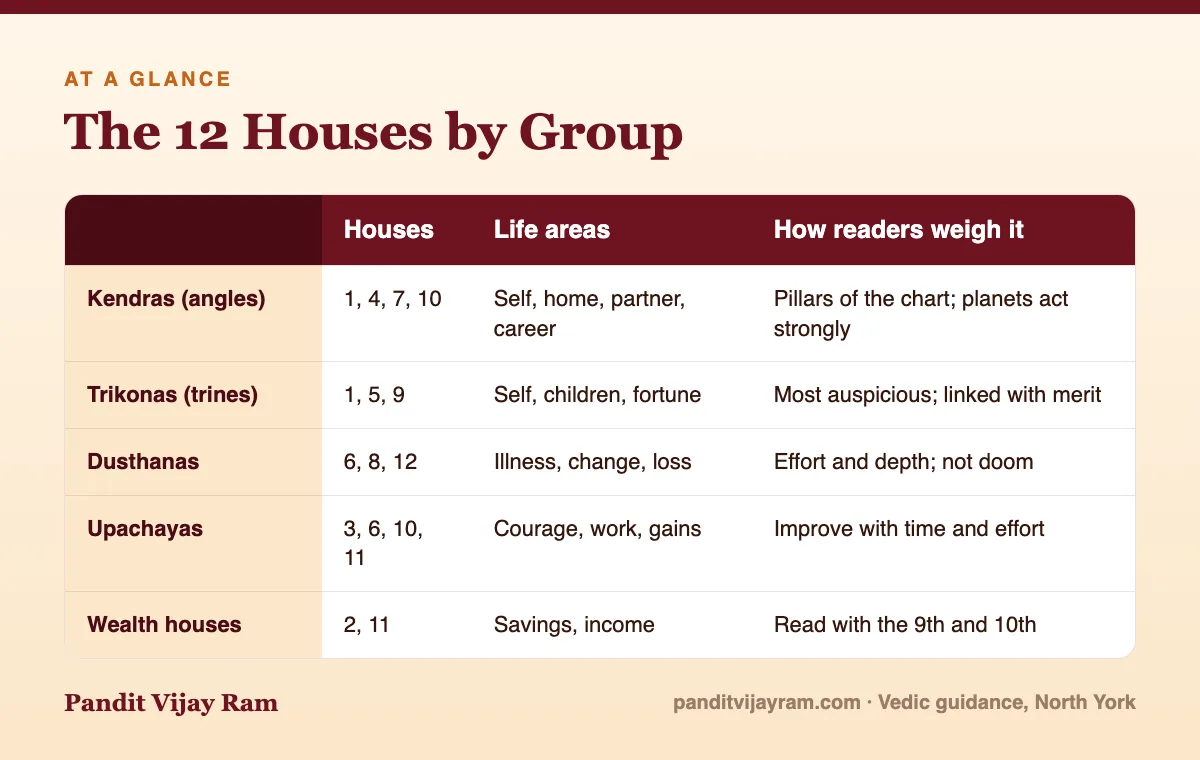
Astrologers group houses rather than label them good or bad. Kendras (1, 4, 7, 10) give stability, trikonas (1, 5, 9) bring fortune, and dusthanas (6, 8, 12) describe difficulty and effort. Upachayas (3, 6, 10, 11) are houses that tend to improve with time and effort, which is why some malefic planets are welcome there.
These groups explain a lot of what you hear in a reading. A lord of a trikona sitting in a kendra, for example, is the basis of many raj yoga combinations.
- Kendras, the angles: houses 1, 4, 7 and 10. Planets here are prominent and act strongly in daily life.
- Trikonas, the trines: houses 1, 5 and 9. Traditionally the most auspicious, linked with merit, wisdom and grace.
- Dusthanas: houses 6, 8 and 12. They show struggle, loss or change, but also service, depth and letting go.
- Upachayas: houses 3, 6, 10 and 11. Results here tend to grow with effort and age.
- Maraka houses: 2 and 7, discussed in longevity work. This is a technical label and not a forecast of anything.
A useful decision rule for beginners: Saturn, Mars, Rahu and the Sun are often said to do well in upachaya houses, where their push produces results. Gentle planets such as Jupiter, Venus, Mercury and the Moon are usually happier in kendras and trikonas. There are many exceptions, so treat this as a first sorting, never a verdict.
The first house belongs to both the kendra and trikona groups. That double status is one reason the lagna and its lord carry so much weight in every Parashari reading.
How do you read a house in your kundli step by step?
Read one house at a time in a fixed order. Note the sign on the house, then find its lord and where that lord sits. Look at planets inside the house and planets aspecting it. Check the natural significator, then ask which dasha is running. Only after all of this does a picture form.
This six-step order works for any bhava. Try it with the seventh house for partnership or the tenth for work.
- Name the sign. A seventh house in Capricorn reads differently from one in Leo, because each sign has its own nature.
- Find the house lord. The planet ruling that sign carries the house's affairs wherever it goes. A tenth lord in the eleventh links career to income.
- List the occupants. Planets inside the house add their own themes, stronger when they are in their own or exalted sign.
- Check aspects. In Parashari astrology every planet aspects the seventh house from itself. Mars also aspects the fourth and eighth from itself, Jupiter the fifth and ninth, and Saturn the third and tenth.
- Add the karaka. Each house has a natural significator: Venus for marriage, Jupiter for children, Saturn for longevity, the Sun for the father.
- Ask about timing. A house speaks loudest during the dasha of a planet connected with it. Our guide to the Vimshottari dasha explains the periods.
Write a short note after each step rather than jumping to a conclusion. Readers who skip straight to a scary placement usually misread it. If you want a quick list of placements before you begin, the free astrology checkers can help you gather the basics.
What can the houses in a birth chart not tell you?
House readings describe tendencies and themes, not fixed events. They cannot tell you whom to marry, whether a job will be offered or how an illness will go. They depend on an accurate birth time, and they ignore your choices, effort, health care and circumstances, which shape outcomes just as much as any placement.
A chart is a description of patterns. It is useful for reflection and timing, and weak as a crystal ball. Some honest limits:
- Birth time matters. The lagna can change within an hour or two, and every house shifts with it. An estimated time from a parent's memory may place you in the wrong rising sign.
- One house never decides alone. A difficult seventh house can be balanced by a strong Venus, a helpful navamsa and a good choice of partner.
- Many lives share a chart. People born at the same hospital minutes apart lead very different lives, which tells us environment and effort count.
- Health, law and money need professionals. A sixth house reading is no substitute for your family doctor, and a second house is no substitute for a budget.
When to ask for help: if a reading left you frightened, if you are being pushed toward an expensive remedy, or if two printouts disagree about your lagna. A calm second opinion is reasonable. Vijay Ram ji's kundli and horoscope readings start by checking the birth details before saying anything about houses. If you are booking a reading, our article on how to prepare for a kundli reading lists what to bring.
The bottom line
Learning how to read kundli houses means learning twelve themes, from the self in the first to release in the twelfth. Astrologers weigh those houses by group, with kendras for stability, trikonas for fortune and dusthanas for effort. Each house is then read through its sign, lord, occupants, aspects, karaka and running dasha. Used this way, the houses describe tendencies that help you reflect, never fixed outcomes.
Key takeaways
- Houses are counted from the lagna, the sign rising at birth.
- No house is purely good or bad; each has gifts and challenges.
- Kendras, trikonas, dusthanas and upachayas explain most reading language.
- Read a house through its sign, lord, occupants, aspects and karaka.
- An accurate birth time matters more than any single placement.