
Antardasha: Reading the Sub-Periods Inside a Mahadasha

A mahadasha can last as long as twenty years, yet nobody lives two decades at one steady pitch. Some stretches inside a Saturn period feel productive and others heavy; some months in a Venus period feel social and others quiet. The antardasha is the tool astrologers use to explain that texture. Families in North York often show me a dasha printout with dates down the side and ask which line actually applies to them right now. This article explains how sub-periods are calculated, how a reader judges the relationship between the two planets involved, what several common combinations tend to look like, and where pratyantar dashas fit in. It also sets out, plainly, how far these finer divisions can be trusted. In more than forty years of practice, I have found the antardasha the most useful layer for everyday reflection. It is also the layer most often stretched into confident predictions that no chart can honestly support.
What is antardasha in astrology?
Antardasha means inner period. It is the second level of the Vimshottari dasha system, a sub-period ruled by one planet inside the major period of another. South Indian astrologers often call it bhukti. Every mahadasha holds nine antardashas, and the first always belongs to the mahadasha lord, after which the usual order follows.
Think of the mahadasha as the season and the antardasha as the weather within it. The season tells you the general climate. The weather tells you what this particular stretch feels like.
Writers usually express the combination with a slash or a hyphen, such as Saturn–Mercury or Sa/Me. The first planet is the mahadasha lord and the second is the antardasha lord.
The order inside each major period simply continues the fixed Vimshottari sequence from the mahadasha lord:
- A Saturn mahadasha runs Saturn, Mercury, Ketu, Venus, Sun, Moon, Mars, Rahu and finally Jupiter.
- A Jupiter mahadasha runs Jupiter, Saturn, Mercury, Ketu, Venus, Sun, Moon, Mars, Rahu.
- A Venus mahadasha runs Venus, Sun, Moon, Mars, Rahu, Jupiter, Saturn, Mercury, Ketu.
The last sub-period of any mahadasha belongs to the planet just before its lord in the cycle. Some texts call this closing stretch chhidra, a gap or opening, and treat it as a winding-down phase. It is a transition, not an omen.
If the main periods are new to you, start with our overview of the Vimshottari dasha system, which explains the 120-year cycle and how your starting point is fixed by the Moon.

How long does each antardasha last?
Multiply the mahadasha lord's years by the antardasha lord's years and divide by 120. The answer is the sub-period's length in years. So the Saturn sub-period inside Saturn's own mahadasha lasts nineteen times nineteen divided by 120, a little over three years. Short combinations, such as Sun in Saturn, last under a year.
The formula keeps every level in proportion to the full cycle. Here are all nine sub-periods of a Saturn mahadasha, rounded, to show how unevenly they fall:
- Saturn–Saturn: about 3 years and a few days.
- Saturn–Mercury: about 2 years 8 months.
- Saturn–Ketu: about 1 year 1 month.
- Saturn–Venus: about 3 years 2 months, the longest.
- Saturn–Sun: about 11 months, the shortest.
- Saturn–Moon: about 1 year 7 months.
- Saturn–Mars: about 1 year 1 month.
- Saturn–Rahu: about 2 years 10 months.
- Saturn–Jupiter: about 2 years 6 months.
Add them together and you return to nineteen years. The same pattern holds in every mahadasha: the Venus sub-period is always the longest and the Sun's the shortest, because Venus and the Sun have the longest and shortest full periods.
Remember that your very first mahadasha is only a balance. If you were born partway through it, some of its early antardashas had already finished before birth, and your printout will begin in the middle of the list.
You do not need to do this by hand. The free astrology calculators or any Vedic software will print the full table. Knowing the formula simply helps you check that a printout makes sense.
How does an antardasha change the results of a mahadasha?
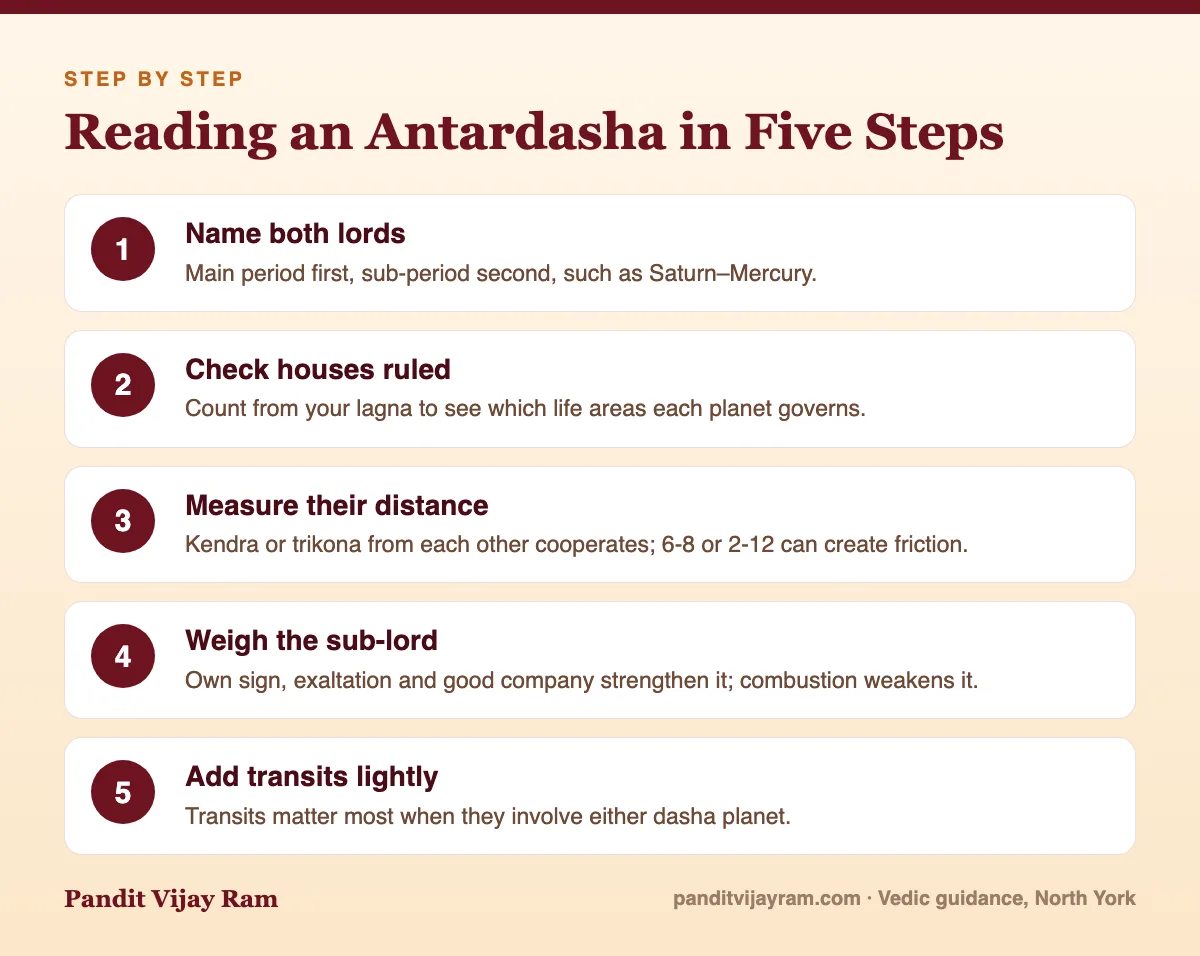
The mahadasha lord sets the main themes, and the antardasha lord decides which of them surface and in what tone. Astrologers compare the two planets: the houses each rules from the lagna, their positions relative to each other, their natural friendship or enmity, and the strength of the sub-period lord. Harmony between them tends to smooth the period.
A practical checklist for weighing any pair:
- What does each planet rule? If both lords govern supportive houses from your lagna, such as kendras and trikonas, the sub-period tends to cooperate with the main one. If the sub-lord rules the sixth, eighth or twelfth, expect more effort, expense or change.
- Where is the sub-lord counted from the main lord? Many astrologers read placements in the kendras or trikonas from the mahadasha lord as cooperative. A sixth-eighth or second-twelfth relationship between them is often read as friction.
- Are they natural friends? Classical friendships, such as the Sun with Jupiter or Venus with Saturn, are said to ease the combination. Natural enemies, such as the Sun with Venus, may pull in different directions.
- How strong is the sub-lord? Own sign, exaltation and good company lift it. Combustion or debilitation without cancellation weakens it.
- What do current transits add? A transit involving either planet can emphasise the period, as our guide to gochar transits explains.
A useful rule of thumb: the sub-lord cannot give what the main lord does not promise in the chart. It can only bring forward, delay or flavour what is already there.
Parashara's text lists results for every combination, but those descriptions assume particular strengths and placements. Reading them literally, without the chart, produces generic and sometimes alarming statements.
What are some examples of mahadasha and antardasha combinations?
Common examples include Jupiter's sub-period within Saturn, often read as a window of guidance inside a demanding stretch, and Rahu's within Jupiter, often described as expansion mixed with restlessness. Every description depends on the houses and strength of both planets in your chart, so treat sample readings as illustrations rather than forecasts.
These sketches show the reasoning, not a verdict for anyone's chart.
- Saturn–Jupiter. A long period of duty meets a planet of learning and counsel. Where Jupiter is well placed, people often describe a mentor, a course or a renewed sense of meaning arriving near the end of a hard decade. Our article on Saturn mahadasha covers the wider period.
- Jupiter–Rahu. Rahu amplifies whatever house it occupies. With Jupiter's period as the backdrop, it may bring travel, ambitious study or unconventional teachers, along with impatience. The close of a Jupiter mahadasha is a good time to check commitments rather than add new ones. See the Jupiter mahadasha guide for context.
- Venus–Sun. The two are natural enemies. Comfort and relationships meet questions of status, pride and authority. For a Leo or Libra ascendant the reading changes sharply, because the houses ruled differ.
- Moon–Mars. These are friends. For a Cancer or Leo ascendant, Mars rules a kendra and a trikona and is a yogakaraka, so the sub-period can bring energy and decisive action. For other ascendants it may instead bring quarrels or haste.
Notice how often the sentence ends with "depends on the ascendant". That is the honest heart of dasha reading. A combination name is a heading; the chart supplies the content.
If a sample reading online frightened you, take it to someone who can look at your own placements before you act on it.
What is pratyantar dasha and how reliable are sub-periods?
Pratyantar dasha is the third level, a sub-sub-period inside an antardasha, calculated with the same proportions. Deeper levels called sookshma and prana dasha shrink to days and hours. The finer the division, the more a small birth-time error throws it off, so most careful astrologers lean on mahadasha and antardasha and treat deeper levels lightly.
To find a pratyantar's length, multiply the three lords' years together and divide by 120 twice. A Saturn–Saturn–Saturn pratyantar lasts roughly five and a half months. Some combinations last only a few weeks.
The precision problem is real. The Moon moves roughly half a degree every hour, which slides every dasha boundary. An error that shifts a mahadasha by a few months can push a pratyantar into a completely different planet.
A sensible way to use the levels:
- Mahadasha: the theme of a life chapter. Fairly robust if the birth time is approximately right.
- Antardasha: the focus of the next year or few. Useful for planning reflection.
- Pratyantar: fine texture, worth considering only with a well-documented birth time.
- Sookshma and prana: technically interesting, rarely dependable for ordinary charts.
Be cautious when anyone names a specific week as dangerous or lucky based on a deep sub-period. That level of claim outruns the method, and it can push people into fear or rushed spending.
Real decisions about health, money and law belong with your doctor, a licensed adviser or a lawyer. If you would like your current antardasha read against your actual chart, Vijay Ram ji's kundli and horoscope readings explain the dasha table line by line, and our page on preparing for a reading lists what to bring.
The bottom line
An antardasha is a sub-period inside a mahadasha, beginning with the main lord and following the fixed Vimshottari order. Its length comes from multiplying the two planets' years and dividing by 120. The sub-period modifies the mahadasha according to each planet's houses, their relationship and the sub-lord's strength. Deeper levels such as pratyantar dasha are finer still, so trust them only as far as your birth time allows.
Key takeaways
- Every mahadasha contains nine antardashas.
- The first antardasha belongs to the mahadasha lord itself.
- Sub-period length equals the two lords' years multiplied, divided by 120.
- The sub-lord can only bring forward what the main lord promises.
- Deeper sub-periods need an accurate birth time to mean anything.