
Vedic vs Western Astrology: Sidereal and Tropical Zodiacs Compared

A common surprise: someone has read for years that they are a Leo, then a Vedic chart calls them a Cancer. They wonder which one is wrong. The honest answer is that neither system has made an error; they are measuring from different starting points. Clients in North York raise this question with me regularly, especially families where the parents follow Jyotish and the children grew up with Western horoscopes. This article sets out the real differences in the vedic vs western astrology debate: the two zodiacs, the shift called the ayanamsa, why Jyotish puts the Moon first, how its timing tools differ from progressions, and how house and aspect rules diverge. It also covers what the two traditions share, because there is more common ground than people expect. In more than forty years of reading charts, I have found that understanding the mechanics calms most of the confusion. Once you see why the signs differ, you can decide for yourself which approach speaks to you, or simply enjoy knowing how each one is built.
What is the main difference between Vedic and Western astrology?
The core difference is the zodiac. Vedic astrology uses the sidereal zodiac, fixed against the stars. Western astrology mostly uses the tropical zodiac, which begins at the March equinox. Because the equinox point slowly drifts against the stars, the two zodiacs have separated, and planets usually fall in different signs in each system.
Both traditions divide the sky into twelve signs of thirty degrees, with the same names and the same planetary rulers for the visible planets. What differs is where the count begins.
- Tropical zodiac: 0 degrees Aries is defined as the Sun's position at the March equinox. The signs are therefore tied to the seasons of the Northern Hemisphere.
- Sidereal zodiac: 0 degrees Aries is tied to a reference point among the fixed stars. In the most common Indian convention, the star Spica (Chitra) sits at the middle of Virgo.
Long ago the two starting points nearly coincided. They have since drifted apart because of a slow wobble of the Earth's axis, known as the precession of the equinoxes. The equinox point moves backward against the stars by roughly one degree in about seventy-two years.
Neither choice is a mistake. A tropical astrologer is describing the Sun's seasonal journey. A sidereal astrologer is describing which star group stands behind a planet. They are asking slightly different questions about the same sky.
This is also why the Vedic rashi can differ from the familiar newspaper sign. Our article on Moon sign versus Sun sign shows how to find your Vedic rashi and why it carries weight.

What is ayanamsa and why does my sign change?
Ayanamsa is the angular gap between the tropical and sidereal zodiacs at a given moment. It is currently close to twenty-four degrees. Subtract it from a tropical position and you get the sidereal position, which is why a planet in the early part of a Western sign usually lands in the previous sign in a Vedic chart.
Here is a worked example using round numbers. Suppose your Western chart puts the Sun at 15 degrees Leo. Subtracting an ayanamsa of about 24 degrees moves it back to roughly 21 degrees Cancer. If the Sun were at 28 degrees Leo instead, it would only fall to about 4 degrees Leo and would stay in the same sign.
So the rule of thumb is simple:
- Planets in the first two-thirds or so of a tropical sign usually move back one sign in a sidereal chart.
- Planets in the last few degrees usually stay where they were.
- The rising sign can shift the same way, which can change the entire house layout.
Not every astrologer uses the same value. The Lahiri (Chitrapaksha) ayanamsa is the most widely used in India and was adopted for the official Indian calendar. The Raman and Krishnamurti values differ by fractions of a degree to more than a degree. Western siderealists often use the Fagan-Bradley value.
Those small differences matter for planets near the edge of a sign and for fine divisional charts. When two Vedic reports disagree, check the ayanamsa setting before assuming one astrologer has erred. Our guide to divisional charts explains why a fraction of a degree can change the finer charts.
Why does Vedic astrology focus on the Moon instead of the Sun?
Jyotish treats the Moon as the indicator of the mind and daily experience, so the Moon sign, or rashi, and the Moon's nakshatra are central. The Moon's nakshatra also sets the starting point of the Vimshottari dasha. Popular Western astrology, by contrast, built its everyday horoscopes around the Sun sign.
In Vedic practice the Moon does several jobs at once:
- It marks the janma rashi, the sign used for many daily and transit readings.
- Its nakshatra, one of twenty-seven lunar mansions, sets the order and balance of the dasha periods at birth.
- Transits such as Sade Sati are counted from the Moon, not from the Sun.
- Traditional name syllables are taken from the Moon's nakshatra pada.
None of this means Jyotish ignores the Sun. The Sun is the soul indicator, and the ascendant often matters more than either light. Western astrologers, for their part, read the Moon carefully in a full chart. The Sun-sign emphasis belongs mostly to newspaper and app horoscopes, which needed a simple way to sort readers into twelve groups.
Another difference is the use of lunar mansions. The nakshatra system, explained in our guide to nakshatras and the birth star, divides the zodiac into twenty-seven parts of thirteen degrees twenty minutes each. Western astrology has had lunar mansions too, but they play a far smaller role in modern practice.
For someone used to Western columns, reading for the Moon sign first can feel unfamiliar. Many people find it describes their emotional habits rather well, but that is a personal impression, not proof of anything.
How do Vedic dashas compare with Western progressions?
Both are timing tools. Vedic astrology divides life into planetary periods called dashas, with Vimshottari the most common, each ruled by a graha for a set number of years. Western astrology typically uses transits, secondary progressions, where one day after birth stands for one year of life, and solar returns.
The comparison below sets the main tools side by side.
- Vimshottari dasha: a 120-year cycle shared among nine grahas, from Ketu's 7 years to Venus's 20. Each mahadasha splits into antardashas and further sub-periods.
- Other Vedic dashas: Yogini, Chara (Jaimini) and Ashtottari are used by some schools for cross-checking.
- Secondary progressions: the chart is moved forward one day for each year lived, and the progressed Moon's movement is watched closely.
- Solar arc directions: every point is moved by the Sun's progressed distance.
- Transits: both traditions use them, but Jyotish counts them from the Moon and from the ascendant and reads them through the running dasha.
- Annual charts: Western solar returns and Vedic varshphal are cousins, both cast when the Sun returns to its birth position.
In practice the dasha gives Jyotish a strong narrative of chapters in life. Western techniques tend to describe overlapping layers of influence. Both approaches still depend on the interpreter's skill, and both describe tendencies rather than fixed events.
For the full sequence of periods and lengths, see Vimshottari dasha explained.
Do houses, planets and aspects work differently in each system?
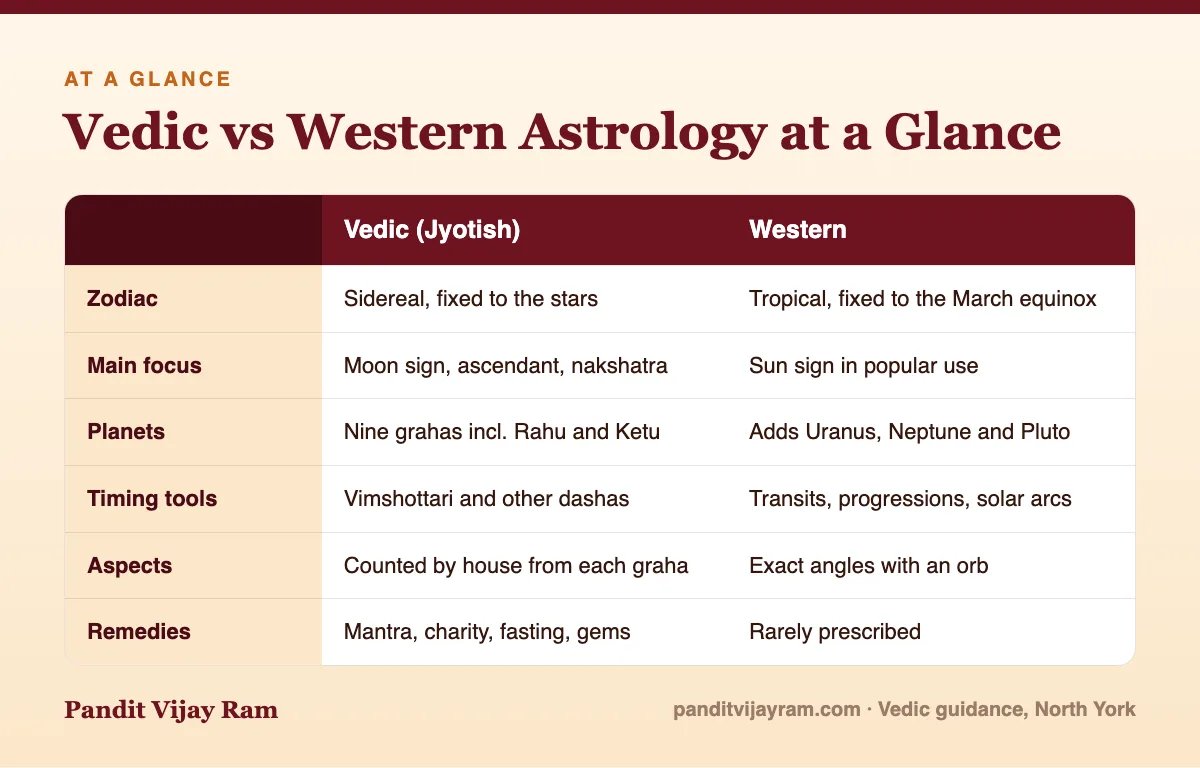
Yes. Many Vedic astrologers use whole-sign houses, nine grahas including the lunar nodes Rahu and Ketu, and fixed planetary aspects counted by house. Western astrologers usually add Uranus, Neptune and Pluto, often use quadrant house systems such as Placidus, and measure aspects by exact angles with an allowed orb.
These technical choices shape how a reading feels.
- Houses. In whole-sign houses the rising sign becomes the entire 1st house, the next sign the 2nd, and so on. Some Vedic schools use the Sripati or Krishnamurti systems as well. Western practice commonly divides space by time or geometry, so house sizes vary.
- Planets. Jyotish works with the Sun, Moon, Mars, Mercury, Jupiter, Venus, Saturn, Rahu and Ketu. The outer planets were not part of the classical system, though a few modern Vedic writers include them.
- Aspects. Every graha aspects the 7th house from itself. Mars adds the 4th and 8th, Jupiter the 5th and 9th, Saturn the 3rd and 10th. Western aspects are angular, such as squares and trines, within a few degrees.
- Divisional charts. Jyotish relies heavily on vargas such as the navamsa. Western astrology has harmonic charts, but they are less central.
- Yogas. Named combinations, such as Gajakesari or raj yogas, are a distinct feature of Indian texts.
Remedies differ too. Jyotish has a long tradition of mantra, charity, fasting and gemstones linked to specific grahas. Western astrology today rarely prescribes remedies at all. If you are curious about the remedial side, Vijay Ram ji's kundli and horoscope readings explain options without pressure.
Which is more accurate, Vedic or Western astrology?
Neither system has scientific evidence showing it predicts events or personality reliably, so accuracy is not a fair basis for choosing. People tend to prefer the tradition that fits their culture, their questions and their taste for detail. Jyotish offers dashas, nakshatras and remedies; Western astrology often leans toward psychological language.
You will find confident claims online that one system is "real" and the other is "wrong". Both sides overstate their case. Controlled tests of astrological claims have not supported either tradition's predictive power, and a responsible practitioner should say so plainly.
What you can reasonably compare is fit:
- Cultural home. Many South Asian families use Jyotish for naming, matching and muhurta. Its vocabulary is part of family life.
- Kind of question. People who want a story of life chapters often like dashas. People who want reflective, psychological language may prefer a Western astrologer.
- Level of detail. Jyotish can be very detailed, which some find helpful and others find overwhelming.
Using both is fine, as long as you do not mix their numbers. A Western Sun position plugged into a Vedic rule, or the reverse, produces nonsense.
Whatever you choose, keep astrology in its place: one source of reflection, never a substitute for medical, legal or financial advice. Our article is astrology accurate looks at the evidence question in more depth.
The bottom line
The heart of vedic vs western astrology is the zodiac: sidereal signs follow the stars, tropical signs follow the seasons, and the ayanamsa of about twenty-four degrees separates them. Jyotish puts the Moon, nakshatras and dashas at the centre, while Western practice leans on the Sun sign, progressions and outer planets. Neither has scientific support as a predictive system, so the better choice is the one that suits your culture and your questions. Understanding how each is built removes most of the confusion about why your sign changes.
Key takeaways
- Vedic astrology uses the sidereal zodiac; most Western astrology uses the tropical zodiac.
- The ayanamsa, roughly twenty-four degrees, is why many signs move back one place.
- Jyotish emphasises the Moon sign, nakshatras and dasha periods.
- Western astrology uses progressions, solar arcs and the outer planets.
- Neither system has scientific evidence of predictive accuracy; choose by fit, not by claims.