
Is Astrology Accurate? An Honest Practitioner's View

It may seem odd for an astrologer to write this article, but people deserve a straight answer. Clients in North York sometimes ask me, quietly, whether any of this is real, often after a frightening prediction from someone else. Is astrology accurate? If accurate means "proven to forecast events", the honest answer is no, and I would rather say so than have anyone make a life decision on a promise I cannot keep. This article explains what the scientific tests have found, why readings can feel accurate anyway, and what people genuinely find useful in Jyotish. It ends with practical rules for using astrology without becoming dependent on it. In more than forty years of practice I have watched many families draw comfort, discipline and cultural connection from their charts. I have also seen people harmed by fear-based readings and by handing their choices to an astrologer. Both experiences shape what follows, so you can make up your own mind with the facts in front of you rather than with hope or fear.
Is there any scientific evidence that astrology works?
No. Scientists have tested astrology many times, and the results have not supported its claims. Astrologers have not matched birth charts to personality profiles better than chance, and people born minutes apart have not turned out more alike than strangers. Astrology is not accepted as a science, and an honest practitioner should say that clearly.
Several kinds of test have been run over the decades.
- Matching tests. In a double-blind experiment published in the journal Nature, physicist Shawn Carlson asked astrologers to match natal charts with personality profiles. They did no better than chance.
- Time twins. Researchers Geoffrey Dean and Ivan Kelly examined a large British group of people born very close together in time. Their later lives and traits showed no meaningful resemblance.
- Sun-sign surveys. Large data sets on occupation, marriage and personality have not found the clusters that sign descriptions would predict.
- Mechanism. No known physical force from distant planets could shape personality at birth in the way astrology describes.
A few studies that seemed positive, such as Michel Gauquelin's work on Mars and athletes, became heavily disputed and have not held up as support for astrology as practised.
Some astrologers reply that the tests were designed badly or that Jyotish was not tested specifically. Those objections deserve a hearing, but they are not evidence that it works. The burden of proof sits with the claim, and that burden has not been met.
So when someone states that your chart will bring a divorce, a job or an illness, understand that no research backs that certainty.

Why does astrology feel so accurate to many people?
Readings often feel accurate because of well-studied habits of the mind. General statements feel personal, people remember hits and forget misses, and a skilled reader picks up cues from conversation. Familiar cultural language also helps. None of this means the person is being deceived deliberately; the effect works on astrologers as well as clients.
Psychologists have names for most of these effects.
- The Barnum or Forer effect. In a classic classroom experiment, psychologist Bertram Forer gave students the same vague personality sketch. Most rated it a very good description of themselves.
- Confirmation bias. We notice evidence that fits what we were told and pass over evidence that does not.
- Selective memory. The one striking prediction that came true is retold for years. The ten that did not are quietly forgotten.
- Cold reading. Tone, hesitation and small details shared during a session guide the reader, often without either person realising.
- Self-fulfilling expectations. Someone told that a period is lucky may act with more confidence, which can change the outcome by itself.
- Flexible symbolism. Planets and houses carry many meanings, so almost any event can be fitted afterwards.
I mention these not to mock anyone's experience. A reading can be meaningful to you for real reasons. But meaningful and predictive are different things, and keeping them apart protects you.
If a reading left you afraid, it is worth asking whether fear, rather than the chart, is doing the work. Our guide to warning signs of spiritual scams explains how anxiety gets used to sell expensive remedies.
If astrology is not scientific, why do people still use it?
People value astrology for reasons that do not depend on prediction. It offers a structured moment to reflect, a shared language for families, a link to religious and cultural practice, and a calm frame for choosing when to begin things. For many South Asian households it is woven into naming, marriage and festival life.
When I ask long-standing clients what they actually gain, their answers rarely involve forecasts. They talk about other things.
- Reflection. A reading gives permission to stop and think about relationships, work and health habits. The chart is a prompt, a little like a journal with headings already written.
- Culture and faith. Jyotish is part of Hindu ritual life: a child's name syllable, a wedding muhurta, a puja on a festival day. Its value there is devotional and communal.
- Timing as discipline. Waiting for a chosen day can stop impulsive decisions and give a family time to plan. The pause is often more useful than the date itself.
- Comfort in hard seasons. Hearing that difficult periods pass, and that one can work steadily through them, gives some people patience.
- Remedies as practice. Mantra, charity and fasting are spiritual disciplines with their own worth, regardless of whether they shift planets.
These benefits are real but modest. They come from attention, ritual and conversation, which means a careful practitioner can offer them honestly. They do not justify frightening predictions or large payments.
If you want to understand how a chart is structured before deciding what you think, our introduction to reading the 12 houses of a kundli is a neutral starting point.
Can astrology predict the future?
There is no reliable evidence that it can. A chart may describe tendencies or periods that a tradition considers easier or harder, but it cannot tell you that a specific event will happen. Anyone promising a job offer, a marriage, a court win or a visa on a particular schedule is claiming more than astrology can support.
Many classical Jyotish texts speak in confident predictive language. Modern practitioners inherited that tone, and some still use it. In my own work I treat predictive statements as traditional interpretation, not as forecasts, and I tell clients so.
A useful test is to ask what a statement would look like if it were wrong. "You may feel more pressure at work during this dasha" is a reflection prompt. "You will lose your job in the spring" is a prediction that can be checked and that no astrologer can honestly make.
Some areas need special care:
- Health: see your family doctor. A chart cannot diagnose or rule out illness.
- Law and immigration: a lawyer, a licensed immigration consultant or IRCC, not a horoscope.
- Money: a budget, a non-profit credit counsellor or a licensed adviser. Astrology should never guide trading or gambling, as our article on why astrologers should not give market tips explains.
- Relationships: no chart can decide another person's feelings or choices.
If you are in crisis or thinking about harming yourself, please call or text 9-8-8, Canada's Suicide Crisis Helpline. No reading should ever stand between you and that help.
How can you use astrology without becoming dependent on it?
Use astrology as one input among many, never as the decision-maker. Set limits on how often you consult, avoid anyone who builds fear or urgency, keep practical planning first, and notice whether readings leave you calmer and more capable or more anxious. If it is shrinking your choices rather than clarifying them, step back.
These are the rules I suggest to clients, and I try to follow them in my own practice.
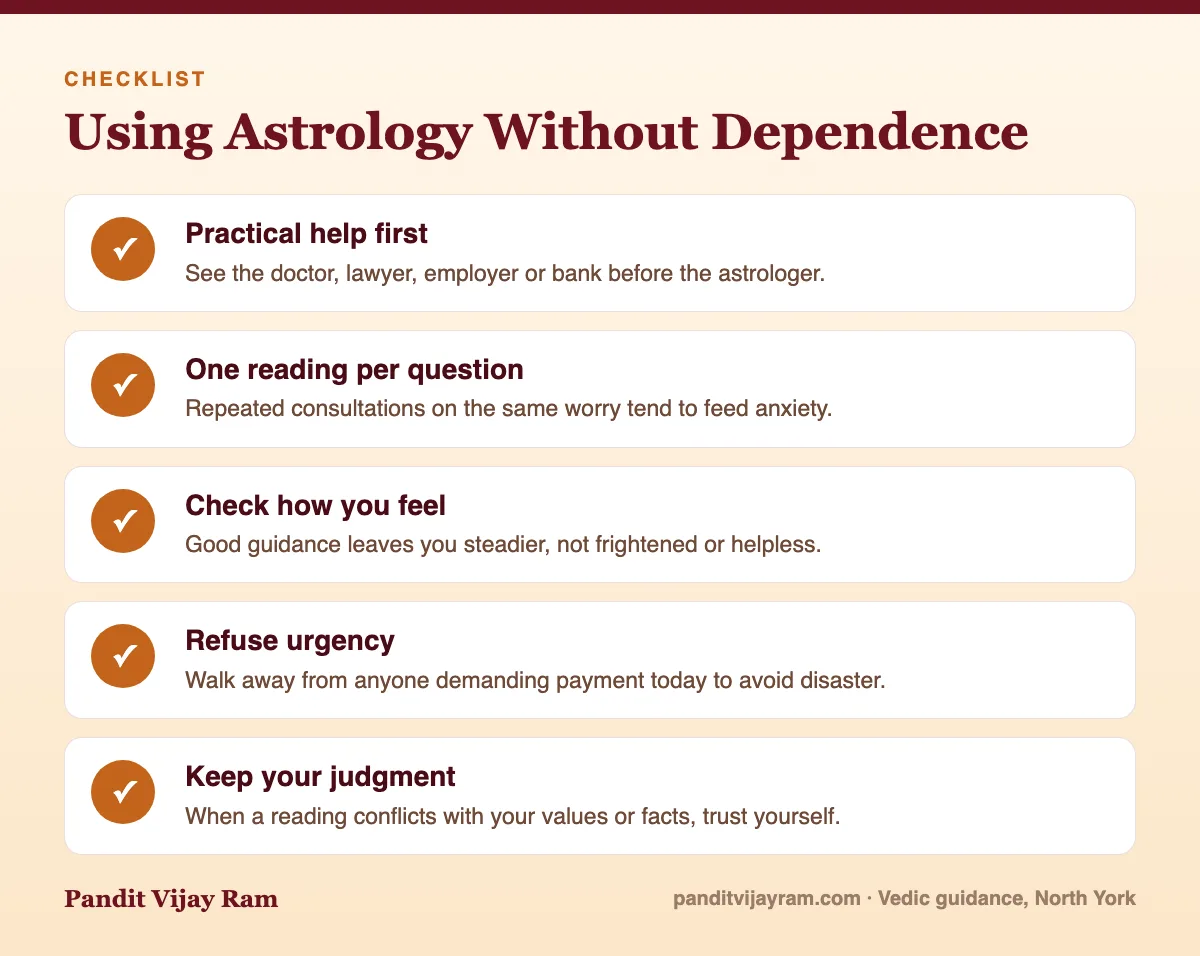
- Practical steps come first. Talk to the doctor, the lawyer, the employer or the bank before you talk to an astrologer about the same issue.
- Limit the frequency. One thoughtful reading on a question is enough. Consulting weekly about the same worry usually feeds anxiety.
- Watch your feelings afterwards. A good session leaves you steadier. A bad one leaves you frightened or feeling helpless.
- Refuse urgency. Genuine guidance never needs to be paid for today to avoid disaster tomorrow.
- Keep your own judgment. If a reading conflicts with your values or your knowledge of a situation, your judgment wins.
- Treat remedies as devotion. A mantra or a lamp is worth doing for the peace it brings, not as a transaction for an outcome.
Families sometimes worry that admitting these limits takes the meaning out of Jyotish. In my experience it does the opposite. Without the pressure of prediction, people relax into what the practice can offer.
If you would like a reading conducted on these terms, the kundli and horoscope service describes how consultations work, and about Pandit Vijay Ram explains his background.
The bottom line
Is astrology accurate in the scientific sense? No: controlled tests have not supported its predictive claims, and readings feel accurate largely because of well-known habits of perception. What people still value is reflection, cultural and devotional connection, and a calm frame for timing decisions. Used as one input, without fear, urgency or dependence, astrology can sit alongside practical planning rather than replace it.
Key takeaways
- There is no scientific evidence that astrology predicts events or personality.
- Readings can feel accurate because of the Barnum effect, confirmation bias and selective memory.
- People value Jyotish for reflection, culture, devotion and timing discipline.
- Health, legal, immigration and money decisions belong with qualified professionals first.
- Any reading that creates fear or urgency is a reason to step back.