
Moon Sign vs Sun Sign: Which One Vedic Astrology Uses and Why
Someone grows up reading that they are a Gemini, then meets an aunt who insists they are a Kanya. Both may be right, because the two are answering different questions. The debate over Moon sign vs sun sign confuses many people raised between two cultures, and I hear it often from families in North York who keep one horoscope app for themselves and a printed kundli for weddings. This article explains what each sign actually measures, why Vedic astrology reaches for the Moon first, how to find your own rashi in a few minutes, and why the sidereal zodiac moves most signs back by one. In more than forty years of reading charts, I have watched people relax once they see that the Western sign was never wrong, just measured from a different starting line. Knowing which system you are reading prevents a lot of needless worry, and a lot of mismatched advice.
What is the difference between a Moon sign and a Sun sign?
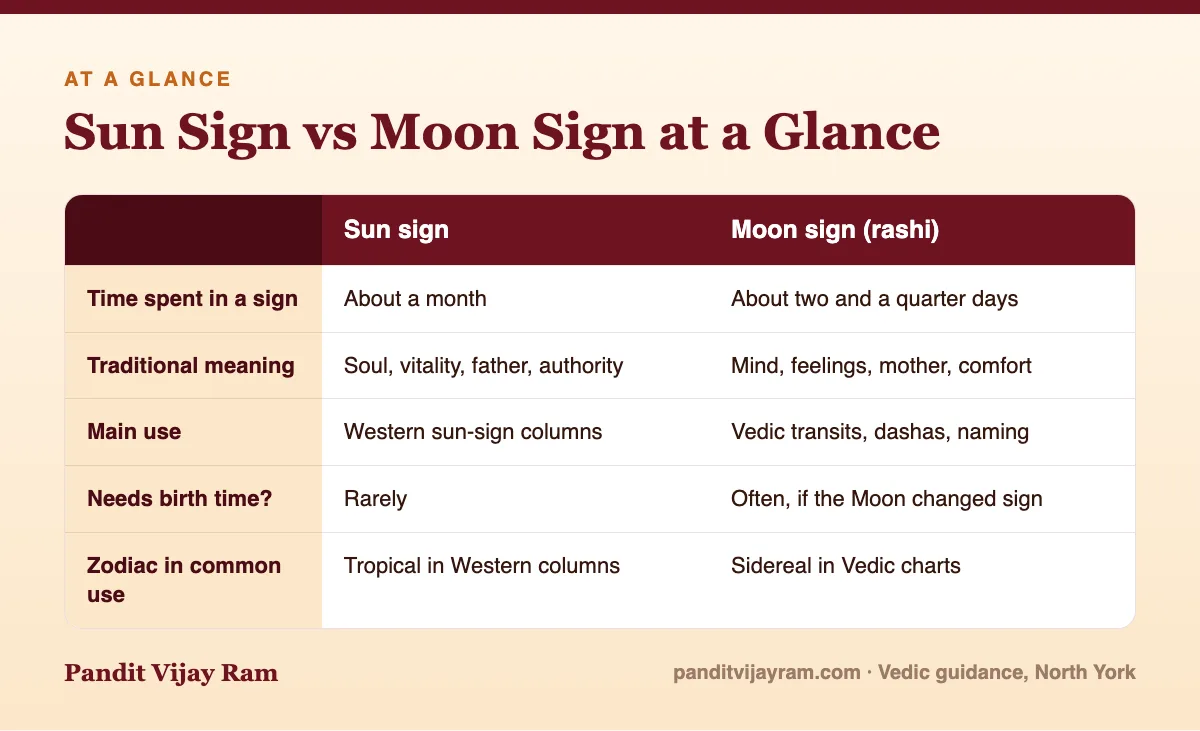
The sun sign is the zodiac sign the Sun occupied when you were born; the Sun spends about a month in each sign. The Moon sign is the sign the Moon occupied, and the Moon moves through a sign in roughly two and a quarter days. So your sun sign is shared widely, while your Moon sign is more personal.
Both signs come from the same sky. They simply track two different bodies moving at very different speeds.
- The Sun takes a year to go round the zodiac. Everyone born across a span of about thirty days shares a sun sign.
- The Moon completes the circuit in about twenty-seven days. Two cousins born a week apart almost certainly have different Moon signs.
In traditional interpretation the two bodies describe different layers of a person:
- Surya, the Sun: the soul, vitality, confidence, the father, authority and public standing.
- Chandra, the Moon: the mind, feelings, memory, the mother, comfort and how you respond day to day.
Neither is the whole person, and Vedic astrology also gives great weight to the rising sign, or lagna. Our article on the lagna in Vedic astrology explains why the ascendant frames the full chart.
One practical point: because the Moon moves so fast, it can change sign on the day you were born. A birth time, even an approximate one, is needed to be sure of your rashi. A sun sign almost never needs a time unless you were born on the day the Sun changed sign.

Why does Vedic astrology use the Moon sign instead of the Sun sign?
Vedic astrology treats the Moon as manas, the mind, which shapes how every experience is felt. Many of its working tools are built on the Moon: transits are counted from the Moon sign, the Vimshottari dasha starts from the Moon's nakshatra, and traditional name syllables come from it. The rashi is therefore a practical reference, not just a personality label.
The preference for the Moon is not only philosophical. It runs through the everyday machinery of Jyotisha.
- Transits. The movement of Saturn, Jupiter and the other planets through the sky, called gochar, is mostly judged by counting from your Moon sign. The well-known Sade Sati period of Saturn is defined entirely by Saturn's distance from the natal Moon.
- Dashas. The degree of the Moon in its nakshatra fixes which planetary period you were born into and how much of it remained. The Vimshottari dasha article shows how.
- Naming. Many Hindu families choose a first syllable from the pada of the Moon's nakshatra, a custom called namakshar.
- Muhurat. Daily electional checks such as chandrabala and tarabala compare the day's Moon with yours.
- Rashiphal. Panchang horoscopes printed for each sign assume you are reading for your Moon sign.
The Moon chart is also used as a second ascendant, called Chandra lagna. Astrologers often read houses from both the lagna and the Moon and give more weight to themes that appear in both.
None of this makes the Sun irrelevant. It remains the natural significator of the father and of vitality, and a strong Sun is read as confidence and stamina. It simply is not the organising point for most Vedic techniques.
Why is my Vedic sign different from my Western zodiac sign?
Most Western astrology uses the tropical zodiac, which begins at the spring equinox. Vedic astrology uses the sidereal zodiac, tied to the fixed stars. Because of a slow wobble in Earth's axis, the two have drifted apart by roughly twenty-four degrees. As a result, many people's Vedic Sun and Moon fall one sign earlier than their Western placements.
The difference comes from astronomy, not from either system being careless.
Tropical zodiac: 0 degrees Aries is defined as the point where the Sun crosses the celestial equator at the northern spring equinox. It is tied to the seasons.
Sidereal zodiac: 0 degrees Aries is tied to a reference among the stars. Indian astronomers traditionally use the region of the star Spica, Chitra, as the anchor for the Lahiri system.
Earth's axis slowly wobbles, a motion called precession. It shifts the equinox point backwards against the stars by about one degree every seventy-two years. The gap between the zodiacs is called the ayanamsa, and it keeps growing very slowly.
What this means in practice:
- If your Western Sun sits in roughly the first twenty-four degrees of a sign, your Vedic Sun is usually in the sign before.
- If it sits in the last few degrees, both systems may agree.
- The same shift applies to your Moon, your rising sign and every planet.
So a Western Taurus born early in that sign is likely a Vedic Aries, Mesha. That is not a contradiction. The two systems label the same sky with rulers placed at different starting points. For a fuller comparison of methods, including progressions and dashas, see our guide to Vedic vs Western astrology.
How do I find my Moon sign or rashi?
You need your date, time and place of birth. Enter them into a Vedic chart calculator set to the sidereal zodiac, or ask an astrologer, and look for the sign holding the Moon, often marked Mo or Ch. If you were born the day the Moon changed signs, the exact time decides which rashi is yours.
Here is a quick, reliable way to confirm your rashi.
- Gather your birth details. Date, clock time as accurately as you can, and city of birth.
- Use a sidereal calculator. Western sites usually give tropical positions, which will often be one sign later. The free zodiac and sign tools on this site use the Vedic method.
- Find the Moon. On a North Indian chart, read the sign number in the box holding the Moon. On a South Indian chart, the box itself names the sign.
- Check the degree. If the Moon is within a degree of the start or end of a sign, ask whether a small time error could move it.
- Compare with family records. An old handwritten kundli or the syllable used for your name often confirms the nakshatra, and therefore the rashi.
The twelve rashis by their Sanskrit names, in order:
- Mesha, Vrishabha, Mithuna, Karka for Aries to Cancer.
- Simha, Kanya, Tula, Vrishchika for Leo to Scorpio.
- Dhanu, Makara, Kumbha, Meena for Sagittarius to Pisces.
If you have no birth time at all, an astrologer may estimate the Moon's sign from the date alone, noting both possibilities when the Moon changed sign that day.
Should I read my horoscope by Moon sign or Sun sign?
For Vedic horoscopes and panchang predictions, read by your Moon sign, because that is how they are written. For Western columns, use your tropical sun sign. Either way, sign-only horoscopes describe millions of people at once, so treat them as general reflection. Personal decisions deserve a full chart and, more importantly, ordinary good judgment.
A daily forecast for one sign is written for roughly one in twelve people on Earth. It cannot know your houses, your dasha or your circumstances. That is not a reason to scorn it, but it is a reason not to lean on it.
A sensible way to use both:
- Vedic rashiphal: read for your Moon sign. If you also know your lagna, some astrologers suggest reading for that as well and noting where the two agree.
- Western column: read for your tropical sun sign if you enjoy it. Do not mix it with Vedic transit advice, because the positions come from different zodiacs.
- Big decisions: marriage, moving, career and health choices need real information, trusted people and, where relevant, professionals. A chart can add timing and reflection.
A warning sign to watch for: a forecast, app or caller that uses your Moon sign to announce a looming disaster and then sells a remedy. Transits colour periods of life; they do not issue sentences.
If you would like your Moon, Sun and lagna read together as one picture, Vijay Ram ji's kundli and horoscope readings explain all three in plain language. Couples comparing rashis can read our separate guide to Moon sign compatibility.
The bottom line
Moon sign vs sun sign is really a question of which body, and which zodiac, you are measuring. Vedic astrology leads with the rashi because the Moon represents the mind and anchors transits, dashas, naming and muhurat. Its sidereal zodiac sits about twenty-four degrees behind the tropical one, so many Vedic signs fall one sign earlier. Find your rashi with a sidereal calculator and an accurate birth time, and read sign-only horoscopes lightly.
Key takeaways
- The Sun stays a month in a sign; the Moon about two and a quarter days.
- Vedic astrology counts transits from the Moon sign.
- The Moon's nakshatra decides the starting Vimshottari dasha.
- The sidereal zodiac is roughly twenty-four degrees behind the tropical.
- Sign-only horoscopes suit reflection, not big decisions.