
Divisional Charts Explained: D1, D9, D10 and Beyond
Open a detailed kundli report and you may find a dozen small charts, each labelled with a letter D and a number. Most people never learn what they are for. Divisional charts are one of the most powerful tools in Vedic astrology, and also one of the most easily misused, because they magnify both insight and error. People in North York sometimes bring me reports with a D60 analysis attached when their birth time was only remembered to the nearest hour. This article explains what the varga system is, lists the sixteen classical charts and what each traditionally shows, and sorts out which ones most astrologers actually rely on. It also shows, with simple numbers, why birth-time accuracy decides how far each chart can be trusted. In more than forty years of practice, I have come to use a few divisional charts often and the rest sparingly. Knowing when a chart is reliable matters as much as knowing what it means.
What are divisional charts in Vedic astrology?
A divisional chart takes the main birth chart and divides every sign into a set number of parts. Each planet and the lagna is reassigned to the sign ruling the part it falls in, producing a new chart. The number of parts names the chart: the D2 splits signs in two, the D9 into nine, the D60 into sixty.
The Sanskrit term is varga, a division or set, and each fraction of a sign is called an amsha, a portion. So the navamsa is the ninth-portion chart and the dashamsa the tenth-portion chart.
Every divisional chart is derived from the birth chart, the rashi or D1. Nothing new is observed in the sky. The varga simply looks more closely at the exact degree of each planet, so that two people with Mars in Leo can be told apart according to where in Leo it sits.
Three ideas guide how vargas are used:
- Specialisation. Each chart is associated with a particular area of life, such as wealth, siblings, children or career.
- Confirmation. A promise seen in the D1 is checked in the relevant varga. If the varga supports it, the promise is considered stronger.
- Dignity. A planet that holds good signs across many vargas is read as robust. Parashara grades planets by how many vargas they occupy in their own or exalted signs, a scheme related to vimshopaka bala, a weighted strength score.
The methods for building each varga differ. Some count signs evenly from the starting sign; others start from a different sign depending on whether the original sign is odd or even. Software handles this, but it explains why different programs, using different conventions, sometimes disagree. For the mechanics of the most famous varga, see our guide to the navamsa chart (D9).

What are the 16 divisional charts and what does each show?
Parashara's shodashvarga runs from the D1 to the D60. Common associations are: D1 body and life, D2 wealth, D3 siblings, D4 property and fortune, D7 children, D9 marriage and dharma, D10 career, D12 parents, D16 vehicles and comforts, D20 spiritual practice, D24 learning, D27 strengths, D30 misfortunes, D40 and D45 inherited tendencies, D60 overall karma.
Here is the classical list with the traditional names, as taught in the Brihat Parashara Hora Shastra. Associations vary a little between teachers.
- D1 Rashi: the whole person and life; the foundation of all.
- D2 Hora: wealth and resources.
- D3 Drekkana: siblings, courage and initiative.
- D4 Chaturthamsa: fortune, home and property.
- D7 Saptamsa: children and progeny.
- D9 Navamsa: spouse, dharma and planetary strength.
- D10 Dashamsa: career, status and achievements.
- D12 Dwadashamsa: parents and ancestry.
- D16 Shodashamsa: vehicles, comforts and happiness.
- D20 Vimshamsa: worship and spiritual progress.
- D24 Chaturvimshamsa: education and learning.
- D27 Saptavimshamsa or Bhamsa: strengths and weaknesses.
- D30 Trimshamsa: misfortunes and difficulties; built from unequal divisions.
- D40 Khavedamsa: auspicious and inauspicious effects, often linked with maternal inheritance.
- D45 Akshavedamsa: general conduct, often linked with paternal inheritance.
- D60 Shashtyamsa: everything, read as the imprint of past karma.
Later authorities add further divisions, such as the D5, D6, D8 and D11, which some astrologers use for specialised questions. Parashara's sixteen remain the standard reference.
Smaller groupings are also used. The shadvarga takes six charts, the saptavarga adds the D7, and the dashavarga uses ten.
Which divisional charts are the most important?
Almost every Parashari astrologer gives most weight to the D1 birth chart, then the D9 navamsa. The D10 for career is widely used next, followed by the D7, D12, D2 and D3 for their specific themes. The finest charts, such as the D30, D40, D45 and D60, are valued in theory but reliable only with very accurate birth times.
A practical ranking, reflecting how many working astrologers use the vargas day to day:
- Essential: D1 and D9. Nearly every reading uses both.
- Common for specific questions: D10 for work, D7 for children, D12 for parents, D4 for property, D2 for money and D3 for siblings.
- Specialist: D16, D20, D24 and D27, used when a question calls for them.
- Fine-grained: D30, D40, D45 and D60. Parashara gives the D60 great weight, yet it is the most fragile.
A sensible decision rule: use a varga only if the question needs it and the birth time can support it. Asking about a career change? The D1 tenth house and its lord come first, then the D10. Our article on the tenth house and career explains that reading. Asking about children? Start with the fifth house and Jupiter in the D1, then the D7.
Schools differ here. Some teachers in the Jaimini tradition give certain vargas different roles, and practitioners of the Krishnamurti system rely on sub-lords rather than vargas. These are legitimate methods with their own logic, not errors.
One thing all careful astrologers agree on: a varga refines the birth chart and never overrides it. A strong D10 cannot create a career theme that the D1 does not show at all.
Why does birth time accuracy matter so much for divisional charts?
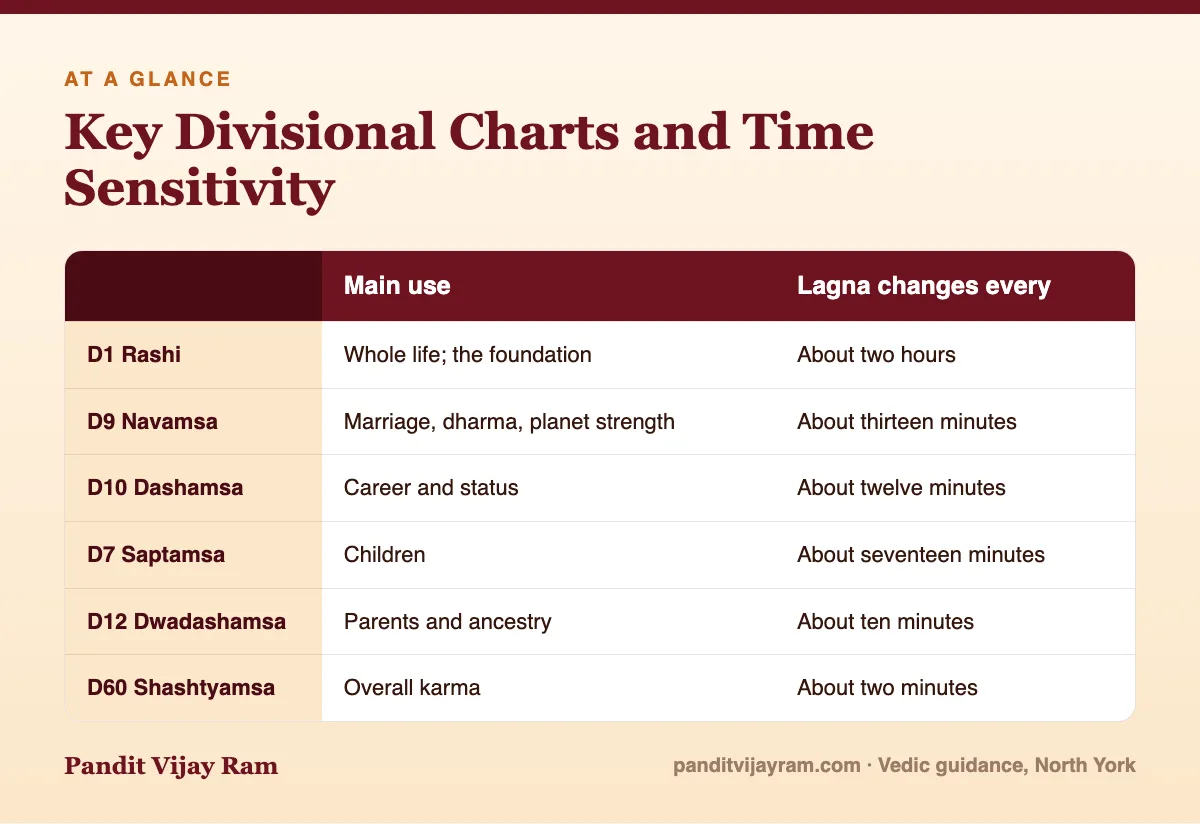
The rising degree moves through the zodiac at roughly one degree every four minutes on average. The smaller a varga's divisions, the faster its lagna changes. The D9 lagna shifts about every thirteen minutes, the D10 every twelve, and the D60 roughly every two. A modest error in birth time can therefore change the finer charts completely.
Here are approximate averages for how long each varga lagna stays in one sign. Actual times vary by sign and latitude, sometimes considerably, especially in Canada.
- D1: about two hours.
- D2: about one hour.
- D3: about forty minutes.
- D7: about seventeen minutes.
- D9: about thirteen minutes.
- D10: about twelve minutes.
- D12: about ten minutes.
- D24: about five minutes.
- D60: about two minutes.
Now compare that with how birth times are usually recorded. Many certificates and family memories round to the nearest five, fifteen or thirty minutes. Even a hospital time may be noted a few minutes after the actual moment.
What that means in practice:
- With a time known only to the nearest hour, rely on the D1 and the Moon, and treat even the D9 lagna as uncertain.
- With a time accurate to about five minutes, the D9 and D10 are usually usable, with boundary checks.
- For the D60, only a carefully documented or rectified time makes sense, and rectification itself is an estimate.
Planets other than the Moon move slowly, so their varga signs are steadier than the lagna's. That is why astrologers sometimes use planetary dignity in vargas even when the varga lagna is uncertain. If your time is uncertain, our guide to the lagna and birth time explains how to check it.
How are the D10 and D7 charts used for career and children?
The D10 is read through its lagna, tenth house and the D10 positions of the Sun, Saturn, Mercury and the birth chart's tenth lord. The D7 is read through its fifth house, its lagna and Jupiter. Both refine what the birth chart already shows. Neither predicts a particular job or pregnancy, and both depend on precise birth times.
D10 for career. A practical reading order:
- Check the D1 tenth house, its lord and planets aspecting it.
- Note the D10 lagna and tenth house, if the birth time supports them.
- See where the D1 tenth lord, the Sun and Saturn fall in the D10.
- Look for planets gaining dignity in the D10, often read as talents that grow at work.
Career choices also need aptitude, training and the job market. Our article on choosing a career with astrology treats the chart as one input among several, and Vijay Ram ji's business and career guidance works the same way.
D7 for children. Astrologers start with the D1 fifth house, its lord and Jupiter, then check the D7 fifth house and Jupiter's condition there. A strained D7 describes a theme needing patience and care, never a ruling on whether a family will have children.
For anyone trying to conceive, a family doctor or fertility specialist comes first. Prayer and chart insight can sit alongside medical care, as the santan prapti guide explains.
The same honesty applies to every varga. These charts describe tendencies in fine detail, and that detail is only as good as the birth time behind it. Readings that announce exact events from a D60 or D30 deserve polite scepticism.
The bottom line
Divisional charts split each sign into finer parts to examine specific life areas, from the D2 for wealth to the D60 for overall karma. Parashara's sixteen vargas are the classical set, but the D1 and D9 carry the most weight, with the D10 and D7 widely used for career and children. Because finer vargas change every few minutes, birth-time accuracy decides how far each chart can be trusted. Use them to refine the birth chart, never to override it.
Key takeaways
- Divisional charts are derived from the birth chart's exact degrees.
- Parashara lists sixteen vargas, called the shodashvarga.
- D1 and D9 matter most; D10 and D7 are common next.
- Finer vargas change lagna within minutes, so time accuracy is vital.
- A varga refines the birth chart and never overrides it.