
Varshphal: How an Annual Solar Return Chart Is Read

Many families ask for a reading around a birthday, hoping to understand the year ahead. In Jyotish the traditional tool for that is varshphal, sometimes written varshaphala, meaning "fruits of the year". Clients in North York often bring printouts from apps that show a mysterious second chart with words like muntha and varshesh, and they want to know what any of it means. This article explains how a varshphal chart is calculated, where the Tajika method came from, how the muntha moves, how the lord of the year is chosen, and which timing tools are used within the year. It also sets out the most important rule: the annual chart works inside the birth chart and its dasha, never above them. In more than forty years of reading charts, I have seen people take an annual chart far too literally, worrying over a single placement. Read in proportion, it is a useful lens for planning the year's priorities. Read alone, it misleads, and nobody should use it to predict specific events.
What is varshphal in Vedic astrology?
Varshphal is an annual horoscope cast for the moment the transiting Sun reaches the same sidereal longitude it occupied at birth, called varsha pravesh. It belongs to the Tajika system, which Indian astrologers adapted from Persian and Arabic sources, and it describes the themes of one year of life, read alongside the natal chart.
The name Tajika points to its origin. Medieval Indian astrologers encountered Persian and Arabic astrology and absorbed several of its techniques, including annual revolutions, sensitive points and applying and separating aspects. Over time these were written up in Sanskrit, and the best-known manual is Tajika Neelakanthi by Neelakantha.
The result is a hybrid. It uses the sidereal zodiac and Indian planetary meanings, but its aspect rules and yogas come from the Tajika tradition rather than from Parashara.
Western astrology has a close relative in the solar return. The main difference is the zodiac: the Vedic Sun returns to its sidereal degree, the Western Sun to its tropical one. The moment can fall a little apart, and because the solar return uses a different rising sign, the charts may look quite different. Our comparison of Vedic and Western astrology explains the zodiac question.
Note that the return moment rarely falls exactly at the birthday hour. The Sun's motion and the calendar do not line up perfectly, so the varsha pravesh may come a day before or after the birthday, at a different time of day.
Vijay Ram ji includes an annual chart within a kundli and horoscope reading when a client wants to plan the coming year.

How is a varshphal chart calculated?
The astrologer finds the exact moment the transiting Sun matches its natal sidereal degree, then casts a chart for that moment. Most schools use the place where the person is living at the time of the return, though some prefer the birthplace. The ascendant of this chart, the varsha lagna, sets the annual houses.
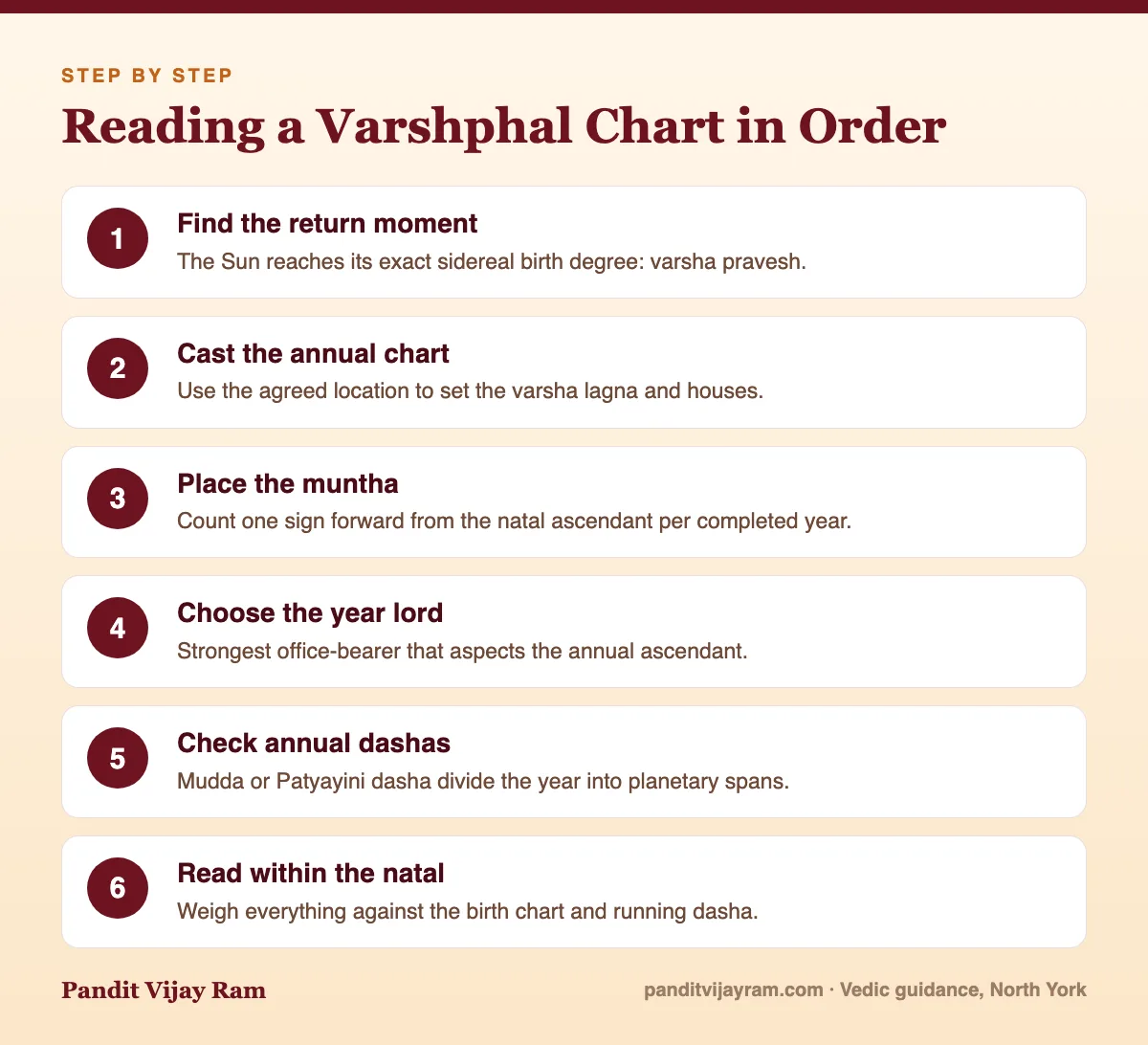
The calculation runs in a fixed order.
- Confirm the natal Sun. This requires an accurate birth chart and a consistent ayanamsa. A different ayanamsa shifts the return moment.
- Find the return moment. Software searches for the instant the Sun reaches that degree in the relevant year of life.
- Choose the location. Many modern practitioners use the city where the person is when the return happens. For someone living in Toronto, that means a Toronto chart even if they were born in Punjab or Guyana. Others use the birthplace throughout life. Ask which convention your astrologer follows.
- Cast the annual chart. The rising sign at that moment becomes the varsha lagna, and the planets are placed in annual houses.
- Calculate the muntha and office-bearers. These are explained below.
- Calculate sahams. These are sensitive points, similar to Arabic parts, found by adding and subtracting planetary longitudes.
Because the varsha lagna changes every year, two people born on the same day can have different annual charts if they live in different cities.
Accurate birth data matters even more here than usual. A small error in birth time can move the natal Sun by a fraction, shift the return time and change the varsha lagna. Our guide on preparing for a kundli reading covers how to confirm birth details.
What is muntha in varshphal?
Muntha is a progressed point that starts in the natal ascendant sign at birth and moves forward one sign for each completed year of life. Its sign and house in the annual chart, and the condition of its lord, are read as a key indicator of the year's emphasis. It completes the zodiac every twelve years.
Working out the muntha is simple arithmetic. Take the natal rising sign, then count forward by the number of years completed. A person with a Leo ascendant who has just completed thirty years counts thirty signs from Leo. Thirty is two full rounds plus six, so the muntha falls six signs on, in Aquarius.
Then the astrologer asks:
- Which house of the annual chart does the muntha occupy?
- Is the muntha's sign lord strong, well placed and supported by benefics?
- Do benefic or malefic planets aspect it, by Tajika rules?
Texts generally regard the muntha as most supportive in the 9th, 10th and 11th annual houses, and as needing more care in the 4th, 6th, 8th and 12th. Schools differ on the remaining houses, and the lord's condition can soften or strengthen any placement.
A caution: the muntha is one factor among many. A so-called bad muntha house describes an area of life that may need attention, not a misfortune. People who panic about it usually stop reading the rest of the chart, which is where balance comes from.
How is the lord of the year chosen?
Tajika texts list five office-bearers, the panchadhikaris: the lord of the natal ascendant, the lord of the annual ascendant, the muntha lord, the tri-rashi lord and the day-night lord. The strongest of these that aspects the annual ascendant usually becomes the varshesh, or year lord, whose condition colours the whole year.
This selection is one of the more technical steps, and it shows how Tajika thinking differs from Parashari reading.
- Janma lagna lord: ruler of the natal rising sign.
- Varsha lagna lord: ruler of the annual rising sign.
- Muntha lord: ruler of the sign holding the muntha.
- Tri-rashi pati: a planet assigned by a table according to the annual ascendant and whether the return falls by day or night.
- Din-ratri pati: for a daytime return, the lord of the sign occupied by the Sun; for a night return, the lord of the Moon's sign.
Strength is measured with the Tajika method called pancha-vargiya bala, and the chosen planet must also aspect the varsha lagna by Tajika aspect. If none qualifies, texts give fallback rules.
Tajika aspects work by angle and orb, closer to Western practice, and they create named yogas. Ithasala is an applying contact between two planets, often read as a matter coming together. Ishrafa is a separating contact, a matter that has passed. There are sixteen named Tajika yogas in all.
Once chosen, a strong, well-placed year lord is read as a supportive tone for the year, and a weak one as a year that asks for patience. Both are tendencies. For how planetary strength is judged more broadly, see our guide to exalted and debilitated planets.
How does varshphal relate to the natal chart and dasha?
The annual chart works within the birth chart, not above it. The natal chart shows the overall potential, the running Vimshottari dasha shows the chapter of life, and varshphal shows how that chapter may express itself during one year. An annual chart cannot deliver what the natal chart and dasha do not support.
This principle prevents most of the errors I see in app-generated annual reports. A useful way to picture it is three layers.
- Natal chart: the lifelong landscape, read through houses, lords, yogas and divisional charts.
- Dasha: which part of that landscape is lit up during a period of years. See Vimshottari dasha explained.
- Varshphal: the weather of one year inside that period.
Within the year, Tajika astrologers use their own short timing tools. Mudda dasha compresses the Vimshottari sequence into a single year, so each planet rules a few days to a couple of months. Patyayini dasha divides the year by the planets' positions in the annual chart.
When the annual chart and the dasha agree, astrologers give the theme more weight. When they disagree, the natal and dasha picture is usually trusted more.
Transits matter too. Saturn's and Jupiter's movements, read from the Moon, still apply during the year; our article on gochar transits covers those. For the timing of specific transits in a given year, consult a current ephemeris or a Toronto panchang rather than any generic list.
Can varshphal predict events in the coming year?
No reliable evidence shows that annual charts predict events. In practice, varshphal is best used as a planning lens: which areas of life the tradition highlights, where to be patient, and which practices might steady you. Decisions about health, money, work, law or immigration still belong with qualified professionals and your own judgment.
Annual readings tempt people to look for dates: the month of a job offer, a wedding, a move. Those questions are understandable, but neither natal nor annual astrology can honestly answer them.
Here is how I suggest using an annual chart:
- Name two or three themes. For example, the 4th house highlighted by muntha might suggest attention to home and parents.
- Pair each theme with a practical step. A home theme might prompt a family conversation or a maintenance plan, not a ritual alone.
- Choose one steady devotional practice linked to the year lord, such as a weekday mantra, if that is meaningful to you.
- Leave the rest open. Life brings things no chart mentioned.
Be wary of anyone who uses an annual chart to frighten you into costly remedies before your birthday. A year with a weaker year lord is a year for steadiness, not panic.
Varshphal is also not a substitute for medical care, legal advice or financial planning. If the year ahead holds real worries in those areas, start with the professionals and let the chart, at most, help you reflect on how you meet them.
The bottom line
Varshphal is the Tajika annual chart, cast for the moment the Sun returns to its natal sidereal degree. It is read through the annual ascendant, the muntha, the lord of the year and short annual dashas. Above all, it works inside the natal chart and the running Vimshottari dasha, and it describes themes rather than predicting events. Used as a planning lens, a varshphal reading can help you set sensible priorities for the year.
Key takeaways
- Varshphal is cast for the moment the Sun returns to its exact sidereal birth degree.
- The muntha moves one sign per completed year, starting from the natal ascendant.
- The year lord is chosen from five office-bearers by strength and aspect to the annual ascendant.
- The annual chart works within the natal chart and running dasha, never above them.
- Use it to plan priorities, not to predict dates or events.