
The 10th House in a Kundli: Career, Status and Reputation

Most people who ask about their chart and career are not looking for mysticism. They want to know whether they are in the right field, why recognition feels slow, or whether a change is wise. The 10th house career reading is where an astrologer starts, and it is often misunderstood. Here is what it involves, for professionals in North York and across the diaspora. You will learn what the karma bhava signifies, why it is considered the strongest kendra, how the 10th lord's placement shapes the way you work, what the Sun, Mercury, Jupiter and Saturn contribute, how the D10 chart refines everything, and where the chart's usefulness ends. For choosing a field or a change, other articles on this site go deeper, and links appear below. In more than forty years of reading charts I have found the 10th house most helpful at describing how a person works best. The exact job title is decided by skill, opportunity and choice.
What does the 10th house represent in a kundli?
The 10th house, called karma bhava, represents profession, actions in the world, authority, status, reputation and public life. It is a kendra, an angular house, and also an upachaya, a house that improves with effort and time. Many astrologers consider it the most powerful of the four kendras for worldly achievement.
The word karma here means action, not fate. The 10th house shows what you do in public and how the world sees it. Classical and modern sources assign it a cluster of meanings:
- Profession and duty: the work you are known for, paid or unpaid.
- Status and reputation: standing in a profession or community.
- Authority: bosses, governments and your own leadership.
- Achievement: honours, promotions and visible results.
- Father: some lineages read the father partly from the 10th, though the 9th is the classical house for him.
Two classifications matter. As a kendra, the 10th gives planets placed there prominence and a capacity to act. As an upachaya, along with the 3rd, 6th and 11th, it is a house where results tend to grow with age and effort. That is a hopeful idea: career outcomes in a chart are not fixed at birth but are expected to build.
The 10th also has natural significators, or karakas. The Sun signifies authority and government; Mercury, commerce and skill; Jupiter, wisdom and good fortune; Saturn, labour, service and persistence. Saturn is often called the karma karaka, the significator of work itself.
For how the 10th fits with the other eleven houses, see our plain-English guide to the twelve bhavas.

What does the 10th lord's placement say about career?
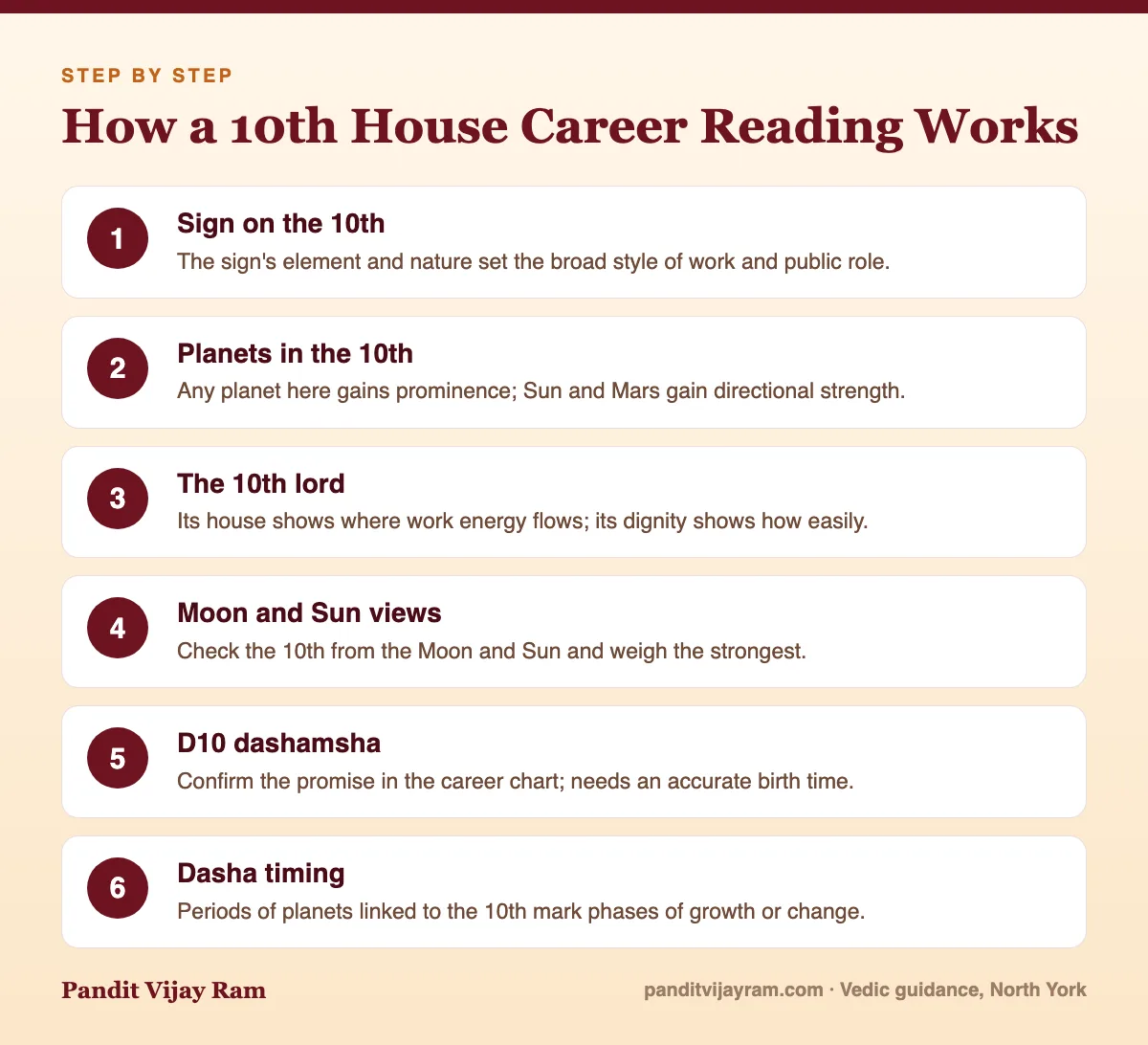
The house occupied by the 10th lord shows where your work energy flows. A 10th lord in the 7th suggests work through partnerships or clients; in the 4th, work linked to property, education or home; in the 12th, work abroad, in institutions or behind the scenes. Its sign, dignity and aspects show how easily that flows.
Find the sign on your 10th house; its ruling planet is the 10th lord. Then see where it sits. Common readings, offered as tendencies:
- 1st: self-directed work; career closely tied to personal identity.
- 2nd: family business, finance, speech, food or teaching.
- 3rd: communication, media, sales, short travel, skilled trades.
- 4th: property, vehicles, education, agriculture, work from home.
- 5th: creativity, advising, teaching, speculation-linked fields.
- 6th: service, health care, law, competitive or problem-solving work.
- 7th: partnerships, consulting, trade, client-facing roles.
- 8th: research, insurance, investigation, occult study, irregular paths.
- 9th: teaching, religion, law, publishing, international links.
- 10th: strong focus on career; often self-made standing.
- 11th: large organisations, networks, steady gains from work.
- 12th: foreign settings, hospitals, charities, behind-the-scenes roles.
These are directions, not job titles. A 10th lord in the 6th could describe a nurse, a litigator or a mechanic. Its sign narrows things further: fire signs lean towards initiative, earth towards practical work, air towards ideas and people, water towards care and intuition.
A strong 10th lord that also connects with the lords of the 9th or 5th forms one of the classic links described in our post on raj yoga. For career paths specifically, see using astrology to choose a field.
Which planets in the 10th house are good for career?
The Sun and Mars are said to gain directional strength, dig bala, in the 10th, so both are traditionally welcome there. Jupiter and Mercury bring advisory and commercial skill; Saturn brings slow, solid achievement through hard work. Any planet in the 10th becomes prominent in public life, so even 'difficult' planets can give drive and visibility.
Brief themes for each planet in the 10th house:
- Sun: leadership, government, administration, a desire for recognition; strong here by direction.
- Moon: public-facing roles, care work, hospitality; career changes may come in phases.
- Mars: engineering, defence, surgery, sport, property, management; also strong by direction.
- Mercury: commerce, accounting, writing, technology, communication.
- Jupiter: teaching, law, finance, counselling, religious work.
- Venus: arts, design, beauty, hospitality, luxury goods, diplomacy.
- Saturn: long-term institutions, labour, construction, public service; rising slowly but steadily.
- Rahu: unconventional or foreign fields, technology, ambition that can be restless.
- Ketu: specialist or technical work, research, sometimes detachment from status.
Two cautions. First, an empty 10th house is not a bad sign; then the 10th lord and the aspects on the house tell the story. Second, a planet's results also depend on which houses it rules from your lagna. Saturn in the 10th for a Taurus ascendant rules the 9th and 10th and is excellent; for a Leo ascendant it rules the 6th and 7th, giving a different flavour.
For questions about steady public-sector roles, our post on government job indicators discusses the Sun, the 10th and the 6th honestly.
How is the D10 dashamsha chart used for career?
The dashamsha, or D10, divides each sign into ten parts of three degrees and is the main divisional chart for career. Astrologers check its ascendant, the condition of the birth chart's 10th lord within it, and planets in its 10th house. Because the D10 ascendant changes roughly every twelve minutes, an accurate birth time is essential.
Divisional charts, or vargas, zoom in on one area of life. The D10 is the career lens. Its construction follows a classical rule: for odd signs, the ten parts are counted starting from the same sign; for even signs, from the ninth sign. Our overview of divisional charts explains the wider system.
A simple working method many astrologers follow:
- Confirm the birth time. If it is uncertain by more than a few minutes, treat the D10 as provisional.
- Find the birth chart's 10th lord in the D10. Is it in its own sign, exalted, or debilitated there? This shows whether the career promise holds up under the microscope.
- Look at the D10 lagna and its lord. These describe the overall professional temperament.
- Check the D10's 10th house. Planets there add colour to the kind of work suited.
- Compare with the dasha. Planets strong in both the birth chart and D10 tend to give career developments during their periods.
Some practitioners add the Jaimini amatyakaraka, the planet with the second-highest degree in the chart, as a career significator. Others use the 10th from the Moon and Sun alongside the lagna. A classical rule from Phaladeepika looks at the lord of the navamsa occupied by the 10th lord to suggest the source of livelihood. Different methods, same aim: a consistent picture across several views.
Can a kundli tell me which career to choose?
A kundli can describe your working style, likely strengths and periods of growth or pressure. It cannot reliably name a specific job, predict an offer, or replace aptitude, training and the job market. Use the 10th house as one input next to career counselling, skills assessments and honest conversations with people in your target field.
A practical way to combine astrology with real-world planning:
- Start with what you know: your interests, skills, education and the work you lose track of time doing.
- Check the labour market: Canada's Job Bank lists outlooks and requirements for occupations by province.
- Talk to people: informational interviews with those already in the field reveal more than any chart.
- Then read the chart: does the 10th house and its lord broadly agree with what you have found? Where they differ, it may point to a side of work you have not tried.
- Use timing gently: a supportive dasha can be a good time to apply, retrain or ask for responsibility, but a hard one is no reason to stay stuck.
If you are facing a delay at work, our article on promotion delays covers workplace realities first. For bigger shifts in mid-career, see career change and astrology.
A business and career consultation brings the chart together with practical planning. Astrology is spiritual guidance and personal reflection; it is not a substitute for career, financial or legal advice from qualified professionals.
The bottom line
The 10th house career reading begins with karma bhava itself: its sign, its planets and the placement of its lord. The Sun, Mercury, Jupiter and Saturn each add a distinct flavour, and the D10 dashamsha refines the picture when the birth time is accurate. Use all of this to understand your working style and timing, alongside skills, training and the job market, not as a prescription for one job.
Key takeaways
- The 10th house, karma bhava, governs work, status, authority and reputation.
- It is both a kendra and an upachaya, so career results tend to grow with effort.
- The 10th lord's house shows where work energy flows; its sign shows the style.
- The Sun and Mars gain directional strength in the 10th; Saturn is the karma karaka.
- The D10 refines career readings but needs an accurate birth time.