
Career Change Later in Life: Using Your Chart as One Input

Changing careers in your forties or fifties can feel both exciting and frightening. There may be a mortgage, children in school, ageing parents, and a quiet voice asking whether it is too late. People from North York and across the GTA often come to me at exactly this point, asking whether career change astrology can confirm that the moment is right. I understand why. A chart offers a sense of order when a decision feels too large to hold. This article treats the chart honestly, as one input among several. It begins with the practical planning that decides whether a change succeeds: a money runway, a skills inventory, conversations with people in the new field, and a trial before the leap. It then outlines the kinds of retraining support available to adults in Canada, and only after that explains how astrologers read dasha periods and Saturn's cycle for timing. In more than forty years of practice, I have watched many people make late career changes well, and the common thread has been careful preparation and family support rather than a perfect planetary moment.
Can astrology help with a career change later in life?
Astrology can help you reflect on what suits your temperament and on whether a period feels like a time for consolidation or new beginnings. It cannot tell you which job offer to accept or whether a new career will succeed. Use it beside aptitude, finances, labour-market information and family advice, never instead of them.
A new career kundli reading usually starts with the same houses as any career reading: the 10th house of work, its lord, the 6th house of daily service and the 11th house of gains. The lagna and Moon describe temperament: whether you prefer stability or variety, solitude or teams.
Where midlife change is concerned, a chart reading can do three helpful things:
- Name your strengths. A strong Mercury may point to communication and analysis; a strong Mars to hands-on, active work; a strong Jupiter to teaching or advising. Our article on choosing the right career field with astrology lists these associations.
- Frame the period. A dasha change can feel like a natural moment to reassess. Naming it may help you stop drifting.
- Ease self-blame. People who feel restless often think something is wrong with them. Seeing the restlessness as part of a period can bring calm.
What a reading should not do is push you into a leap you have not planned. Anyone who says "you must change jobs before a certain date or suffer" is using fear, not astrology.
If your question is really about being stuck where you are rather than leaving, our guide to promotion delays and Saturn may be a better fit.

How do I plan a career change at 40 or 50?
Build a money runway first, list the skills you already have, speak to people working in the new field, and test the change with a course, volunteering or part-time work. Involve your family early. A good decision rule: do not resign until you have tested the new path and covered several months of expenses.
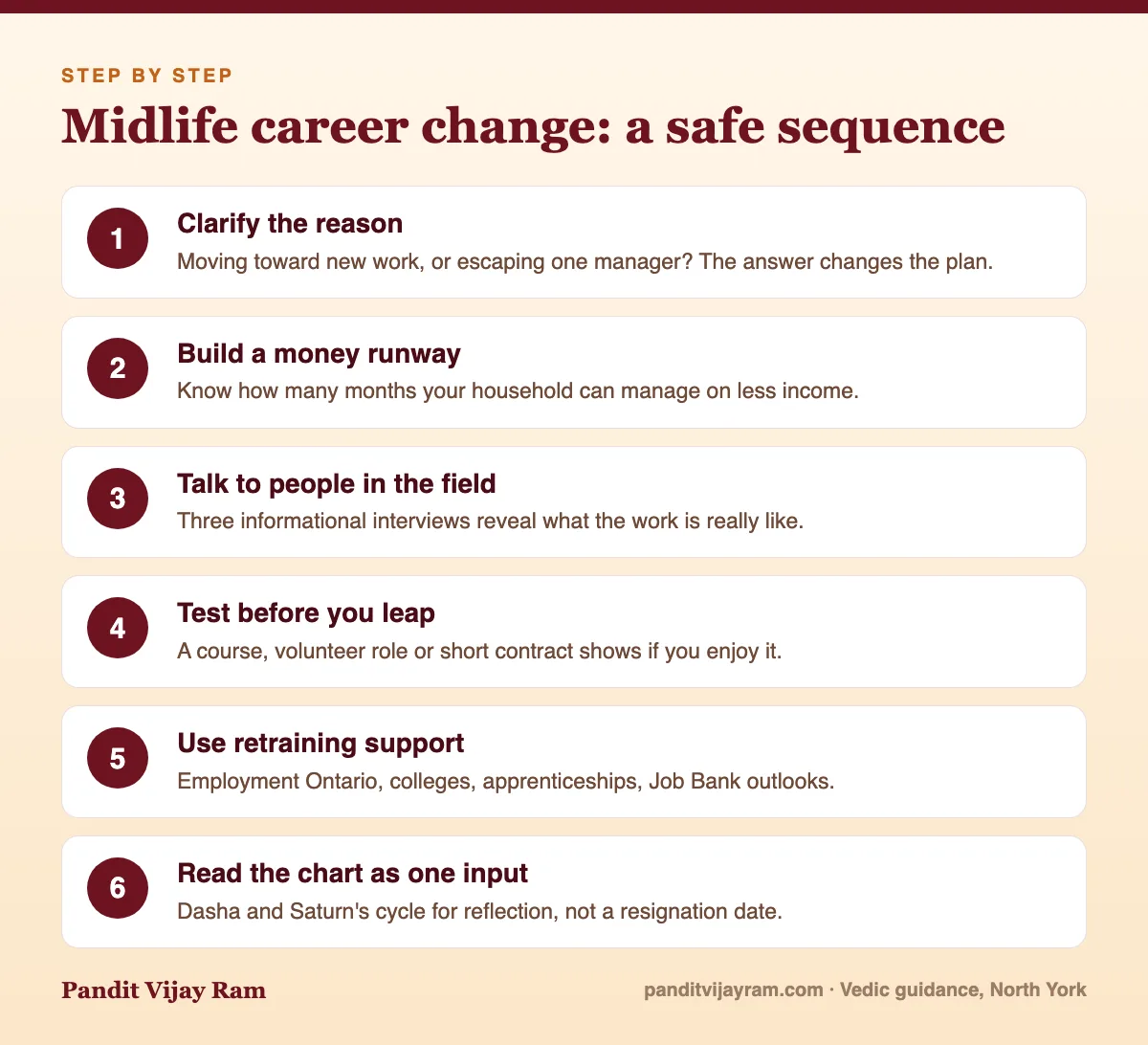
Changing careers at 40 is not unusual. Plenty of people retrain, start businesses or move sectors in midlife. The ones who manage it best tend to follow a plan like this:
- Clarify the reason. Are you moving toward something, or escaping a bad manager? The second may need a new employer rather than a new career.
- Calculate your runway. Work out how many months your household could manage on reduced income. Include training costs.
- List transferable skills. Managing people, budgets, clients or projects carries across many fields.
- Hold informational interviews. Ask three people in the target field what the work is really like, and what they would do in your place.
- Run a small test. An evening course, a volunteer role or a short contract shows whether you enjoy the work.
- Plan the bridge. Part-time hours, a phased move or a side business can reduce risk.
- Agree with family. A spouse or parents who understand the plan are far more supportive than ones who learn about it after a resignation.
Decision rule: if the test went well and your runway covers several months, a move is reasonable. If either is missing, keep building before you jump.
If your career change was not chosen but followed a layoff, our article on spiritual help after a job loss covers the first practical steps in Canada.
Ask the market
Job postings in the field you want are free research: note the qualifications that appear again and again.
What retraining options exist in Canada for adults changing careers?
Adults in Canada can explore Employment Ontario services, continuing-education programs at colleges and universities, apprenticeships in skilled trades, credential-recognition help for internationally trained professionals, and federal tools such as Job Bank. The Canada Training Credit may help eligible workers with course costs. Check current eligibility on official government websites.
Program names and rules change, so treat this as a starting map and confirm details with each provider.
- Employment Ontario. Provincial employment services offer career counselling, job-search help and, for eligible people, information about training support.
- Colleges and universities. Continuing-education departments run evening, weekend and online courses built for working adults.
- Apprenticeships. Skilled trades combine paid on-the-job learning with classroom training. Many people enter them in midlife.
- Credential recognition. Internationally trained professionals, such as engineers, nurses and accountants, can contact their regulatory body about assessment and bridging programs.
- Job Bank. The federal Job Bank lists jobs and publishes labour-market information about wages and outlook by occupation.
- Canada Training Credit. A refundable federal tax credit that may help eligible workers with tuition. Check the Canada Revenue Agency's site for current rules.
- Settlement agencies. Newcomers can find free career workshops and mentorship.
A short conversation with a career counsellor before enrolling can save money and time. Ask about job placement rates and whether employers in the field actually recognise the credential.
Nothing here is financial advice. If retraining means borrowing, a non-profit credit counsellor can help you plan.
When is the right time to change jobs according to astrology?
Astrologers look at dasha changes, the antardasha of the 10th lord or of planets linked to new beginnings, and Saturn's return to its natal position, roughly every 29 to 30 years. These are read as periods that invite reassessment. They are not instructions, and practical readiness should decide your actual timing.
In the Vimshottari system, life unfolds through planetary periods of fixed length: Venus twenty years, Saturn nineteen, Mercury seventeen, Rahu eighteen, Jupiter sixteen, the Moon ten, Mars and Ketu seven each, and the Sun six. The order and starting point come from your birth nakshatra. Our Vimshottari dasha explainer sets out the sequence.
For questions about the right time to change job, astrologers commonly consider:
- Mahadasha transitions. The months around the change from one major period to the next, called dasha sandhi, are often described as unsettled. Some readers advise caution here; others see it as a natural pivot.
- Antardasha of the 10th lord. Read as a time when career themes come forward.
- Jupiter periods. Associated with learning and teaching, which suits retraining. See our Jupiter mahadasha guide.
- Saturn return. Saturn takes about 29 and a half years to circle the zodiac. Its return near ages 30 and 59 is widely discussed as a time of reckoning with responsibility.
- Rahu periods. Linked with restlessness and unconventional moves, sometimes impulsive ones.
Notice that these periods apply to everyone in some form. I use them to ask good questions: what has outlived its purpose, what do you want to learn next? The answers, not the dates, guide a sensible career transition.
What if fear or family pressure is holding me back?
Fear of starting over and family expectations are the most common barriers to a late career change. Talk openly with your family about the plan and the safety net, seek a career counsellor's view, and keep a steadying practice. If worry is affecting sleep or mood, see your family doctor.
Many families, especially those who immigrated and sacrificed for stability, find a midlife career change unsettling. A parent may ask why you would leave a secure job. A spouse may worry about the mortgage. These concerns deserve respect, not dismissal.
Some approaches that help:
- Share the numbers. Show the runway and the bridge plan. Concrete plans calm fearful relatives.
- Invite them in. Ask a spouse or parent to join an information session or meet someone in the new field.
- Agree checkpoints. "If this has not worked after a set period, I will return to my old field" gives everyone reassurance.
In the chart, a strong Saturn or a sensitive Moon can describe caution and worry, while a strong Mars or Rahu describes appetite for risk. Seeing your own pattern helps you balance it.
Simple devotional practices support courage. A Ganesh prayer at the start of any new course marks a fresh beginning. Saraswati vandana honours learning. Some people offer yellow flowers or chana dal on Thursdays for Jupiter, the planet of wisdom.
If you would like your 10th house, dasha and temperament read together, the business and career consultation treats the chart as one input in a wider plan. And if anxiety or low mood is persistent, please speak with your family doctor.
The bottom line
Career change astrology is most useful as one input: a way to reflect on temperament and on whether a period invites reassessment. The decisive work is practical, from building a money runway and testing the new field to using Canadian retraining and labour-market resources. Dasha changes, Jupiter periods and Saturn's return can frame the question, but they should not set your resignation date. Plan carefully, bring your family with you, and let prayer steady the courage you need.
Key takeaways
- A chart can describe temperament and timing themes but not the success of a new career.
- Build a money runway and test the new field before resigning.
- Employment Ontario, colleges, apprenticeships and Job Bank support adult retraining.
- Dasha transitions and Saturn's return invite reflection rather than dictate decisions.
- Share the plan with family early, and see a doctor if worry affects your health.