
Raj Yoga in a Kundli: What It Really Means and What It Doesn't

Someone looks at your chart and announces that you have a raj yoga. For a moment it feels wonderful. Then years pass, life is ordinary, and you start to wonder whether the yoga was broken, cursed or never real. This article explains raj yoga in kundli terms the way classical texts define it, for readers in North York and beyond. You will see exactly which house lords must combine, which planets become yogakarakas for each ascendant, why most charts contain at least one such link, what makes one strong or weak, and how a dasha switches it on. We will also be frank about what the word 'raja', or king, has come to promise online, and what it can realistically mean in a working life. In more than forty years of reading charts I have met many contented people without a famous yoga and many restless ones with three. The yoga is a capacity, not a crown.
What is raj yoga in a kundli?
In Parashari astrology, a raj yoga forms when a lord of a kendra, the 1st, 4th, 7th or 10th house, connects with a lord of a trikona, the 1st, 5th or 9th. Kendras represent effort and structure; trikonas represent merit and fortune. Their link is read as fortune supporting action, which classical writers associated with rising status.
The houses of a kundli are grouped by function. Kendras, the angular houses, are where you act in the world: self, home, partnership and career. Trikonas, the trines, are where accumulated merit and grace flow in: self, intelligence and children, and dharma or fortune. The lagna belongs to both groups, which is why the ascendant lord is so important.
A connection between the two groups is the heart of the idea. Texts recognise several kinds of link:
- Conjunction: both lords in the same sign.
- Mutual aspect: each lord aspecting the other, such as across the 7th.
- Exchange (parivartana): each lord sitting in the other's sign.
- One-way aspect or placement: one lord aspecting or occupying the other's house, usually treated as weaker.
The strongest pairing is generally said to be the 9th and 10th lords, the lords of fortune and action, often called a dharma-karmadhipati yoga.
If houses are new to you, our plain-English tour of the twelve bhavas is a good first read, and every house lord depends on your rising sign.

Which planet is a yogakaraka for each ascendant?
A yogakaraka is a single planet that rules both a kendra and a trikona, so it forms a raj yoga on its own. Saturn is yogakaraka for Taurus and Libra ascendants, Mars for Cancer and Leo, and Venus for Capricorn and Aquarius. The other six ascendants have no single yogakaraka.
Because each planet except the Sun and Moon rules two signs, it sometimes happens that both of its signs fall in key houses from the lagna. These are the cases:
- Taurus lagna: Saturn rules the 9th and 10th.
- Libra lagna: Saturn rules the 4th and 5th.
- Cancer lagna: Mars rules the 5th and 10th.
- Leo lagna: Mars rules the 4th and 9th.
- Capricorn lagna: Venus rules the 5th and 10th.
- Aquarius lagna: Venus rules the 4th and 9th.
For these ascendants, a well-placed yogakaraka is often the single most useful planet in the chart. Its dasha tends to be a period of building, though not necessarily of comfort; Saturn as yogakaraka still works through patience and hard work.
For Aries, Gemini, Virgo, Sagittarius, Pisces and Scorpio, raj yogas come only from two different lords combining. That is not a disadvantage. It simply means you look at pairs rather than a single planet.
A note on remedies. Some readers recommend a gemstone for the yogakaraka. That can be reasonable, but only after its strength and placement are checked; our gemstone and numerology guidance covers trial wearing and fraud cautions.
Why do so many people seem to have a raj yoga?
Because the definition is broad. With up to seven kendra and trikona houses and several ways for their lords to connect, most charts contain at least one such link. Classical texts list dozens of raj yogas, and modern software often flags every one. Frequency alone tells you a label is not rare enough to promise kingship.
A simple thought experiment shows the problem. There are six distinct lords of the kendras and trikonas in most charts. Each can link to another by conjunction, by aspect, by exchange or by placement. Add the yogakaraka cases and it would be unusual for a chart to show no raj yoga at all.
Then there are the named variants that circulate online: viparita raj yoga from the lords of the 6th, 8th and 12th, neecha bhanga raj yoga from cancelled debilitation, and dozens more. Some appear in classical works such as Brihat Parashara Hora Shastra; some are later additions; some seem to have been named on websites. Our explainer on neecha bhanga and debilitated planets looks at one of the most over-sold.
Dhana yogas, combinations of the lords of the 1st, 2nd, 5th, 9th and 11th, are equally common and equally over-promised. Their money side is covered in our guide to the 2nd and 11th houses.
This is why a serious reader never stops at 'you have a raj yoga'. The useful questions are how strong it is, which houses it involves, and when it is likely to be active. In ancient society, 'king' was the highest status anyone could imagine. Today a working raj yoga more often looks like respect in a profession, a position of responsibility, or steady upward movement.
What makes a raj yoga strong or weak?
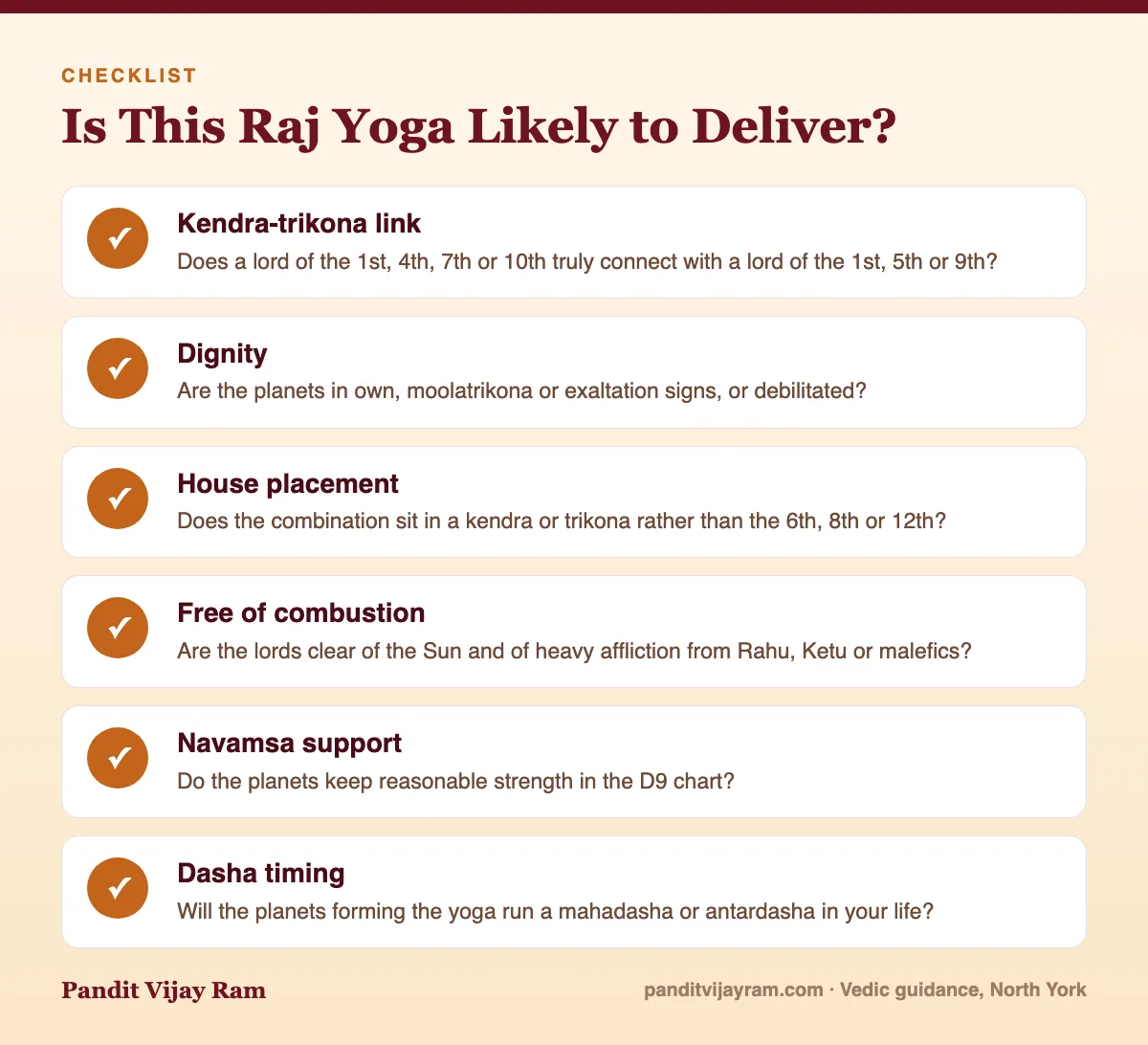
A raj yoga gains strength when its planets are in their own or exaltation signs, well placed in kendras or trikonas, unafflicted by malefics and not combust. It weakens when the planets are debilitated, in the 6th, 8th or 12th, heavily afflicted, combust, or poorly placed in the navamsa. Weak yogas give modest, short-lived results.
A working checklist many astrologers use:
- Dignity: own sign, moolatrikona or exaltation strengthens; debilitation weakens unless cancelled.
- House placement: the combination performs best in a kendra or trikona and struggles in the 6th, 8th or 12th.
- Combustion: a lord too close to the Sun loses some capacity to deliver; see our guide to combust planets.
- Afflictions: conjunction with or aspect from difficult house lords, Rahu or Ketu can dilute or complicate results.
- Dual lordship: a planet that rules a kendra but also the 8th, for example, carries mixed results.
- Navamsa: planets that keep their dignity in the D9 are considered more reliable.
- Lagna strength: a weak ascendant and lord limit how much any yoga can deliver to the person.
Shadbala, the six-fold strength calculation, gives a numerical view of the same idea. It is useful but should not override judgement; a planet with modest shadbala but excellent placement can still perform.
Honest assessment cuts both ways. A raj yoga that fails several of these tests is still a real connection in the chart. It may show up as a few good years, a respected role in a small community, or recognition later in life. That is worth knowing, and it is far more useful than a promise of fame.
When does a raj yoga give results?
Raj yogas are traditionally said to give results during the dasha or antardasha of the planets that form them, especially when transits support the same houses. A yoga whose planets never run a major period in your lifetime may stay mostly latent. That is why timing, not presence, is the real question.
Parashari astrology treats the dasha as the switch. If your raj yoga is formed by the 9th lord Jupiter and the 10th lord Mercury, the Jupiter and Mercury mahadashas, and their sub-periods within other dashas, are the windows when its themes are most likely to surface. Our guide to Vimshottari dasha explains the sequence.
Some planets also run their periods at life stages that shape the result. A raj yoga activated in childhood may show as family circumstances; one activated in the forties may show as career standing. Some yogas are never activated by a major period at all, which is one reason two people with the 'same' yoga can have quite different lives.
What it does not do. No raj yoga guarantees a job title, an election win, a visa or wealth. It describes a tendency towards responsibility and recognition when circumstances, effort and timing line up. Education, health, character and opportunity still do most of the work.
If you want to know whether a yoga in your chart is real, strong and likely to be active, a careful kundli reading will look at all of the above. For career-specific questions, business and career guidance combines the chart with practical planning.
The bottom line
Raj yoga in kundli terms is a connection between kendra and trikona lords, or a single yogakaraka that rules both. Most charts have one, so its presence matters far less than its strength and the dasha that activates it. Read realistically, a raj yoga points to capacity for responsibility and recognition, never a promise of power or wealth.
Key takeaways
- A raj yoga links a lord of the 1st, 4th, 7th or 10th with a lord of the 1st, 5th or 9th.
- Saturn, Mars or Venus is a yogakaraka for six ascendants and forms the yoga alone.
- Raj yogas are common, so their presence alone predicts very little.
- Dignity, placement, combustion and afflictions decide how much a yoga can deliver.
- Results appear mainly in the dashas of the planets forming the yoga.