
Save My Marriage From Divorce: Steps Before It Is Too Late

Perhaps the word divorce has been said out loud for the first time. Perhaps it has been hanging in the air for months. You still love your spouse, or at least you remember loving them, and you want to know whether there is a way back. When someone asks me how to save my marriage, I take the question seriously, because many marriages that feel finished can recover. Couples visit me in North York from across the GTA at exactly this point, sometimes together and sometimes one partner alone. This guide sets out a practical step plan: how to stop the damage, how to find the real issues underneath the arguments, how counselling helps, how to rebuild everyday warmth, and how to recognise when separation would be kinder for everyone. It does not offer magic, timelines or promises. In more than forty years of practice, I have seen that marriages recover when both people start working on themselves rather than on each other, and when the family around them gives the couple room to try.
Can I save my marriage from divorce?
Often, yes, if both partners are willing to try, there is no ongoing abuse, and each person is prepared to change something in themselves. Marriages recover from long distance, money fights, in-law strain and even affairs. They cannot be saved by one partner alone, by pressure, or by ritual without real change.
Before starting any plan, ask yourself three honest questions:
- Are we both willing? A spouse who says "I'm not sure" is still open. A spouse who has clearly decided to leave needs respect, not a campaign. If that is your situation, the guide on when a wife wants a divorce covers listening and accepting her choice.
- Are we safe? If either of you is afraid of the other, the first step is safety, not repair.
- Am I ready to look at my own part? Every long conflict has two contributors, even when one has done more harm.
If the answers are yes, the outlook is better than most people in crisis believe. Many couples who reach this point have simply run out of skills, not out of love. Long working hours, children, immigration stress and family pressure wear down the habits that once kept them close.
The decision-focused guide on whether a relationship is worth saving includes a checklist that can help you think this through before you start.

What are the first steps to save a marriage on the rocks?
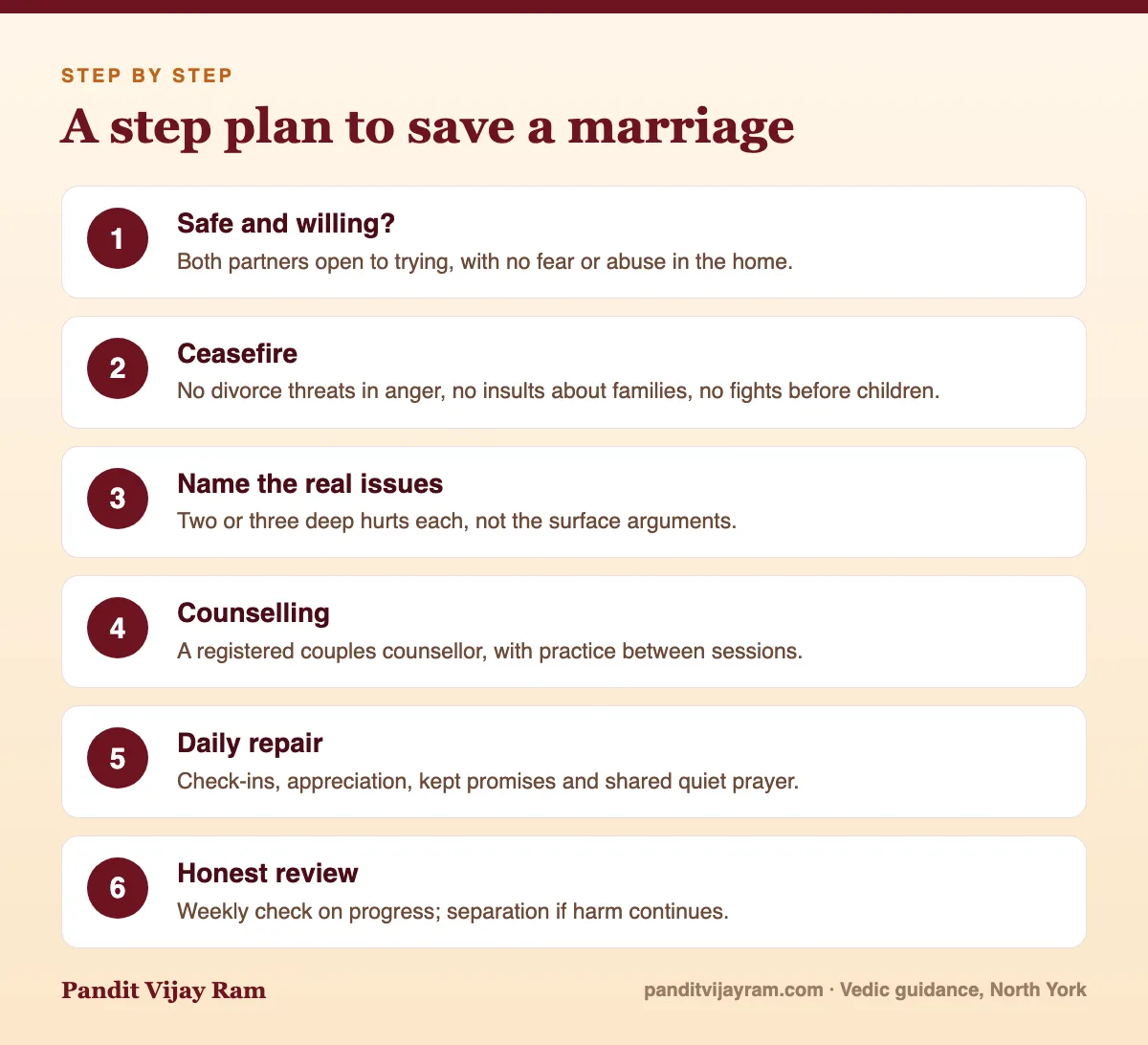
First, call a ceasefire on hurtful arguments. Second, each write down the two or three issues that matter most. Third, agree on one change each that you will make this week. Fourth, book a couples counsellor. Fifth, ask family to give you privacy while you work on things together.
Couples in crisis often try to solve everything at once, in one long, exhausting talk. That rarely works. A slower, clearer order helps:
- Ceasefire. Agree that for the next few weeks, neither of you will raise divorce in anger, insult the other's family or argue in front of the children. When a conversation heats up, either can call a twenty-minute break.
- Name the real issues. Separately, each writes the two or three things that hurt most. Often they are different from the fights you have: the fight is about dishes, the issue is feeling unappreciated.
- One change each. Choose something small and visible, such as coming home by seven, or not checking the phone at dinner.
- Counselling. Book a first appointment rather than waiting until things improve on their own.
- Family boundaries. Ask parents and siblings to stop discussing your marriage and stop taking sides while you work on it.
- Review weekly. Spend fifteen minutes each Sunday saying what went better and what still hurts.
If an affair is part of the story, the guide to rebuilding trust after cheating covers the extra steps of accountability and transparency.
How does marriage counselling help when a marriage is close to divorce?
A counsellor slows the conversation down so both people feel heard, identifies the cycle that keeps repeating, and teaches specific skills to interrupt it. Approaches such as emotionally focused therapy and research-based methods help partners understand the hurt beneath the anger. Couples usually attend weekly or fortnightly and practise between sessions.
Many couples from our communities feel uneasy about telling a stranger their private problems. A good counsellor respects culture and faith, and does not ask anyone to abandon their values. Their job is to help both of you be understood.
What to expect:
- An assessment. The first session or two usually cover your history, the main conflicts and what each of you hopes for.
- Naming the cycle. Many couples fall into a pattern where one partner pursues and the other withdraws. Seeing it as a shared trap rather than one person's fault is a turning point.
- Skills. Calm-down techniques, ways of making a complaint without blame, and how to make and accept a repair attempt.
- Practice at home. Short exercises between sessions are where most change happens.
Ask any counsellor whether they are registered with an Ontario regulatory college, whether they work with couples regularly and whether they have experience with families like yours. If one spouse refuses to attend, the willing spouse can still begin individually.
Wondering how counselling and a spiritual reading fit together? The guide to marriage counselling versus astrology compares them honestly.
How do you rebuild closeness while working on your marriage?
Closeness returns through small, repeated moments: daily check-ins, appreciation spoken aloud, shared meals without screens, gentle touch where both are comfortable, and keeping small promises. Shared faith practice, such as lighting the evening lamp together or attending a puja as a couple, can give both partners a calm space that is not about the problems.
Counselling handles the hard conversations. Daily life rebuilds the friendship. Simple habits couples find helpful:
- Morning and evening check-ins. Two minutes each: "What's on your mind today?" and "How did it go?"
- Appreciation. Say one specific thing you value each day. Research on long marriages suggests positive moments need to clearly outweigh negative ones.
- Keep small promises. Trust is rebuilt by reliability, not speeches.
- Time alone together. Even an hour a week, out of the house, away from relatives and children.
- Share something sacred. Light a diya together each evening, read a short verse, or visit the mandir together on a festival. It offers peace without needing to talk about problems.
From a Vedic view, many couples ask for a shared prayer for harmony, such as a Ganesha puja to remove obstacles or Gauri-Shankar worship for marital unity. These are acts of devotion for a relationship both partners want, not methods to control a spouse. The marriage problem guidance page explains how a reading and puja can sit alongside counselling.
A chart may also show that one or both partners are going through a demanding dasha. That can encourage patience, but it is a tendency, never a sentence on the marriage.
When is separation healthier than trying to save the marriage?
Separation is healthier when there is physical, emotional, sexual or financial abuse, when one partner refuses to stop an affair or an addiction, when one spouse has firmly decided to leave, or when children are living with constant conflict. Ending a harmful marriage safely is not a failure; it is protection.
Many families in our communities treat divorce as the worst possible outcome. Elders may urge a couple to "adjust" at any cost. Yet some marriages do lasting harm to everyone in the home, especially children who grow up surrounded by fear or contempt.
Consider separation seriously if:
- You are afraid of your spouse, or your spouse controls your money, phone, friends or movements.
- There has been any physical harm, threats or forced sexual contact.
- A partner continues an affair, gambling, drinking or drug use and refuses help.
- Your spouse has calmly and repeatedly said they want to end the marriage.
- Years of genuine effort, including counselling, have not changed the pattern.
If there is danger, call 911, and use the guide to domestic-violence help in the GTA for shelters and safety planning. Before separating, get independent legal advice; the guide to legal aid for family matters in the GTA explains low-cost options. A lawyer, not a relative, should guide decisions about children and property.
Choosing separation does not mean you did not try. Sometimes the bravest act of love is a calm, respectful ending that lets both people heal.
The bottom line
If "save my marriage" is more than a wish for you, turn it into a plan: stop the hurtful fighting, name the real issues and start counselling together. Rebuild warmth through small daily habits and shared practices both of you value, with family giving you room. And be honest that where abuse, an unending affair or a firm decision to leave is present, a safe separation is healthier than holding on.
Key takeaways
- A marriage can recover when both partners are willing and safe.
- Call a ceasefire, name two or three real issues and make one change each.
- Couples counselling teaches skills to break repeating conflict cycles.
- Small daily habits rebuild closeness more than long talks.
- Abuse, an ongoing affair or a firm decision to leave make separation healthier.