
Rebuilding Trust After Cheating: A Vedic and Practical Path

Some couples decide, after the first shock of an affair has passed, that they want to try again. Others are not sure yet but want to know what trying would involve. Either way, the question is the same: can we rebuild trust after cheating, and how? I meet couples in North York and across the GTA at this stage, sometimes months after the discovery, when the raw pain has dulled but the doubt has not. This guide sets out the longer path. It explains what the partner who had the affair has to carry, what the hurt partner can reasonably ask for, how long repair usually takes, and where a shared vow or prayer can help. It also explains the Vedic idea of prayaschitta, sincere atonement, which fits this work closely. And it says plainly that leaving is a legitimate choice. In more than four decades of guiding married couples, I have seen marriages become stronger after infidelity, and I have seen people rightly walk away. Both deserve respect. What does not work is pretending nothing happened.
Can trust really be rebuilt after cheating?
Yes, for many couples, but only when both people choose the work. The partner who cheated must stop all contact with the affair partner and accept responsibility without excuses. The hurt partner must be willing, at their own pace, to test whether change is real. Without both, trust cannot return.
Trust is not a feeling that one person can decide to have again. It is a prediction: "I believe you will be honest with me tomorrow." After an affair that prediction has been proven wrong. It returns only when new evidence piles up, day after day, that honesty is now the rule.
From what I have seen, couples who succeed share some features:
- The affair has truly ended, including messages and social media.
- The partner who cheated answers questions without irritation, even the same question for the fifth time.
- Neither person rushes forgiveness or uses it as a weapon.
- Both are willing to look at the marriage honestly, without making the hurt partner responsible for the affair.
- They get outside help rather than relying on willpower.
Couples who struggle often have one partner who wants to "move on" quickly. That is understandable, because guilt is uncomfortable. But the hurt partner cannot heal on someone else's timetable.
If you are still in the first weeks after the discovery, our guide to the first weeks after discovering an affair focuses on safety, health and steadiness before repair begins. For ongoing support with both of you, the marriage problem guidance page explains how I work with couples.

What does the partner who cheated need to do to rebuild trust?
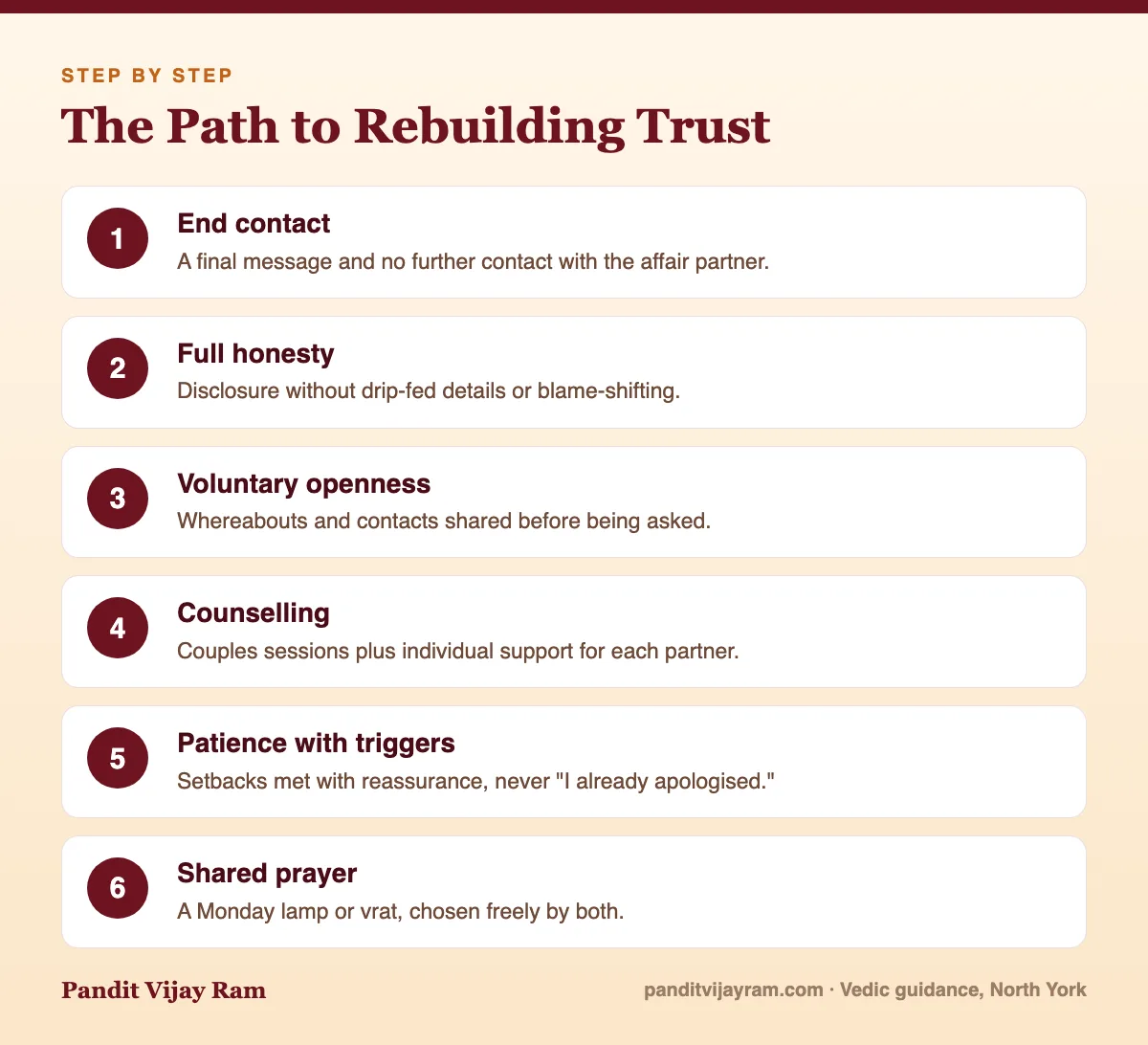
They need to end contact completely, take responsibility without blaming the marriage or the spouse, answer honest questions, offer openness about phone and whereabouts voluntarily, tolerate the hurt partner's anger and setbacks, and show changed behaviour consistently over time. In Vedic terms, this is prayaschitta: acknowledgement, remorse and corrective action together.
Prayaschitta is the Vedic idea of atonement. It is not a payment that cancels a wrong. It is a sincere turning: admitting what was done, feeling its weight, and taking deliberate steps to repair the harm. Applied to an affair, that means:
- Admit fully. Partial confessions that come out piece by piece do enormous damage. Each new detail restarts the shock.
- Own it. "I chose this" rather than "You were always busy" or "It just happened."
- End contact and prove it. A brief, final message, seen by the spouse if they wish, and no further contact. If contact is unavoidable at work, say so and set limits openly.
- Offer transparency. Share where you are and who you are speaking with before you are asked. Openness offered freely rebuilds trust; openness extracted does not.
- Stay with the pain. Your spouse may be angry months later. Respond with patience rather than "I already apologised."
- Look at yourself. Individual counselling helps the person who cheated understand why they did, so it is less likely to happen again.
Some people seek a ritual to clear their guilt. Prayer can support remorse, but no puja replaces telling the truth and changing behaviour. In my practice, remedies for the person who cheated always come with these practical commitments.
A spiritual reading for one partner alone is available through the kundli and horoscope service, and many find it helps them understand their own restlessness.
How long does it take to rebuild trust after an affair?
There is no fixed timeline. Many couples find repair takes well over a year, with good weeks followed by sudden setbacks triggered by dates, places, songs or messages. Progress shows as fewer and shorter triggers, not their disappearance. The hurt partner's pace sets the timetable, not the partner who cheated.
Couples often expect a straight line upward. In practice repair looks more like a slow tide, with waves that sometimes knock both people back.
Typical stages I see:
- Crisis. Questions, anger, sleeplessness and an urge to know everything.
- Testing. The hurt partner watches whether words match actions. Small inconsistencies feel huge.
- Rebuilding. Good days become more common. The couple begins doing ordinary things together again.
- Integration. The affair becomes part of the couple's history rather than the centre of every day.
Triggers can arrive without warning: the anniversary of the discovery, a hotel on a drive, a name on a screen. When one appears, the hurt partner can say "I'm triggered," and the other responds with reassurance rather than defensiveness. Agreeing on that script ahead of time helps greatly.
Astrology can sometimes add perspective. A hard Saturn transit over one partner's Moon, or a change of dasha, may help explain why a particular season feels heavier. I share that only as context. It does not set a deadline for forgiveness.
If either partner's mood stays very low, or sleep and work suffer for weeks, a family doctor should be involved. Rebuilding a marriage is hard enough without untreated depression or anxiety underneath it.
Can a shared vrat or prayer help a couple heal after infidelity?
A shared vrat or prayer can help when both partners choose it freely. Monday Shiva-Parvati worship, a Pradosh observance or a simple evening lamp lit together gives the couple a regular moment of honesty and quiet. It supports repair; it must never be used to pressure the hurt partner into forgiving.
In Hindu tradition, Shiva and Parvati represent a marriage that endures through separation, testing and reunion. Many couples find it meaningful to bring their repair to them.
Practices that suit this stage:
- Monday prayer together. Water offered to a Shiva lingam, Om Namah Shivaya repeated softly, and a moment for each partner to say silently what they are working on.
- Pradosh vrat. Observed at twilight on the thirteenth lunar day, it is traditionally dedicated to Shiva and associated with release from past wrongs. A light fast is fine; health comes first.
- Solah Somvar. Some couples take this longer vow as a sign of commitment. Our post on the Solah Somvar vrat for marriage covers its rules and cautions.
- Shared seva. Serving food at a temple, gurdwara or community kitchen together lets the couple experience being on the same side again.
A caution from experience: when the partner who cheated pushes for prayer as a way to end discussion, the hurt partner can feel silenced. Prayer should open honesty, not close it. If one person is not ready, the other can pray alone without making it a test.
For a fuller shared home practice, the guide to spiritual cleansing for couples describes a simple routine for clearing heaviness from the home together.
When is it better to leave than to rebuild after cheating?
Leaving is often wiser when affairs repeat, contact with the affair partner continues, the partner shows no real remorse, blame is shifted onto you, or there is abuse or coercion. It is also valid simply when you cannot trust again. Dharma does not require staying with ongoing deception.
Families and communities sometimes press the hurt partner, especially women, to stay at any cost for the children or for the family's name. I do not agree. A home built on continuing deception teaches children that dishonesty is normal.
Warning signs that repair is not happening:
- Secret contact with the affair partner continues or restarts.
- New lies appear, even about small things.
- You are told the affair was your fault.
- Your questions are met with anger or threats.
- There is any physical violence, intimidation or control of money.
- Your own health, mental or physical, keeps deteriorating.
Choosing to leave does not mean the marriage was worthless, or that you failed. It can be a respectful ending. Before moving out, get legal information from a family lawyer or a community legal clinic, particularly about children and property.
Spiritually, a release prayer can help close the chapter without bitterness. Our article on clearing ties to a past relationship describes one. If, later, either of you wonders whether reconciliation is possible after separating, the guide to love after divorce or separation looks at that honestly.
If you ever feel unsafe, call 911. If despair becomes overwhelming, call or text 988.
The bottom line
Couples who rebuild trust after cheating do so through full accountability, voluntary openness and patience with setbacks, guided by the hurt partner's pace. Prayaschitta, sincere atonement, describes that inner work well, and shared prayer or a vrat can support it when both choose it freely. Counselling for the couple and for each person makes success more likely. Where deception continues or safety is at risk, leaving is a respectful and legitimate choice.
Key takeaways
- Trust returns through consistent evidence, not through promises.
- The partner who cheated carries the work of accountability and openness.
- The hurt partner sets the pace; setbacks are normal.
- Shared prayer supports repair only when both choose it.
- Leaving is valid when deception continues or safety is at risk.