
Exalted and Debilitated Planets: Uchcha, Neecha and Neecha Bhanga
Few lines on a kundli printout cause more worry than the word 'debilitated'. People see it next to Venus or Jupiter and assume that part of life is ruined. Others are told they have a neecha bhanga raj yoga and expect a great rise. Both reactions miss what the classical idea actually says. This guide explains what a debilitated planet is, and what an exalted one is, for readers in North York and anywhere else. You will find the exaltation and debilitation sign of every planet with its peak degree, the reasoning behind the system, the main conditions for neecha bhanga as different texts give them, and what these states tend to look like in a real life. A comparison chart sums up the signs. In more than forty years of practice I have often found a debilitated planet pointing to the area where a person worked hardest and eventually became most skilled. That story is rarely told online, and it deserves to be.
What does exalted and debilitated mean in Vedic astrology?
Exaltation, uchcha, is the sign where a planet is considered most powerful and able to express its best qualities. Debilitation, neecha, is the opposite sign, where it is considered weakest and least comfortable. Each has a peak degree. These states are part of planetary dignity, alongside own sign, moolatrikona, friendly and enemy signs.
Think of dignity as how much at home a planet feels. In its own sign it is the householder. In moolatrikona it is at its office, doing its main work. In exaltation it is an honoured guest, given more than it would have at home. In debilitation it is in unfamiliar territory, where its natural instincts do not fit the surroundings.
Every planet's debilitation sign is exactly seven signs, 180 degrees, from its exaltation. The peak points follow the same rule. The Sun's deepest exaltation is 10° Aries, so its deepest debilitation is 10° Libra.
Strength rises and falls gradually around those points. A planet at its exact exaltation degree is given maximum uchcha bala, a component of the six-fold strength calculation called shadbala; a planet at its exact debilitation degree gets none, and positions between are scaled. So a Sun at 28° Libra is technically debilitated but already well away from its weakest point.
Dignity is only one factor. House placement, aspects, conjunctions, combustion and the navamsa all modify it. A debilitated planet in a kendra with good aspects can outperform an exalted one hidden in the 12th. Our guide to the twelve houses explains why placement matters so much.

Which signs are planets exalted and debilitated in?
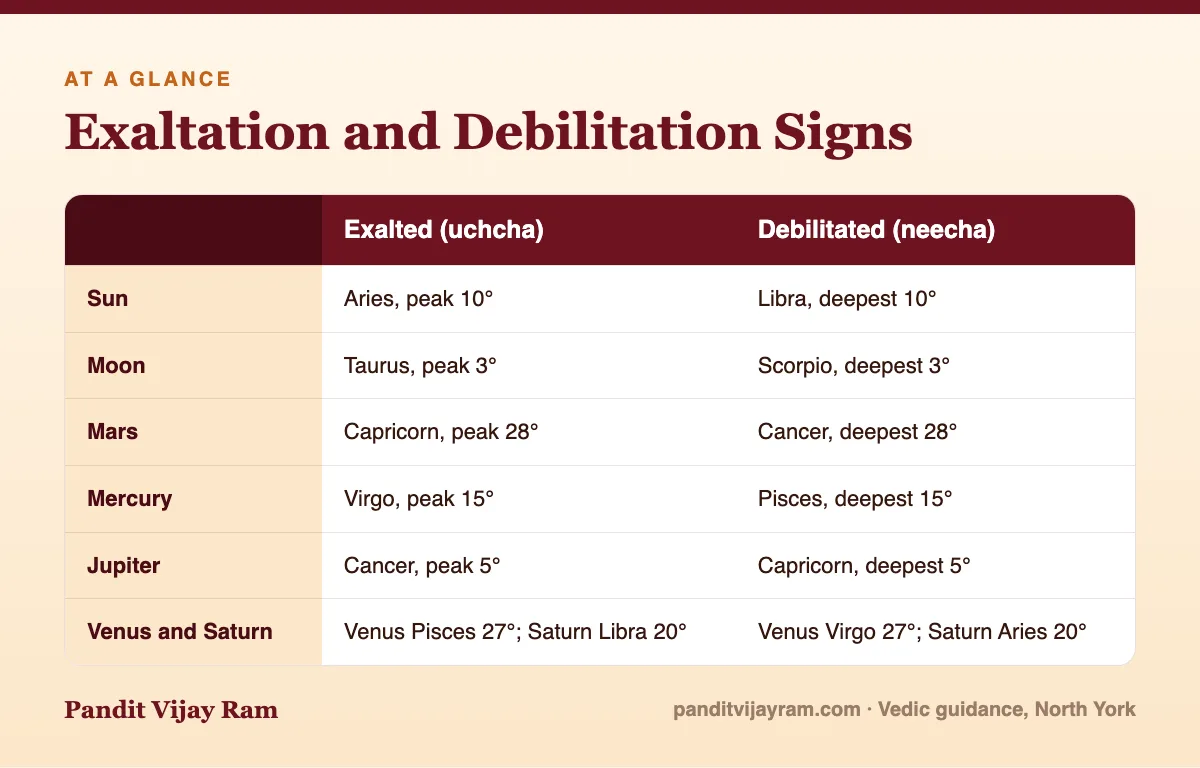
In Parashari astrology the Sun is exalted in Aries, the Moon in Taurus, Mars in Capricorn, Mercury in Virgo, Jupiter in Cancer, Venus in Pisces and Saturn in Libra. Each is debilitated in the opposite sign: Libra, Scorpio, Cancer, Pisces, Capricorn, Virgo and Aries respectively. Rahu and Ketu's signs are disputed between schools.
Here is the full list, with the traditional peak degree, which applies to both the exaltation and the debilitation point.
- Sun: exalted Aries, debilitated Libra, peak 10°.
- Moon: exalted Taurus, debilitated Scorpio, peak 3°.
- Mars: exalted Capricorn, debilitated Cancer, peak 28°.
- Mercury: exalted Virgo, debilitated Pisces, peak 15°.
- Jupiter: exalted Cancer, debilitated Capricorn, peak 5°.
- Venus: exalted Pisces, debilitated Virgo, peak 27°.
- Saturn: exalted Libra, debilitated Aries, peak 20°.
Some pairs make intuitive sense. The Sun, a planet of authority, is honoured in fiery, pioneering Aries and uneasy in Libra, which seeks consensus. Saturn, the planet of patience and fairness, is at its best in Libra and frustrated in impatient Aries. Venus, love and refinement, is generous in Pisces and becomes critical in fussy, analytical Virgo, where Mercury is exalted.
Rahu and Ketu. The nodes are shadow points, and classical texts disagree. Many follow Taurus exaltation for Rahu and Scorpio for Ketu; others prefer Gemini and Sagittarius. Some astrologers do not apply dignity to the nodes at all. If two readings differ on a node's dignity, this is usually why.
Mercury is unusual: Virgo is its exaltation, moolatrikona and own sign at once, divided by degree.
What are the effects of a debilitated planet?
A debilitated planet tends to struggle in expressing its significations naturally. A neecha Venus might show as difficulty feeling satisfied in love or comfort; a neecha Jupiter as doubt about guidance or faith. Effects vary with house, aspects and dasha, and many people develop real skill in exactly the area a debilitated planet governs.
A debilitated planet is not absent or broken. It still rules its houses and still runs its dasha. What changes is the ease with which it delivers. A few typical themes:
- Sun in Libra: confidence that depends too much on approval; leadership learned through partnership.
- Moon in Scorpio: emotional intensity and privacy; a mind that processes slowly and deeply.
- Mars in Cancer: drive mixed with emotion; anger that turns inward or flares at home.
- Mercury in Pisces: intuitive rather than linear thinking; detail can slip.
- Jupiter in Capricorn: practical rather than philosophical wisdom; caution with advice.
- Venus in Virgo: high standards in love and beauty; service as an expression of affection.
- Saturn in Aries: impatience with slow processes; discipline earned through mistakes.
These are tendencies, not verdicts, and they shift with the house involved. A debilitated planet ruling a difficult house can even give some relief from that house's troubles, which is one reason dual lordship matters.
Debilitation is also one of the factors used to judge whether bigger combinations hold up. A weak Jupiter, for example, softens the promise of Gajakesari yoga, and a debilitated lord weakens a raj yoga. A careful reader always notes it and then asks whether neecha bhanga applies.
What is neecha bhanga raj yoga?
Neecha bhanga means 'cancellation of debilitation'. Classical texts list conditions under which a debilitated planet's weakness is offset, most commonly when the lord of its sign, or the planet exalted there, sits in a kendra from the lagna or Moon. Calling every cancellation a raj yoga is a later overstatement many astrologers question.
Texts differ, but these conditions appear most often. Let us take Jupiter debilitated in Capricorn as the example throughout.
- Sign lord in a kendra: Saturn, lord of Capricorn, is in the 1st, 4th, 7th or 10th from the lagna or Moon.
- Exalted planet of that sign in a kendra: Mars, which is exalted in Capricorn, is in a kendra from the lagna or Moon.
- Exaltation lord in a kendra: the Moon, lord of Cancer where Jupiter is exalted, is in a kendra from the lagna.
- Aspect from the sign lord: Saturn aspects the debilitated Jupiter.
- Exchange: Jupiter in Capricorn and Saturn in Sagittarius or Pisces, each in the other's sign.
- Navamsa exaltation: Jupiter falls in Cancer in the D9.
Many charts with a debilitated planet meet at least one condition, which is another reason not to treat neecha bhanga as rare. Several modern authors argue that cancellation simply removes the weakness, and that it produces a raj yoga only if the planet is also part of a genuine kendra-trikona link.
The life pattern most often described is a struggle early in the planet's significations followed by mastery: the person who failed school maths and became an accountant, or who was shy and became a teacher. That arc is encouraging, but it describes effort rewarded, not a promise of fame.
Do debilitated planets need remedies?
Not automatically. Many debilitated planets are cancelled, mild or well placed. Remedies are worth discussing when the planet's dasha is running, it rules key houses for your lagna, and its themes are genuinely causing difficulty. Mantra, charity and steady habits linked to that planet are the gentlest supports; gemstones need careful checking first.
Before any remedy, a sensible reader asks three questions. Is the debilitation cancelled? Does the planet rule important houses for this ascendant? Is its dasha or antardasha active now, or soon? If the answers are yes, no, and no, there may be nothing to address.
When support makes sense, traditional options include:
- Mantra: the planet's beej mantra or a hymn to its deity, recited on its weekday.
- Charity: giving items or service linked to the planet, such as food grains, books or help to elders.
- Behaviour: practising the planet's virtues. For a neecha Mars, channelled exercise and patience at home; for a neecha Mercury, careful note-keeping.
- Graha shanti puja: a formal prayer for one planet, sometimes done during its dasha.
On gemstones. Opinions differ on whether to wear the stone of a debilitated planet. Some say it strengthens a weak planet; others warn it amplifies whatever the planet rules, including difficult houses. That is why a stone should follow a chart review, not a printout label. Our gemstone guidance and the article on choosing a gemstone explain trial wearing and fraud cautions.
For a personal assessment of which planets are actually weak, a kundli reading looks at dignity, cancellation and timing together.
The bottom line
A debilitated planet sits opposite its exaltation sign and finds it harder to express its natural qualities, while an exalted planet sits where it is strongest. Each has a peak degree, and the Rahu-Ketu signs are disputed between schools. Neecha bhanga cancels the weakness under several conditions, but it is common and usually points to hard-won skill, not a sudden rise.
Key takeaways
- Debilitation is always the sign opposite exaltation, with the same peak degree.
- Sun Aries, Moon Taurus, Mars Capricorn, Mercury Virgo, Jupiter Cancer, Venus Pisces, Saturn Libra.
- A debilitated planet still rules its houses and runs its dasha; it delivers less easily.
- Neecha bhanga conditions are common, and not every cancellation is a raj yoga.
- Remedies are optional and depend on house lordship, cancellation and the running dasha.