
Blue Sapphire (Neelam): Why It Is Tested Before Wearing
Few stones carry as many stories as neelam. Some people speak of sudden luck after wearing it, and others whisper that it brought trouble, so newcomers often approach it with a mix of hope and nerves. If you are weighing a blue sapphire neelam, the calm truth is that its reputation reflects Saturn's own nature: slow, serious and very particular about where it is placed in a chart. Families in North York often bring me a neelam that was gifted or bought on a trip, asking whether to put it on. In more than forty years of practice, my answer has always started with the chart, then the stone itself, then a short observed trial. This article explains why neelam is tested first, which ascendants tend to welcome it, how the customary trial is done, what to know about heat treatment and imitation, and the practical cautions around cost. It is written for people who want a careful decision rather than a dramatic one. Gemstones belong to faith and tradition; they never replace medical, legal or financial advice.
What is neelam stone and which planet does it represent?
Neelam is the Hindi name for blue sapphire, a blue variety of the mineral corundum. In Vedic astrology it is the ratna of Shani, the planet Saturn. Saturn signifies discipline, patience, work, endurance and accountability, so the stone is chosen when those qualities need support in a suitable chart.
Gemmologically, sapphire is aluminium oxide, the same mineral as ruby. Trace elements create the colour: iron and titanium give blue. Corundum is very hard, second only to diamond among common gems, which is one reason it suits daily rings.
Fine blue sapphires come from several regions, including Sri Lanka, Kashmir, Myanmar, Madagascar, Thailand and Australia. Origin affects price and reputation, yet it says nothing about astrological suitability. A Sri Lankan stone is not more spiritual than an Australian one.
In Jyotish, Shani rules Capricorn and Aquarius, is exalted in Libra and is debilitated in Aries. His themes include labour, service, old age, delay that teaches patience, and karma that asks to be faced. Those themes explain why the stone is handled with respect.
Neelam is especially discussed during Saturn mahadasha, the nineteen-year period ruled by Shani. People also ask about it during Sade Sati, though a transit alone is not a reason to wear Saturn's gem. The natal chart comes first.

Why is blue sapphire tried before wearing?
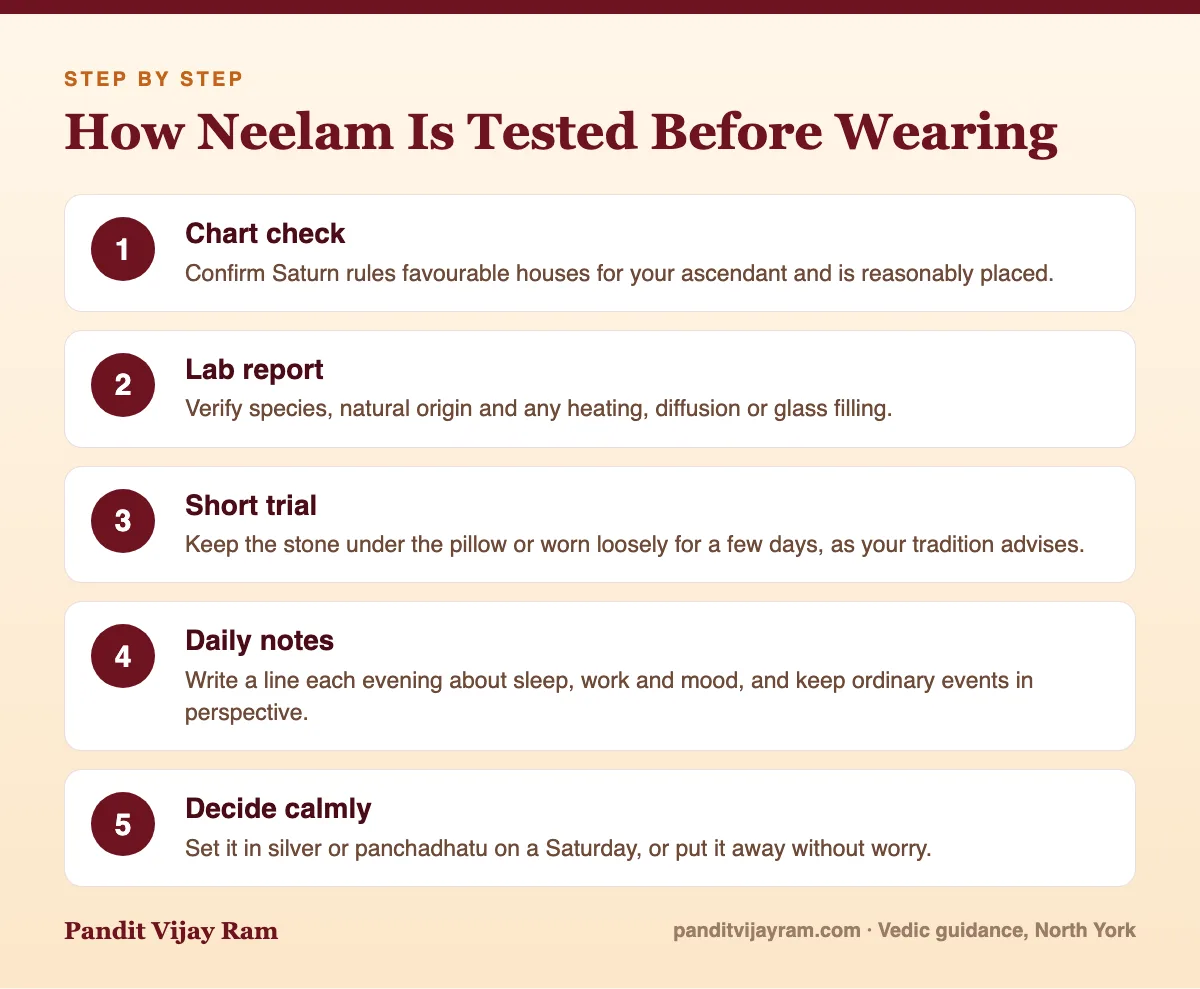
Blue sapphire is tried first because tradition holds that its effects show quickly, for better or worse, compared with other gems. A short trial lets the wearer notice how the stone sits with them before committing. It is a custom of caution and observation, not proof that neelam is dangerous.
The idea of testing neelam appears across many families and gem traditions. The logic is simple. Saturn is the slowest of the visible planets and rarely gives quick results, so when people felt changes soon after wearing his stone, the stone gained a reputation for speed.
I want to separate respect from fear. A ring cannot harm you by sitting on your finger. What tradition warns against is strengthening Saturn in a chart where he rules difficult houses, which may make his heavier themes more prominent. If the stone does not suit you, removing it ends the matter.
Common trial customs include:
- Keeping the stone wrapped in blue cloth under the pillow for a few nights and noting dreams and sleep.
- Tying it to the arm or wearing it loosely for several days before setting it.
- Wearing the finished ring for a week or two while keeping a short journal.
Traditions vary on length and method. Whichever you choose, read ordinary events as ordinary. A late bus or a cold is not a message from Saturn. If you notice anxiety or poor sleep, please speak with your family doctor rather than blaming or crediting the stone.
Who should wear blue sapphire?
Blue sapphire generally suits ascendants for which Saturn is a functional benefic: Taurus and Libra, where he is yogakaraka, and Capricorn and Aquarius, which he rules. For other ascendants it depends on Saturn's houses, sign dignity, aspects and the running dasha, and many astrologers advise against it.
Here is a decision rule I use, offered as a starting point rather than a verdict:
- Likely suitable: Taurus and Libra rising, where Saturn rules a kendra and a trikona together.
- Often suitable: Capricorn and Aquarius rising, because Saturn is the lagna lord, provided he is not badly afflicted.
- Case by case: Gemini and Virgo rising. Saturn rules a trikona but also the eighth or sixth house, so placement decides.
- Usually avoided: Aries, Cancer, Leo, Scorpio, Sagittarius and Pisces rising, where Saturn rules mostly difficult or neutral houses for that lagna.
Beyond the ascendant, I look at where Saturn sits. A well-placed Saturn in a kendra or trikona strengthens the case. Combustion, debilitation without cancellation, or heavy affliction from Rahu weakens it. Our guide to choosing a gemstone from your chart explains functional benefics in more depth.
Customary wearing details are a silver or panchadhatu ring on the middle finger, put on Saturday evening after reciting a Shani mantra such as Om Sham Shanaishcharaya Namah. Some teachers prefer gold or a different hour. Traditions vary, and none of them change whether the stone suits the chart.
How can I tell if a neelam is real or treated?
You cannot reliably tell a natural, untreated neelam by eye. Heat treatment is routine in sapphire, and some stones are diffused with beryllium, glass-filled, synthetic or simply blue glass. An independent gem laboratory report that states identity and treatment is the only dependable way to know what you are buying.
Most blue sapphire on the market has been heated to improve colour and clarity. Gem traders generally accept heating when it is disclosed, and many astrologers accept heated stones too, though some prefer unheated ones. The key word is disclosure.
Other treatments are more serious:
- Beryllium or lattice diffusion pushes colour into the stone at high temperature.
- Glass or lead-glass filling hides fractures and can be damaged by jewellery repair.
- Synthetic sapphire is grown in a laboratory. It is real corundum chemically but not a natural gem.
- Simulants such as blue glass, spinel or iolite are sometimes sold as neelam by mistake or design.
Look for a report from a laboratory with no stake in the sale. It should give weight, measurements, species, natural or synthetic, and any indication of heating or filling. Check the report number on the lab's own website. Our article on fake gemstones and certificates covers return policies and consumer protection in Canada.
Price stories need care too. A dramatically high quote is not evidence of quality, and an unusually low one deserves questions.
What if neelam does not suit my chart?
If neelam does not suit your chart, Saturn can still be honoured through mantra, service and discipline. Reciting the Shani mantra on Saturdays, feeding people in need, helping elders and keeping steady work habits are traditional remedies. A substitute stone such as amethyst may be considered only if Saturn is still a friendly planet.
People sometimes feel disappointed when I say neelam is not for them. I understand that, because the stone has a glamorous reputation. Yet Saturn is the planet of patient effort, and his best remedies have always been practical.
Options I suggest often:
- Mantra. Reciting Om Sham Shanaishcharaya Namah or the Shani Stotra on Saturdays, at a pace you can sustain.
- Hanuman worship. Many families recite the Hanuman Chalisa on Saturdays for relief during Saturn periods.
- Seva. Giving food, warm clothing or time to people who labour hard, including shelter volunteers.
- Routine. Keeping promises, paying dues on time and caring for your body are Saturn's own lessons.
A lower-cost stone is discussed in our guide to gemstone substitutes. Those stones follow the same suitability rule, so they are not a way around an unfriendly Saturn.
For a careful look at your own chart, including Saturn's dasha and placement, our gemstone consultation or a full kundli reading is a good place to begin.
The bottom line
Blue sapphire neelam is tested before wearing because of its quick reputation, but the trial is about calm observation rather than fear. It suits ascendants where Saturn is a functional benefic, mainly Taurus, Libra, Capricorn and Aquarius, and other charts need careful review. Buying with an independent lab report protects you from undisclosed treatments and imitations, and mantra and service remain strong remedies when the stone is not right.
Key takeaways
- Neelam is blue corundum and the gem of Saturn in Vedic astrology.
- A short trial is a custom of caution, not evidence that the stone is harmful.
- Taurus, Libra, Capricorn and Aquarius ascendants are the usual candidates.
- Most sapphire is heated; insist on a lab report that discloses treatment.
- Saturn is also honoured through mantra, seva and steady habits.