
Santan Prapti Remedies: Spiritual Support Alongside Fertility Care

Waiting for a child can be one of the loneliest kinds of grief, because it is often carried quietly. Couples who look for santan prapti remedies in North York and across Canada usually arrive tired of questions at family gatherings and unsure whether to trust doctors, prayer or both. This guide answers that honestly. You will learn why a fertility assessment for both partners belongs at the very start, what the Santan Gopal mantra and related pujas mean, what a kundli can and cannot say about the fifth house, and how to keep a gentle daily practice that supports you through appointments rather than competing with them. In more than forty years of practice I have sat with many couples in this situation, and I have learned to begin by asking about their doctor before I ask about their chart. Nothing here is a promise. It is a way to hold hope with some steadiness, protect your relationship from blame, and give the medical side the time and attention it needs.
What are santan prapti remedies in Vedic tradition?
Santan prapti means the blessing of receiving a child. The remedies are devotional: chanting the Santan Gopal mantra to Bal Krishna, keeping the Putrada Ekadashi fast, offering a Santan Gopal puja or havan, honouring ancestors, and giving in charity. They ask for grace and patience, not a guaranteed outcome.
The tradition treats a child as a gift rather than a right, and the practices reflect that humility. The most familiar ones are:
- Santan Gopal mantra. A prayer to Krishna as a baby, recited by one or both partners with a simple sankalp stating the wish.
- Putrada Ekadashi. An Ekadashi associated in the Puranic stories with a king who prayed for a son; today couples keep it for any child, daughter or son.
- Santan Gopal puja or havan. A more formal offering, usually done once with a priest and then followed by home recitation.
- Ancestral rites. Some families include tarpan or shraddh, because the tradition links the family line with the ancestors. Our guide to pitru dosh and shraddh remedies explains when this is relevant and when it is not.
- Seva and daan. Feeding others, supporting a children's charity, or caring for a cow at a temple goshala.
None of these is a technique that forces a result. They are ways of praying with structure. Many couples tell me the structure itself helps, because it gives the waiting a shape. You can read how Vijay Ram ji approaches this work on the santan prapti service page.

Should we see a fertility doctor before trying spiritual remedies?
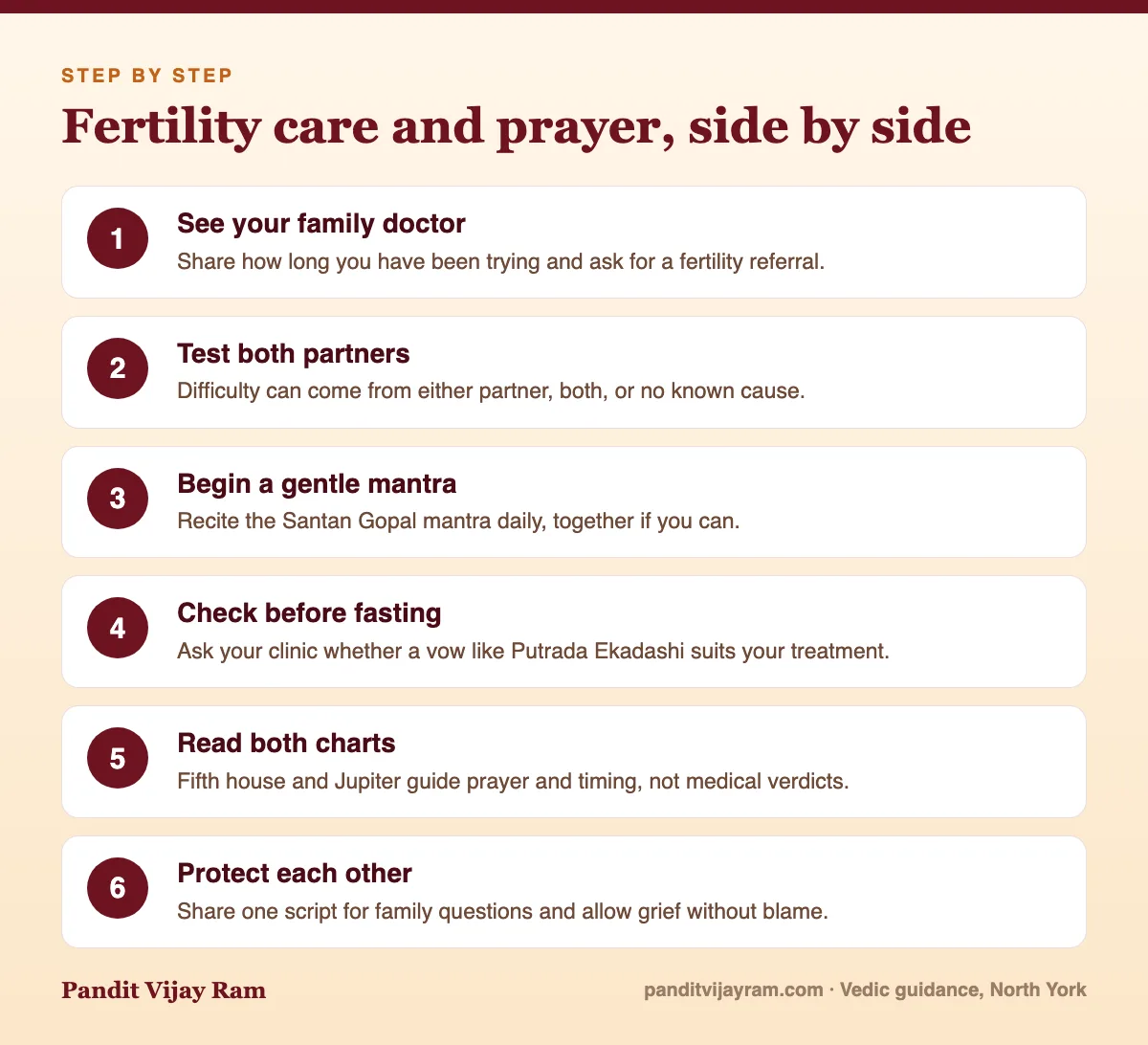
Yes. Start with your family doctor, ask for a referral to a fertility clinic, and make sure both partners are assessed. Many causes of difficulty conceiving are treatable, and some are time-sensitive. Prayer can begin the same day, but it should never delay tests, treatment or a specialist appointment.
When a couple sits down with me, my first question is whether both of them have been checked. Too often only the wife has seen a doctor, because relatives assume the difficulty lies with her. That assumption is unfair and medically wrong; difficulty can come from either partner, from both, or from no cause anyone can find.
A sensible order looks like this:
- Book with your family doctor. Mention how long you have been trying, your ages, cycle patterns and any past health issues.
- Ask about a referral. A fertility clinic or reproductive specialist can arrange tests for both partners.
- Ask what is covered. Provinces differ in what they fund. Your clinic can explain what applies to you.
- Look after the basics. Sleep, smoking, alcohol, weight and stress all matter, and your doctor can guide you.
- Then add prayer. A daily mantra fits beside every stage of treatment.
If you plan to fast, tell your doctor first. Fasting can be unsuitable during some treatments and in pregnancy. A gentler vow, such as lighting a lamp and reciting a mantra, keeps the devotion without the strain. Our guide to Ekadashi fasting and who should not fast covers the cautions in more detail.
How do you chant the Santan Gopal mantra?
The common form is: Om Devaki Suta Govinda Vasudeva Jagatpate, Dehi Me Tanayam Krishna Tvamaham Sharanam Gatah. It asks Krishna, son of Devaki, for a child and offers surrender. Couples usually recite it once a day, often one mala of 108, after a bath, facing an image of Bal Gopal.
The words are simple, and their meaning matters more than perfect pronunciation. Roughly: O Govinda, son of Devaki, Lord of the world, Krishna, grant me a child; I take refuge in you.
A calm home routine might be:
- Choose a fixed time, morning or evening, that you can keep on workdays.
- Light a ghee or oil lamp before a picture or small murti of Bal Gopal. A tulsi leaf or a little butter and sugar is a traditional offering.
- State your sankalp once in your own words: who you are, what you hope for, and that you accept the outcome with faith.
- Recite one mala, or fewer rounds if that is what your energy allows on a hard day.
- Sit quietly for a minute afterwards. Some couples hold hands; others simply breathe.
Husbands can chant too, and I encourage it. Shared prayer quietly says the burden belongs to both of you. Some families also listen to or read the Harivansh Purana over a period of weeks, a custom connected with santan prayers in parts of North India.
If recitation starts to feel like a test you are failing, shorten it. Devotion offered gently is still devotion. When a formal ceremony feels right, a family can arrange one through the puja and anushthan service.
What does the 5th house say about children in a kundli?
In Vedic astrology the fifth house, its lord and Jupiter, the karaka for children, are read for progeny, along with the ninth house and the saptamsa divisional chart. A reading can describe timing tendencies and which planets ask for prayer. It cannot diagnose infertility or say whether treatment will work.
When a couple asks me to look at their charts for children, I examine both horoscopes, not only the wife's. I look at:
- The fifth house. Called putra bhava, it is read for children, creativity and past merit.
- The fifth lord and Jupiter. Their strength, placement and the dashas running now.
- Malefic influence. Saturn, Rahu or Ketu on the fifth can suggest delay or a need for patience in the tradition's language.
- Divisional charts. The saptamsa (D7) adds detail for this area of life.
What comes out is guidance on prayer and timing, never a medical verdict. If I see a Jupiter period beginning, I might suggest Thursday worship. If Saturn is heavy, I might suggest steady service and patience. I do not tell couples they are "cursed" or that they will never have a child, and you should be wary of anyone who does.
A full kundli and horoscope reading places the fifth house in the context of the whole chart, which is the only honest way to read it. A single placement seen in isolation says very little.
How can couples cope with family pressure while trying for a child?
Agree as a couple on what you will share and with whom, and give each other permission to leave conversations that hurt. Ask one trusted elder to quiet the questions. Seek a counsellor familiar with fertility stress, and see your family doctor if sadness affects sleep, work or hope for weeks.
In many South-Asian, Caribbean and Latino families, a couple's private hope becomes a public topic at every wedding and festival. Questions are usually meant kindly, but they land hard. A few things help:
- A shared script. Something brief and warm, such as "We'll tell you when we have news," said by whichever partner is asked.
- No blame inside the marriage. If an elder suggests one partner is "the problem", the other partner answers. Unity protects you both.
- Limits on remedies from relatives. Well-meaning aunts may send threads, stones and rituals. You can thank them and choose only what sits right with you.
- Grief allowed. Failed cycles and pregnancy loss are real losses. Mourning them is not a lack of faith.
Fertility clinics often have counsellors, and community health centres can connect you to support groups. If low mood deepens, or thoughts of hopelessness appear, speak to your doctor. In a crisis you can call or text 988 at any hour.
Some couples find a short shared practice, like the routine in our guide to spiritual cleansing for couples, gives them a quiet space at home that the questions cannot reach.
The bottom line
Santan prapti remedies are best understood as prayer that walks beside fertility care, never ahead of it. Begin with a doctor for both partners, then add a gentle practice such as the Santan Gopal mantra, Putrada Ekadashi in a form your health allows, or a single puja. Read the fifth house for guidance and timing, not for verdicts, and protect your marriage from blame while you wait.
Key takeaways
- Both partners should be assessed by a doctor before or alongside any spiritual remedy.
- The Santan Gopal mantra is a prayer to Bal Krishna that either partner can recite daily.
- Check with your doctor before fasting during treatment or pregnancy.
- The fifth house and Jupiter guide prayer and timing; they do not diagnose infertility.
- No honest practitioner promises a child or calls a couple cursed.