
Spiritual Cleansing for Couples: Clearing Shared Heaviness Together

Couples sometimes describe a heaviness that sits between them rather than in either one. Nothing dramatic has happened, yet conversations go flat, small irritations pile up and the home no longer feels restful. Spiritual cleansing for couples is a way of meeting that heaviness together, side by side, with both partners choosing to take part. Couples in North York and across the GTA ask me about this more often than people expect, often after a stressful move, a new baby, a job loss or simply years of busy routine. This guide explains what a shared cleansing involves, from the joint lamp and sankalp to a simple weekly home routine. It also explains clearly what it is not. It is not a ritual to make a partner love you, stay, or change their mind. In over forty years of sitting with families, I have seen that the most meaningful moment in a couple's ritual is often when they say the sankalp together and hear each other's wishes aloud. That moment belongs to both of them.
What is a spiritual cleansing for couples?
A spiritual cleansing for couples is a shared devotional routine in which both partners purify their home and themselves, state a common intention and pray for harmony. It usually combines a lamp lit together, a joint sankalp, a short mantra and a cleaning of shared spaces. Both partners take part by choice.
In Hindu tradition, marriage is a partnership in dharma. The husband and wife sit together for many rituals, from the wedding fire onwards, and a sankalp is often spoken in both names. A couple's cleansing draws on that idea.
The core elements are simple:
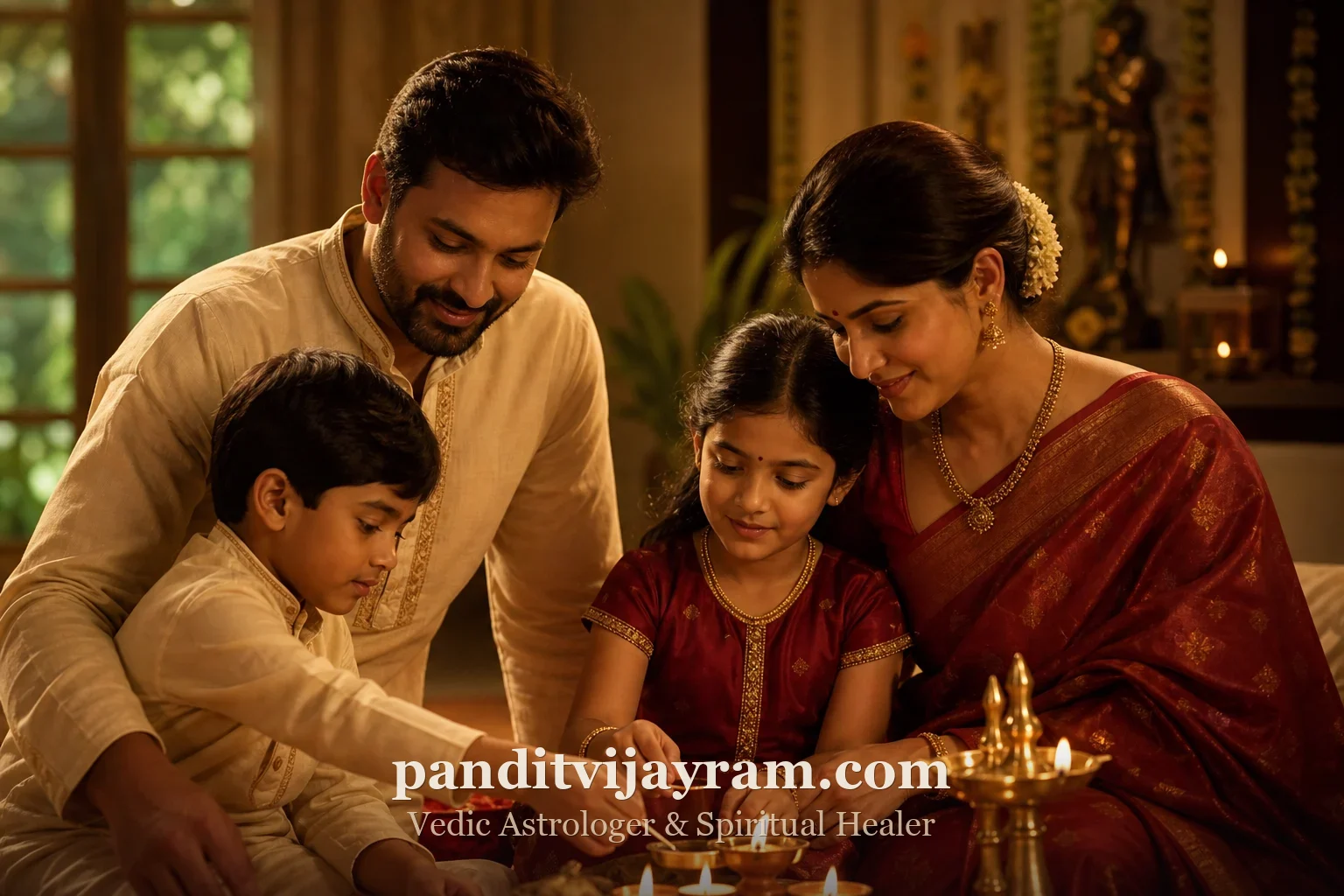
- A shared lamp. One diya with two cotton wicks twisted together, lit by both partners at the same moment.
- A joint sankalp. A spoken intention naming both partners and what they hope for: peace at home, patience, kindness, clear speech.
- Prayer for harmony. A short mantra such as Om Uma Maheshwarabhyam Namah, honouring Parvati and Shiva as a divine couple, or the Lakshmi Narayan mantra.
- Clearing shared spaces. The bedroom, the kitchen and the entrance, cleaned and refreshed together.
Some couples like to sit before an image of Ardhanarishvara, the half-Shiva, half-Parvati form that shows two as one. It is a gentle reminder that the work is shared.
This is different from individual cleansing. If one partner wants to work on their own fear or grief, that is personal practice. A couple's cleansing is for the space and the life they hold in common. For background on methods generally, see our overview of what spiritual cleansing is.
Is a couples cleansing the same as a love spell?
No. A couples cleansing is done together, with both partners willing, for harmony in a shared life. A love spell or binding ritual tries to influence or control another person's feelings, often without their knowledge. Vijay Ram ji does not perform rituals to override anyone's free will, and a couple's practice never aims to.
This line matters, so it is worth being direct.
A couple's cleansing:
- Requires both partners to know about it and agree.
- Asks for qualities in your own life and home: patience, peace, honest speech.
- Leaves each partner free to feel and choose as they do.
A love spell or binding:
- Is often done secretly, without the other person's knowledge.
- Tries to make someone feel, stay or return against their own wishes.
- Treats a partner as something to be managed rather than a person to be respected.
In the Vedic view, trying to override another person's will creates its own karmic weight, and it rarely brings the closeness people hope for. It also tends to deepen anxiety in the person who commissions it. Our guide to prayer instead of binding for marriage explores the ethical alternatives in more depth.
If your partner does not want to take part, respect that. You can still pray for peace in your own heart and your own conduct. You cannot cleanse a relationship on someone else's behalf, and you should not try.
If a partner pressures, threatens or controls you, that is not an energy problem. It is a safety problem. Contact the police, or call 911 in an emergency.
How do couples do a cleansing together at home?
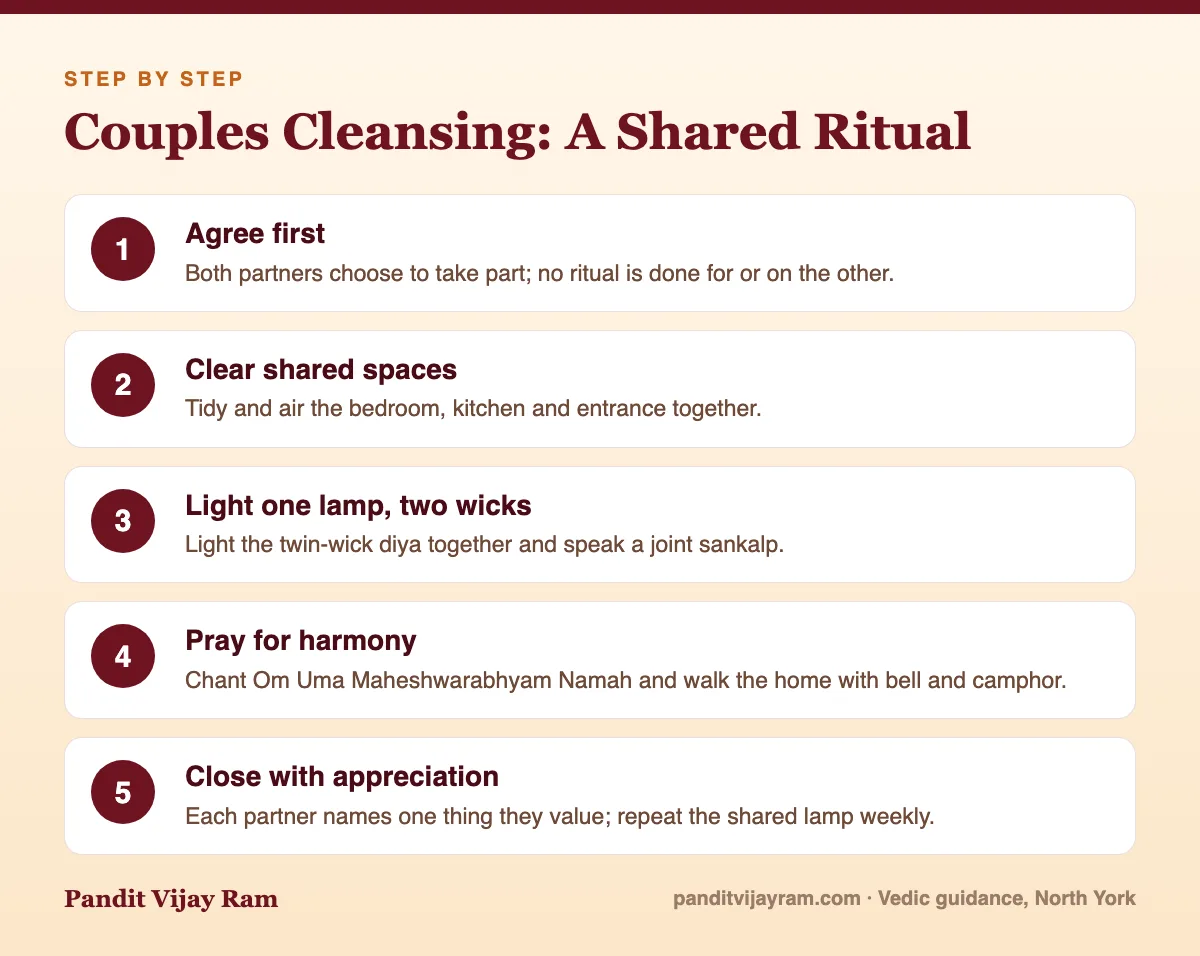
Choose a calm evening, tidy and air the home first, then sit together facing east or north. Light a shared lamp, say a joint sankalp, chant a short mantra for harmony, walk through the rooms together with a bell or camphor, and close by speaking one appreciation each. The whole ritual takes under an hour.
The steps on this page give the full sequence. A few points help it go well:
Agree beforehand. Talk about why you want to do this and what you each hope for. If one of you is reluctant, wait. A ritual done under protest adds to the strain.
Prepare together. Clear clutter from the bedroom and the entrance, wash the floors with a little rock salt in the water, and open windows for twenty minutes. Our guide to cleansing the bedroom for peace gives detail for that room.
Write the sankalp. Keep it short and in your own words, for example: "We, [both names], at our home in [city], pray for patience, kind speech and peace between us and in our family." Each partner can add one wish.
Share the tasks. One partner rings the bell while the other carries the camphor. One reads the mantra while the other keeps count with a mala.
Close with words. After the aarti, each partner says one thing they appreciate about the other. It feels awkward the first time. It is often the most valuable part.
Keep it going. Light the shared lamp together once a week, on a Friday or Monday if you like. The weekly habit carries the calm forward.
What can a couples cleansing not fix?
A couples cleansing cannot fix deep problems of trust, addiction, infidelity, money conflict, mental illness or abuse. It cannot make a partner stay or change their feelings. It can support a couple already willing to work on things, alongside honest conversation and, where needed, couples counselling or medical help.
Ritual works best as a companion to real effort, not a replacement for it. These are the situations where a couple needs more than a lamp:
- Repeated fights over the same issue. Money, in-laws, chores and parenting arguments respond to clear agreements and, often, a counsellor.
- Infidelity or broken trust. This needs honest conversation and usually professional support. Our marriage problem service offers spiritual guidance alongside, never instead of, counselling.
- Addiction. Alcohol, gambling or drug problems need medical and community support.
- Depression or anxiety in either partner. See a family doctor. In a crisis, call or text 988.
- Fear of a partner. Control, threats or violence mean safety comes first. Call the police or 911.
Some couples ask whether their charts are to blame. A kundli reading can show stressful periods, such as a Saturn transit over the seventh house, which may explain a hard stretch. The relationship compatibility service looks at both charts together. A chart can explain patterns; it never decides who should stay or go.
If tension at home involves the wider family too, our guide to constant fights at home covers that broader picture.
When should a couple ask for outside help?
Ask for outside help when shared practice and honest talks have not eased the strain over several weeks, when the same argument keeps repeating, or when either partner feels unheard. A counsellor helps with communication. A practitioner can help with a joint puja, a chart reading or a guided ceremony for both.
Different kinds of help suit different needs. A quick guide:
- Couples counsellor. For communication, recurring conflict, trust and intimacy. Many speak Hindi, Punjabi, Urdu, Tamil, Gujarati or Spanish, and some work with faith-based families.
- Family doctor. For sleep, mood, stress or health problems in either partner.
- Practitioner. For a joint puja such as a Satyanarayan katha or Uma Maheshwar puja, a chart reading for both partners, or a guided cleansing of the home after a hard season.
- Police or a crisis line. For any threat, violence or coercion. This always comes first.
After a single bitter argument, a quick reset may be enough; our guide to clearing energy after an argument describes a short ritual for that moment.
A practitioner worth seeing will ask about both partners' wishes, encourage counselling where it fits, and decline any request to influence one partner without the other's knowledge. More guides on shared and household practice sit on the cleansing and protection hub.
The bottom line
Spiritual cleansing for couples is a shared practice of lamp, joint sankalp, prayer and home care, chosen freely by both partners. It is never a love spell and never aims to change or control the other person. It supports a couple already willing to work together, alongside honest conversation, counselling and safety where those are needed.
Key takeaways
- A couple's cleansing is done together, by choice, for harmony in a shared life.
- A shared two-wick lamp and a joint sankalp are the heart of the practice.
- It is not a love spell; it never seeks to influence a partner's will.
- Counselling, medical care and safety come first for deep or dangerous problems.
- A weekly shared lamp helps carry the calm forward.