
Solah Somvar Vrat for Marriage: Rules and Realistic Expectations

Families often suggest the Solah Somvar vrat when a daughter or son is ready to marry and the right match has not appeared. Sometimes the person suggests it to themselves, quietly, after a disappointing proposal. Either way, they want to do it properly and to know what they can honestly hope for. I am asked about the solah somvar vrat by people in North York almost every Shravan season. This guide covers the essentials: what the sixteen Mondays involve, how to begin, what each Monday looks like, the katha that is read, how the vow closes, and the health cautions that matter more than any rule. It ends with an honest word about expectations. In more than forty years of practice I have watched this vow steady many young people through an anxious stretch. The fast does not produce a husband or wife on a schedule. It does give a person sixteen weeks of calm attention to Shiva, which changes how they wait.
What is the Solah Somvar vrat and why is it kept for marriage?
Solah Somvar means sixteen Mondays. Monday, Somvar, is the day of the Moon and is sacred to Shiva, who wears the crescent Moon. Because Parvati won Shiva as her husband through devotion and austerity, the vow is traditionally kept by those seeking a good marriage, and by couples praying for a harmonious one.
A vrata in Hindu practice is a vow: a chosen discipline kept for a set period with a clear intention. The Solah Somvar vow is one of the most popular in North Indian and diaspora households.
Why Shiva and why Monday:
- Shiva as the ideal husband. Stories describe him as steady, faithful and devoted to Parvati, though unconventional.
- Parvati's own tapasya. She is said to have kept long austerities to win Shiva. Women praying for a partner see her as a model of patient devotion.
- Monday and the Moon. Soma, the Moon, rests on Shiva's head. The Moon governs the mind and emotions in astrology, so Monday prayer also aims to settle the heart.
Who keeps it:
- Unmarried women, most commonly, and increasingly unmarried men.
- Married couples, praying for understanding or after a hard period.
- Anyone seeking Shiva's blessing for a specific wish, not only marriage.
It is distinct from the weekly Somvar fast many families keep all year, and from the Monday fasts of the Shravan month alone. If your family follows Gauri-Shankar or Katyayani worship instead, our guide on prayer for marriage instead of binding explains those paths.

What are the rules of the Solah Somvar fast?
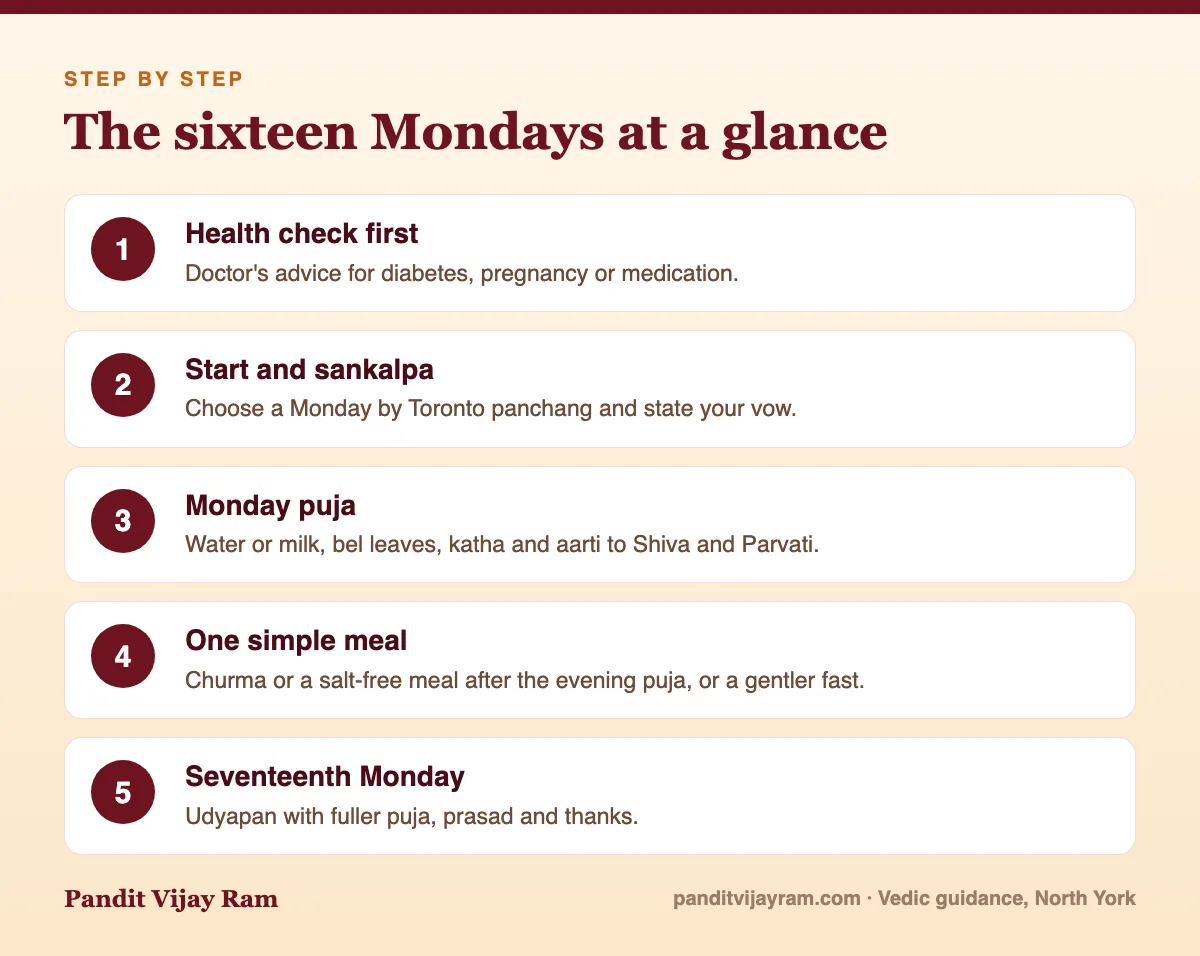
Begin on a Monday chosen with family or a priest, often in Shravan. Each Monday, bathe early, worship Shiva and Parvati, offer water or milk and bel leaves, read the katha and eat one simple meal, often without salt. Keep the sixteen Mondays consecutive, then close with an udyapan on the seventeenth.
Rules differ by region and family. These are the points most households share, from strict to flexible.
- Starting day. Many begin on the first Monday of Shravan, or on a Monday in the bright fortnight of an auspicious month. Check a Toronto panchang rather than one printed for India.
- Sankalpa. On the first Monday, state the intention once: your name, the vow of sixteen Mondays and what you are praying for.
- Morning. Bathe, wear clean clothes and offer water, raw milk or panchamrit to a Shiva lingam or image.
- Offerings. Bel leaves, white flowers, sandalwood, rice and a ghee lamp. Avoid ketaki and turmeric on the lingam, as many traditions advise.
- Katha. Read or listen to the Solah Somvar katha, then perform aarti.
- One meal. Typically eaten after the evening puja. Many families make churma from wheat flour, ghee and jaggery, offer it, share part of it and eat the rest.
- Consistency. If a Monday is missed through illness or menstruation, families differ: some pause and continue, others add a Monday at the end. Ask your family priest.
Doing the puja at a temple is fine, though a home altar is enough. For a fuller observance with a priest, see the puja and anushthan service.
What is the Solah Somvar vrat katha?
In the version most families read, Shiva and Parvati play a game of dice in a temple, and a priest who gives a careless answer is struck with illness. Celestial women teach him the sixteen-Monday vow, and he is restored. The story then passes from devotee to devotee, each regaining something lost through the same vow.
The katha is told in several versions, so your family's book may differ in names and details. The common thread runs like this.
- The priest. Asked who will win the game, he names Shiva without thinking. Parvati wins and, displeased, curses him. Apsaras later visit the temple, tell him about the sixteen Mondays, and he keeps the vow and recovers.
- Parvati. Hearing of it, she keeps the vow herself, and her estranged son Kartikeya returns to her.
- Kartikeya's friend. A young man who keeps the vow travels to a distant kingdom and wins the hand of a princess.
- The king. When that young man becomes king and neglects his wife's worship, trouble follows until devotion is restored.
What does the story teach? It is less a promise of rewards than a chain of lessons: speak carefully, honour others' devotion, and remember that blessings fade when humility does. The marriage episode sits inside a larger story about character.
Read it slowly each Monday, ideally aloud with family. Many people say they understand it differently by the sixteenth week. If you are keeping the vow because a match keeps falling through and you suspect something more, our guide to marriage delay and spiritual causes starts with ordinary reasons first.
Who should not keep a strict Monday fast?
Anyone with diabetes, low blood pressure, an eating disorder history, kidney problems, or medication that must be taken with food should speak to their family doctor first. Pregnant and breastfeeding women, teenagers and older adults should not keep a strict one-meal fast. A gentler fast or puja without fasting keeps the vow just as sincere.
Tradition has always allowed adjustments for health. The vow lies in devotion and consistency, not in hunger.
Specific cautions:
- Diabetes. Skipping meals while on insulin or some tablets can cause dangerous lows, and a large jaggery-and-ghee churma in the evening can cause a spike. Ask your doctor how to adjust.
- Pregnancy and breastfeeding. Do not fast strictly. Pray, offer, read the katha and eat normally.
- Medication. Many medicines, including some for blood pressure, thyroid and pain, should be taken with food at set times.
- Eating disorders. Ritual fasting can reopen old patterns. A non-food vow is wiser.
- Salt-free days. Usually harmless, but those prone to fainting or working physical jobs should take care.
Gentler versions families use:
- Fruit, milk and nuts through the day, with a normal dinner.
- Skipping one indulgence, such as sweets or screens, instead of food.
- Full puja and katha with no fast at all.
Winters in Canada are long and cold, and work schedules do not pause on Mondays. Adjusting is not cheating. For more on fasting safely as spiritual practice, see our article on fasting and Ekadashi.
Will Solah Somvar vrat bring a good husband or wife?
The vow is a prayer, not a contract. Many people meet a partner during or after it, and many do not on that timeline. What it reliably offers is calm, discipline and a sense of being held while you wait. Keep taking practical steps alongside it: family introductions, honest profiles and a chart reading if helpful.
It is kinder to say this plainly at the start than to leave someone disappointed on the seventeenth Monday.
What the vow can do:
- Give anxious waiting a structure and a purpose.
- Build patience, self-respect and clearer priorities about the kind of partner you want.
- Bring a family together around something positive every week.
What it cannot do:
- Produce a proposal by a set date.
- Make a specific person agree to marry you.
- Replace meeting people, being open, or saying yes to an introduction.
Some families keep the vow because a chart shows a Manglik placement or a delaying Saturn period. A reading can put that in proportion; often the picture is lighter than feared. Our guide to Mangal dosh remedies and kumbh vivah covers simpler options, and the kundli and horoscope service explains what a reading looks at.
If the waiting has turned into deep sadness, trouble sleeping or hopelessness, please talk to your family doctor. If you ever feel unsafe, call or text 9-8-8.
The bottom line
The solah somvar vrat is a sixteen-Monday vow to Shiva and Parvati, kept with morning worship, the katha, a single simple meal and a closing udyapan. Health comes first: diabetes, pregnancy, medication and eating disorder history all call for a gentler version agreed with your doctor. The vow builds patience and devotion while you wait for the right partner, but it works best alongside practical steps rather than in place of them.
Key takeaways
- Solah Somvar is sixteen consecutive Mondays of Shiva-Parvati worship.
- Each Monday has puja, the katha and usually one simple meal.
- The vow closes with an udyapan on the seventeenth Monday.
- Diabetes, pregnancy and medication need a gentler, doctor-approved version.
- It steadies the heart; it does not deliver a spouse on schedule.