
How to Move On When You Still Love Them

People often assume that moving on means you have stopped loving someone. So when the love is still there, they feel stuck, or guilty, or certain they must keep trying. Learning how to move on when you still love them begins with a different idea: love and letting go are not opposites. You can care deeply for a person and still accept that the relationship is over. In North York I sit with many people who feel torn in exactly this way, especially when the other person has made a clear choice to leave. This guide explains why letting go is so hard while love remains, what the teaching of vairagya offers, practical steps that make acceptance possible, and how to recognise when hoping has become harmful to you. In my more than forty years of practice, the people who found peace were rarely those who forced the love out of their hearts. They were those who let it soften into a quiet blessing and turned their attention back to their own life.
Can you move on from someone you still love?
Yes. Moving on does not require you to stop loving someone. It means accepting that the relationship has ended, no longer organising your life around getting it back, and letting the love become goodwill rather than longing. Many people carry gentle affection for a former partner and still build happy lives.
We often picture moving on as a switch: one day you love them, the next you feel nothing. Real hearts do not work that way. Love fades slowly, changes form, and sometimes leaves a soft warmth that lasts for years without causing pain.
What changes when you move on is not the presence of love but its role in your life:
- From hope to acceptance. You stop waiting for a message or a sign.
- From centre to edge. They are no longer the first thing you think about in the morning or the measure for every decision.
- From longing to goodwill. You can wish them well without needing them to come back.
This is especially important when the other person has chosen to leave. Their choice deserves respect, even when it breaks your heart. Holding on does not change their decision; it only keeps you in pain. When love was never fully returned, the path is slightly different and is described in one-sided love.
Letting the love remain, without acting on it, is not weakness. It is a mature kind of love that asks nothing in return.

Why is it so hard to let go when you still love them?
Letting go is hard because love is tied to hope, habit, identity and fear. The mind keeps imagining a future that included them, daily life still has their shape, and part of you may fear you will never feel this way again. Recognising these forces makes them easier to loosen.
Several forces keep people holding on:
- Hope. Even a small chance of reunion keeps the heart waiting. Mixed signals from the other person make this stronger.
- Shared identity. You may have been part of a couple in your family's eyes, among friends and in your own mind. Letting go means rebuilding who you are.
- Invested time. "We spent so many years together" can feel like a reason to keep trying. Past years, however precious, do not oblige either of you to continue.
- Fear of never again. Many people quietly believe this was their only chance at love. That fear speaks loudly in grief and is rarely true.
- Unfinished feelings. Anger, guilt or unspoken words can keep a bond alive. Making peace with them is explored in forgiving an ex without getting back together and finding closure after a breakup.
None of these forces means you are doing something wrong. They are the natural pull of attachment. Naming them gently, perhaps in a notebook, helps you see that the pain comes from holding, not from loving.
What does vairagya teach about letting go of someone you love?
Vairagya is the Vedic and yogic ideal of non-attachment: freedom from clinging, not freedom from love. The Yoga Sutras pair it with steady practice, and the Bhagavad Gita teaches acting without grasping at results. Applied to heartbreak, it means loving someone while releasing your demand that they return.
The word vairagya is often translated as detachment, which can sound cold. Its real sense is closer to freedom: a heart that can care without being chained.
Two classical teachings are helpful here:
- Practice and non-attachment together. The Yoga Sutras of Patanjali say the restless mind is steadied by abhyasa, steady practice, and vairagya, non-attachment. One without the other does not work. Letting go needs a daily practice to hold on to instead.
- Action without grasping. In the Bhagavad Gita, Krishna teaches Arjuna that we have a right to our actions but not to their fruits. In love, that means you can act with care and honesty, but you cannot own the other person's response.
In practice, vairagya after a breakup might look like this:
- Offering a short prayer for their wellbeing each evening, then turning to your own life.
- Noticing the urge to check on them and choosing, kindly, not to act on it.
- Accepting that love can be real and still not be meant to continue as a relationship.
Some people find a ritual of release useful, such as the practice described in cord cutting after a past relationship. Vairagya is not about forgetting. It is about holding memories lightly enough to keep living.
What practical steps help you move on while you still love them?
Practical steps include saying clearly to yourself that it is over, reducing contact, grieving on purpose rather than all day, letting your love take the form of a blessing, rebuilding friendships and routines, and imagining a future of your own. Expect slow progress, with setbacks, over weeks and months.
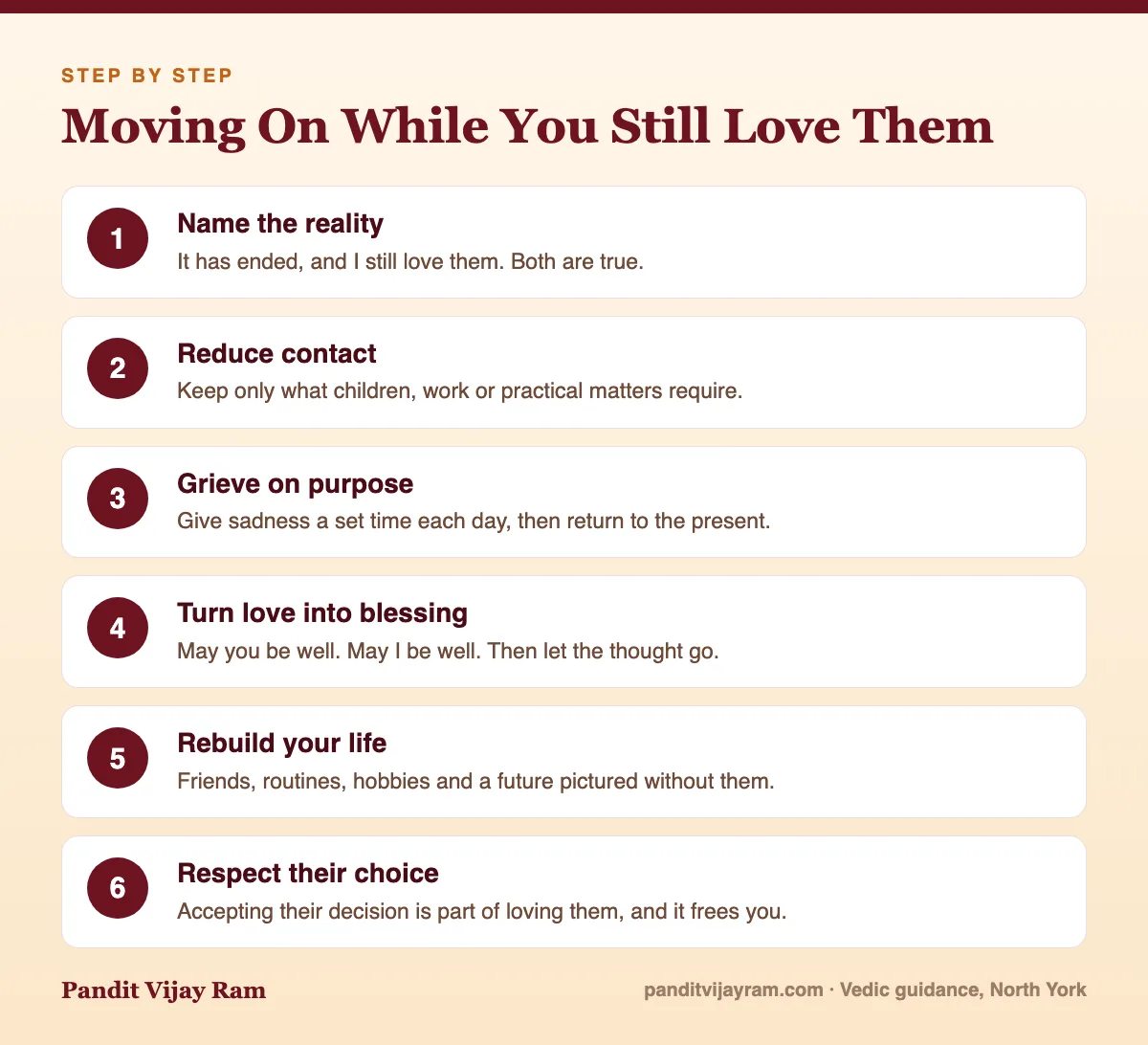
Here is a sequence I often share. Move through it at your own pace:
- Name the reality. Write one honest sentence, such as "The relationship has ended, and I still love them." Both halves are true.
- Reduce contact. Each message, profile check or meeting reopens the wound. Keep only what is necessary for children, work or practical matters.
- Grieve on purpose. Give the sadness a set time each day to cry, write or pray. Outside that time, gently return to what is in front of you.
- Turn love into blessing. When you think of them, say silently, "May you be well. May I be well." Then let the thought go.
- Rebuild yourself. Reconnect with friends you drifted from, return to a hobby, or try something new. Self-respect after rejection is the focus of rebuilding self-worth after rejection.
- Picture your own future. Write what you want your life to look like in a year, with no mention of them.
- Be patient with relapses. A song or a birthday may bring it all back. That is a wave, not a failure.
If you would like help working through this, a love problem consultation combines a calm conversation with prayer for your own healing.
When should you stop hoping and accept it is over?
It is time to accept the relationship is over when the other person has clearly said so, has moved into a new relationship or marriage, has asked for no contact, or when the relationship harmed you. Respecting their choice is part of loving them, and it frees you to heal.
Use this decision rule. If any of the following is true, the kindest path for both of you is acceptance:
- They have said clearly it is over, especially more than once or in writing.
- They have asked you not to contact them or have blocked you. A boundary like this must be respected.
- They are in a new relationship or are marrying someone else. Interfering would harm them and you. Guidance for that situation is in when your ex is getting married.
- The relationship involved abuse, control or repeated betrayal. In that case, your safety and self-respect come first.
- Your health, work or family life is suffering because of the waiting.
Sometimes the situation is genuinely unclear, and both people are still open to talking. A careful reading through the get your ex love back service looks honestly at whether reconciliation is something both of you freely want. Vijay Ram ji does not perform rituals to make anyone return, and he will tell you plainly when the kinder path is letting go.
Acceptance is not defeat. It is the moment you stop spending your life on a door that has closed, and begin noticing the ones still open.
The bottom line
Learning how to move on when you still love them starts with accepting that love and letting go can live side by side. Hope, identity and fear make it hard, but naming them loosens their hold. Vairagya teaches loving without clinging, supported by steady daily practice, and practical steps such as reduced contact, purposeful grieving and rebuilding your life make acceptance possible. Respecting the other person's choice is part of loving them, and it is also what sets you free.
Key takeaways
- You can move on without stopping loving someone; love can soften into goodwill.
- Hope, shared identity and fear of never loving again keep people holding on.
- Vairagya means loving without clinging, supported by steady practice.
- Reduce contact, grieve on purpose and turn longing into a daily blessing.
- When they have clearly chosen to leave, respecting that choice is part of love.