
Finding Closure After a Breakup

The hardest breakups are often the ones with loose ends. A text that was never answered, a reason that never made sense, a last meeting that never happened. Many people believe closure after breakup must come from the other person, so they wait for an explanation that may never arrive. I meet people in North York who have waited months for that one conversation, replaying every word they would say. This guide offers another route. You will learn what closure really is, why the other person often cannot give it, and five methods you can use on your own, including the letter you don't send. You will also learn when a closure conversation is worth asking for, how to keep it short and respectful, and when it is better left alone. In more than forty years of guiding people through endings, I have seen that the people who heal well stop asking for a perfect answer. They make a fair, honest account of what happened, and they mark the ending with care. That is what this page helps you do, step by step.
What does closure after a breakup actually mean?
Closure is the point where the story of the relationship feels finished enough to stop rehearsing it. You may still feel sad, but you no longer need new information to accept the ending. It is an inner settling of the questions, not a final agreement between two people about who was right.
People often say "I just need closure" when they mean several different things. Separating them makes the work clearer.
- Understanding. You want to know why it ended.
- Acknowledgement. You want the other person to admit their part.
- Ending well. You wanted a last moment that felt respectful, not a slammed door or silence.
- Permission. Part of you is waiting for a sign that it is truly over before you let yourself move.
Only the first two depend partly on the other person, and even then their answer may be incomplete. People leave for reasons they do not fully understand themselves. Some cannot say the real reason without causing more hurt, so they say something vague.
The last two you can give yourself. A respectful ending can be created after the fact, through a letter, a prayer or a small act of release. Permission to move on is a decision, not a feeling that arrives on its own.
In Vedic thought, the steady mind that accepts what has happened without bitterness is part of vairagya, a gentle detachment. It does not mean you stop caring. It means the past stops steering your present. If you are still unsure whether you even want to let go, the guide on moving on while you still love them sits alongside this one.

Why do some breakups leave no closure at all?
Breakups leave no closure when they end suddenly, without explanation, or with blame that never gets answered. Ghosting, a partner moving abroad, family pressure or a breakup by text all cut the story mid-sentence. The mind keeps searching for the missing piece, which is why the loop feels so hard to stop.
Our minds dislike unfinished stories. When a relationship stops without a clear reason, thoughts return to it again and again, testing explanations. This is normal, though exhausting.
The endings that most often leave people stuck include:
- Being ghosted after months or years together.
- A breakup forced by parents or community, where neither person fully chose it.
- A partner who moved away and simply faded.
- A sudden ending after one fight, with words said in anger and never taken back.
- A secret relationship, where you could not grieve openly and nobody around you knew.
In diaspora families that last situation is common. A couple may hide a relationship across faith or caste lines, and when it ends there is no one to talk to. The silence around the relationship becomes silence around the grief. The article on heartbreak in South Asian families looks at that experience closely.
Knowing why the loop happens does not stop it at once, but it changes how you treat it. Instead of thinking "something is wrong with me for still thinking about this", you can say "my mind is trying to finish a story, and I will help it finish". If the loop is taking over your days and nights, the practical techniques in how to stop thinking about your ex work well alongside the closure methods below.
How can I get closure without talking to my ex?
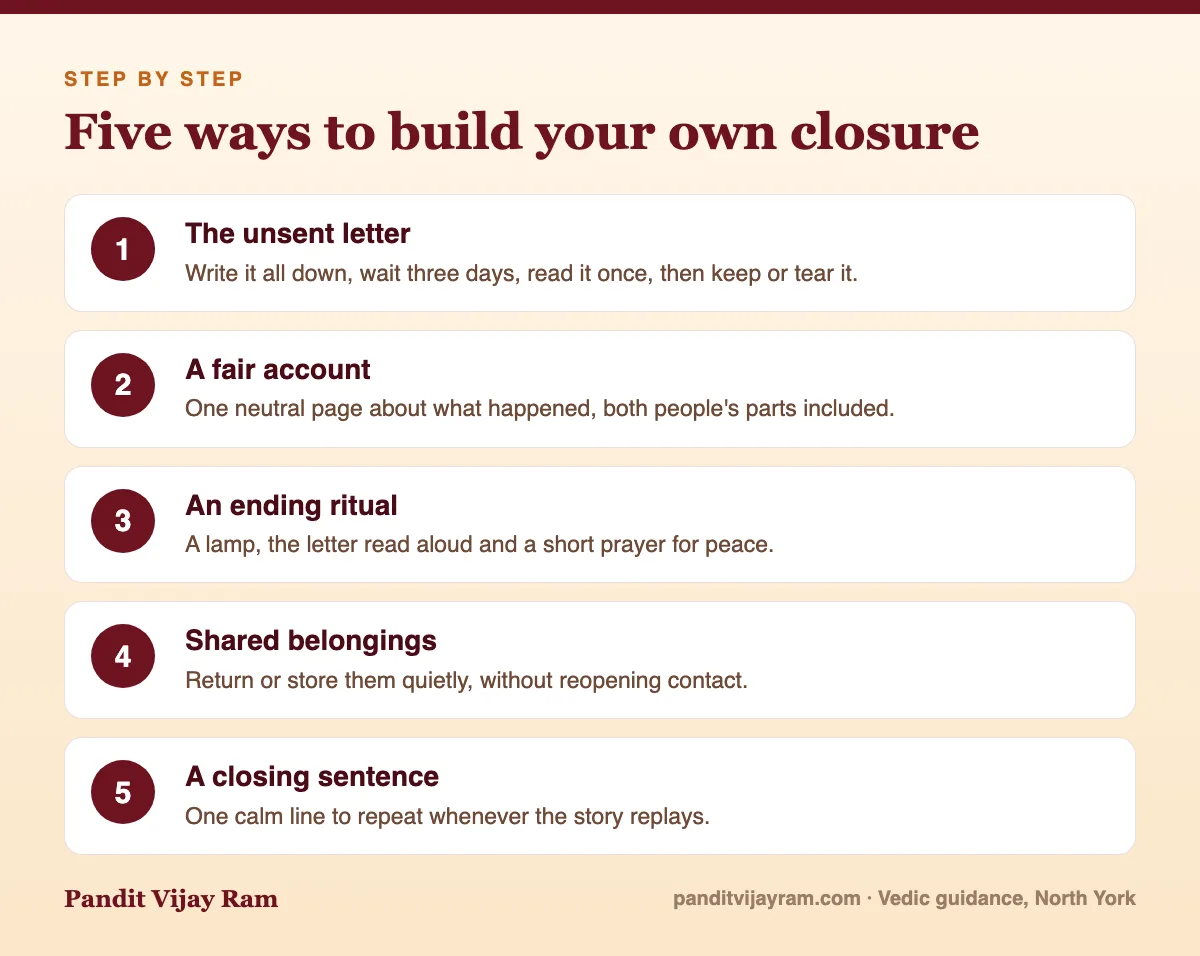
You can build closure alone through five methods: writing an unsent letter, writing a fair one-page account of what happened, choosing a small ending ritual, returning or storing shared items, and deciding on a sentence you will use whenever the story replays. Each one closes a loop that silence left open.
These methods work best one at a time, over a week or two. Do not rush them.
- The letter you don't send. Write everything you would say if you knew they would listen without interrupting. Thanks, anger, questions, regret. Keep writing until you run out. Then put it away for three days and read it once more.
- The fair account. On one page, write what happened as a neutral friend might describe it. Include your part and theirs. Avoid words like always and never. This replaces the blurred, looping version in your head with one clear story.
- A small ending ritual. Light a diya or candle, read the letter aloud once, and say a short prayer for both of you to be at peace. You may tear the letter up or keep it in a closed box. The point is to mark an ending you did not get.
- Shared belongings. Return what is theirs through a neutral route, or store it out of sight. Do not use returning items as an excuse to start a conversation.
- Your closing sentence. Choose one line, such as "It ended, and I am allowed to begin again." Say it whenever the replay starts.
If you want a deeper practice of release, cord cutting in Vedic terms explains a longer prayer of letting go. A daily lamp and a few minutes of quiet prayer over the following weeks help the release settle.
When does a closure conversation help, and when does it hurt?
A closure conversation helps when both people agree to it freely, the breakup was not abusive, and you are asking for understanding rather than a second chance. It tends to hurt when you secretly hope to reunite, when the other person has said no to contact, or when old arguments are likely to restart.
Before you ask for a talk, answer these honestly. If any answer is no, wait or choose the solo methods instead.
- Has the other person left the door open to contact, or have they asked for space or blocked you? A block is a clear answer; the guide on when an ex has blocked you explains why it must be respected.
- Would you be at peace if they gave no clear reason?
- Is your goal understanding, not persuasion?
- Would you feel physically safe meeting them?
- Can you keep it to one conversation, not a series?
If it feels right, keep it brief and kind. Ask once, by message, with no pressure: "I'd value a short talk to close things well, if you're open to it. If not, I understand." Meet somewhere public or speak by phone. Bring two or three questions, not twenty. Thank them at the end, whatever they say.
Never seek a closure talk after a relationship that involved threats, control or violence. That is not an unfinished story; it is a safety matter. The guide to domestic violence help in the GTA lists people who can support you, and in an emergency call 911.
How long does it take to feel closure after a breakup?
There is no fixed timeline. Many people notice the replaying eases over weeks to months once they actively work on closure rather than waiting for it. Long relationships, sudden endings and secret relationships usually take longer. Progress shows as fewer intrusive thoughts and calmer memories, not as never thinking of them again.
People ask me for a number, and I understand why. A number would make the waiting bearable. Honestly, no chart and no counsellor can give one. What I can offer is a way to notice progress.
Signs that closure is forming:
- You can tell the story of the relationship without your chest tightening.
- Days pass when you do not check their social media.
- You think of a good memory and feel warmth rather than only loss.
- The question "why?" feels less urgent, even if it is still unanswered.
- You start making plans that do not include them.
Setbacks are normal. A song, an anniversary or news of their new life can bring the ache back for a day. That is not starting over. It is a wave that passes faster each time.
If months go by and the loop is getting worse, with poor sleep, low mood or hopelessness, please see your family doctor. Our article on breakup depression describes the signs. If you are in crisis, call or text 9-8-8 any time in Canada. A gentle reading through the love problem consultation can sit alongside that care, never instead of it.
The bottom line
Closure after breakup is something you build, not a gift you must wait for. Separate what you need to understand from what you can give yourself, then use the unsent letter, the fair account and a small ending ritual. Ask for a closure conversation only when it is welcome, safe and free of hidden hopes. Measure progress by calmer memories, and reach for medical help if the loop deepens.
Key takeaways
- Closure is an inner settling of the story, not an agreement with your ex.
- Sudden, secret or forced endings leave the mind searching for a missing piece.
- An unsent letter and a fair one-page account close many loops on their own.
- A closure talk works only if both agree freely and it is safe.
- Progress looks like calmer memories, not never thinking of them.