
Getting Love Back After Divorce or Separation: What Is Realistic

Separation turns a household upside down. Suddenly there are two addresses, lawyers' letters, children moving between homes and relatives with strong opinions. Many people in North York and across Canada come to me hoping for help with getting love back after divorce or a long separation, often while still deeply attached to their spouse. This article looks at what is genuinely realistic. You will learn when reconciliation tends to work and when it tends not to, how Canadian family law affects the process, what children need while parents decide, and how spiritual practice can support both partners rather than only one. I will also be clear about limits, because a marriage cannot be restored by one person's effort alone. In over forty years of guiding families, I have seen couples rebuild beautifully after separation, and I have seen others find peace by parting kindly. Both outcomes can be blessed. What matters is that the choice is made freely, honestly and with the children's wellbeing at the centre. Let us go through it carefully.
Can a marriage be saved after separation?
Yes, many marriages recover after a period apart, especially when separation gives both people room to reflect and change. Reconciliation is most realistic when both partners want it, the reasons for the split are understood and addressed, and neither felt unsafe. It is least realistic when one partner has firmly decided to leave.
Separation can be a pause or an ending. Which one it becomes depends on what happens during the time apart. Couples who reconcile successfully usually share some common features:
- Both spouses come to want the marriage, not just one.
- The cause of the split, whether money, in-laws, infidelity, addiction or communication, is named honestly.
- At least one concrete change has been made, such as therapy, sobriety or new financial arrangements.
- There is a willingness to seek outside help rather than relying on promises.
Reconciliation is far harder, and often unwise, where there was violence, threats or controlling behaviour, where one partner is already committed to someone else, or where trust has been broken repeatedly without accountability.
Spiritually, Vedic tradition sees marriage as a sacred bond, yet it also honours each person's free choice. That is why Vijay Ram ji will support a couple who both wish to rebuild, but will not perform rituals to force a reluctant spouse back. The wider ethics are discussed in what a love back spell can and cannot do.

Can couples reconcile during a divorce in Canada?
Yes. Under Canada's Divorce Act, separated spouses can live together again for up to 90 days in total to try to reconcile without restarting the one-year separation period. Lawyers are also expected to discuss reconciliation and family dispute resolution with clients. A family lawyer can explain how this applies to you.
Many people do not realise the law leaves room for a second attempt. The most common ground for divorce in Canada is breakdown of the marriage shown by living separate and apart for at least one year. A trial reunion of up to ninety days, in one stretch or several, does not erase that time if it does not work out.
Some practical points to discuss with a lawyer:
- Married versus common-law. The Divorce Act applies to married spouses. Common-law partners are covered by provincial family law, such as Ontario's rules.
- Agreements in progress. If you have a separation agreement or court order, ask how a reunion affects it.
- Property and finances. Moving back in or reopening joint accounts can have consequences.
- Parenting arrangements. Any change should be stable and clear for the children.
- Safety orders. If a restraining order or bail condition exists, it must be respected regardless of personal wishes.
This is general information, not legal advice. The Department of Justice offers plain-language family law resources, and a family lawyer or legal clinic can guide your specific case. Spiritual guidance, including Vijay Ram ji's marriage problem consultations, works alongside that advice, never in place of it.
How do I get my husband or wife back after separation?
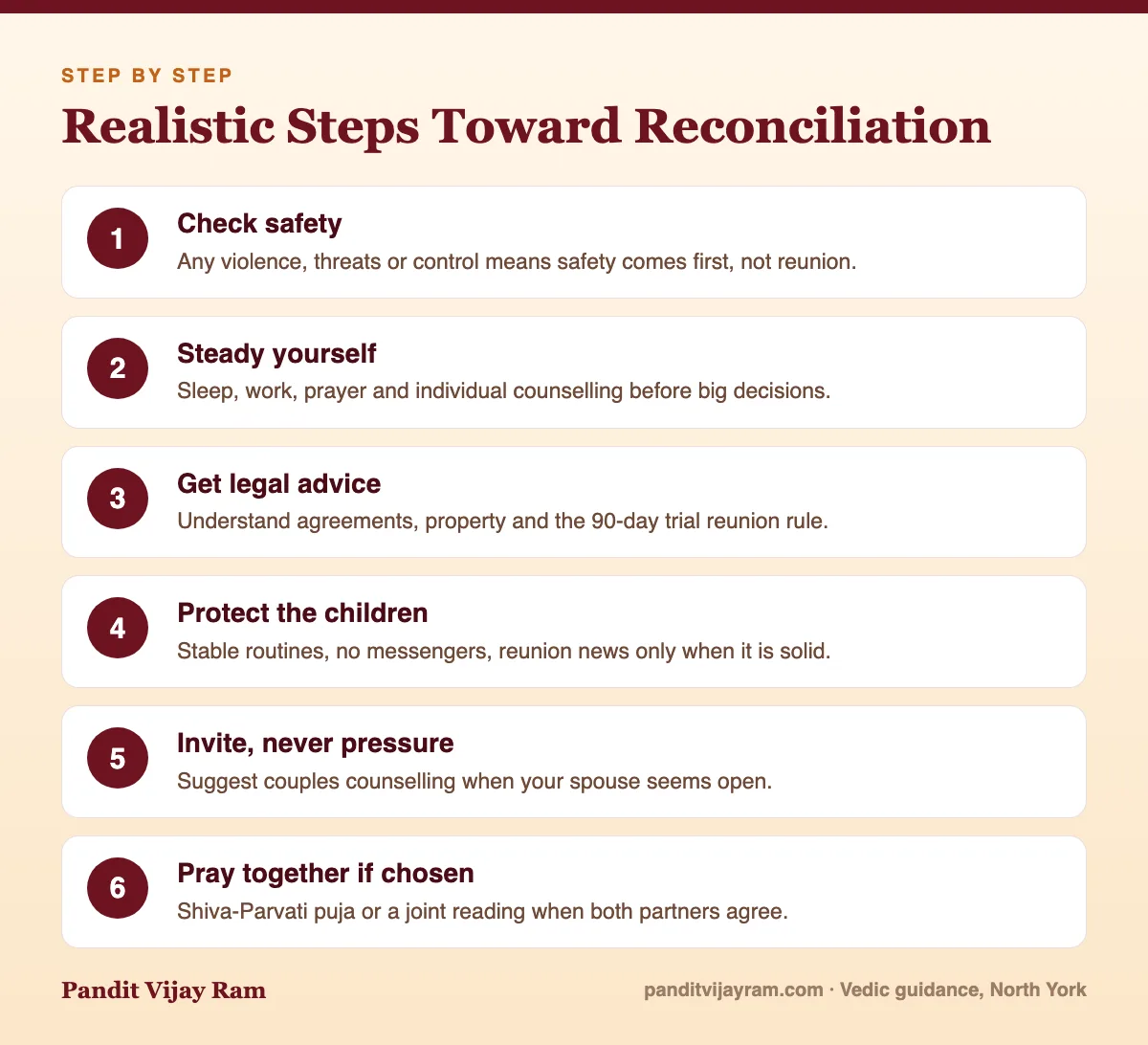
You cannot make a spouse return, but you can create conditions where reconciliation becomes possible. Respect their space, address your own part honestly, communicate calmly about practical matters, seek counselling, and keep the children out of adult conflict. If they become open, suggest couples counselling as a structured next step.
Here is a realistic sequence that many separated spouses find helpful:
- Steady yourself first. Sleep, eat, work and pray. Decisions made in panic rarely help.
- Respect the boundary. If your spouse asked for space, give it. Pushing usually confirms their reasons for leaving.
- Look at your part. Individual counselling can help you see patterns honestly.
- Keep practical contact respectful. Bills, children and logistics can be handled courteously, which itself rebuilds some trust.
- Show change, do not just promise it. Actions over months speak louder than apologies.
- Invite, do not pressure. When the time feels right, suggest seeing a couples counsellor together.
Avoid tactics that backfire: involving relatives to apply pressure, threatening, turning up uninvited or using children as messengers. These may also have legal consequences.
If your spouse has clearly decided to divorce, the kindest path is to accept that, focus on co-parenting and heal. Our article on no contact and spiritual remedies offers practices for that season.
How should children be protected during a separation or reconciliation?
Children need stability, honesty suited to their age and freedom from adult conflict. Do not use them to carry messages, take sides or report on the other parent. Avoid moving back together and apart repeatedly in front of them. Any reconciliation should be tested carefully before children are told the family is reuniting.
Children often believe a separation is their fault, and many quietly hope their parents will reunite. That makes them vulnerable to confusion if adults are unclear.
Guidelines many family counsellors suggest:
- Tell them together if possible. A simple, shared explanation is less frightening.
- Reassure them repeatedly. Both parents love them, and the separation is not their doing.
- Keep routines. School, meals, bedtime and activities should stay as steady as possible.
- No messengers. Adults communicate directly or through a parenting app.
- Protect them from arguments. Disagreements happen away from the children.
- Go slowly with reunion news. Wait until the reconciliation is stable before telling them.
In Canadian family law, decisions about children rest on their best interests. Courts and mediators will look at stability, safety and each parent's ability to cooperate.
Spiritual practice can include children gently, such as lighting a family lamp together each evening, without asking them to pray for their parents to reunite. That burden belongs to adults. For broader household tension, see our article on constant fights at home.
What spiritual support helps both partners after a separation?
Shared prayer can support both partners when each freely chooses it: Shiva-Parvati worship for marital harmony, Monday observances, a compatibility reading with both people's consent and charity done together. Where only one partner wants it, prayer should focus on their own healing and wisdom rather than on changing the other.
In the Vedic tradition, Shiva and Parvati are the model of a marriage that endures hardship through devotion and patience. Couples hoping to rebuild often turn to them.
Practices that suit a couple who both want to try:
- Uma-Maheshwar or Gauri-Shankar puja, done together, as a fresh sankalp for the marriage.
- Monday observance, a simple shared lamp or fast if health allows.
- A joint chart reading, which can show each person's patterns and periods of strain.
- Charity in the marriage's name, such as feeding the needy together.
For Muslim couples, istikhara, the prayer seeking divine guidance on a decision, is often more fitting, and Vijay Ram ji can explain istikhara guidance. Sikh couples may prefer ardas together at the gurdwara.
When only one spouse wants to reconcile, the prayer changes shape. It asks for strength, patience and the wisdom to act rightly, and for the other person's wellbeing whatever they choose. It does not seek to bend their will.
If the separation involved fear, threats or violence, please contact police or a local shelter first. Reconciliation should never be pursued at the cost of safety, and no prayer requires it.
The bottom line
Getting love back after divorce or separation is realistic only when both partners freely choose it, the causes are faced honestly and trust is rebuilt over time. Canadian law allows a trial reunion, but legal advice and children's stability must guide each step. Spiritual practice works best when both spouses share it, and when only one does, it should focus on their own healing. Where there was fear or violence, safety comes before any hope of reunion.
Key takeaways
- Reconciliation works best when both partners want it and real change has happened.
- Canada's Divorce Act allows up to 90 days of trial reunion without restarting separation.
- Children need stability and should never carry messages between parents.
- Shared Shiva-Parvati prayer and joint readings suit couples who both choose them.
- Abuse or threats mean safety first, and no ritual should be used to pressure a spouse.