
After Discovering an Affair: Spiritual Guidance for the First Weeks

Finding out that a husband or wife has been unfaithful can feel like the floor giving way. Sleep goes, appetite goes, and the mind replays every message and every late evening. People who search for an extra marital affair solution in the first days often want one thing: for the pain to stop and for someone to tell them what to do. When people in North York and across the GTA come to me at this stage, I do not start with the chart. I start with their safety, their health and their next few nights of sleep. This guide covers exactly that: what to do and avoid in the first weeks, how to look after your body and mind, why revenge and controlling rituals make things worse, and how prayer can give you a steady place to stand. Long-term repair is a separate question, and a separate article. Through four decades of sitting with people in this kind of shock, I have learned that the choices made in the first fortnight shape everything that follows, so it pays to make them slowly.
What should I do immediately after finding out my spouse is cheating?
Pause before acting. Check that you and any children are safe, tell one trusted person, eat and sleep as best you can, and avoid big decisions such as moving out, posting online or confronting the other person in public. Write down your questions for later. The first task is to get through the shock.
Shock does strange things to judgement. People who are normally calm send messages to the affair partner's family, empty joint accounts, or tell their children everything in one emotional evening. Most later wish they had waited.
For the first few days, I suggest a simple order:
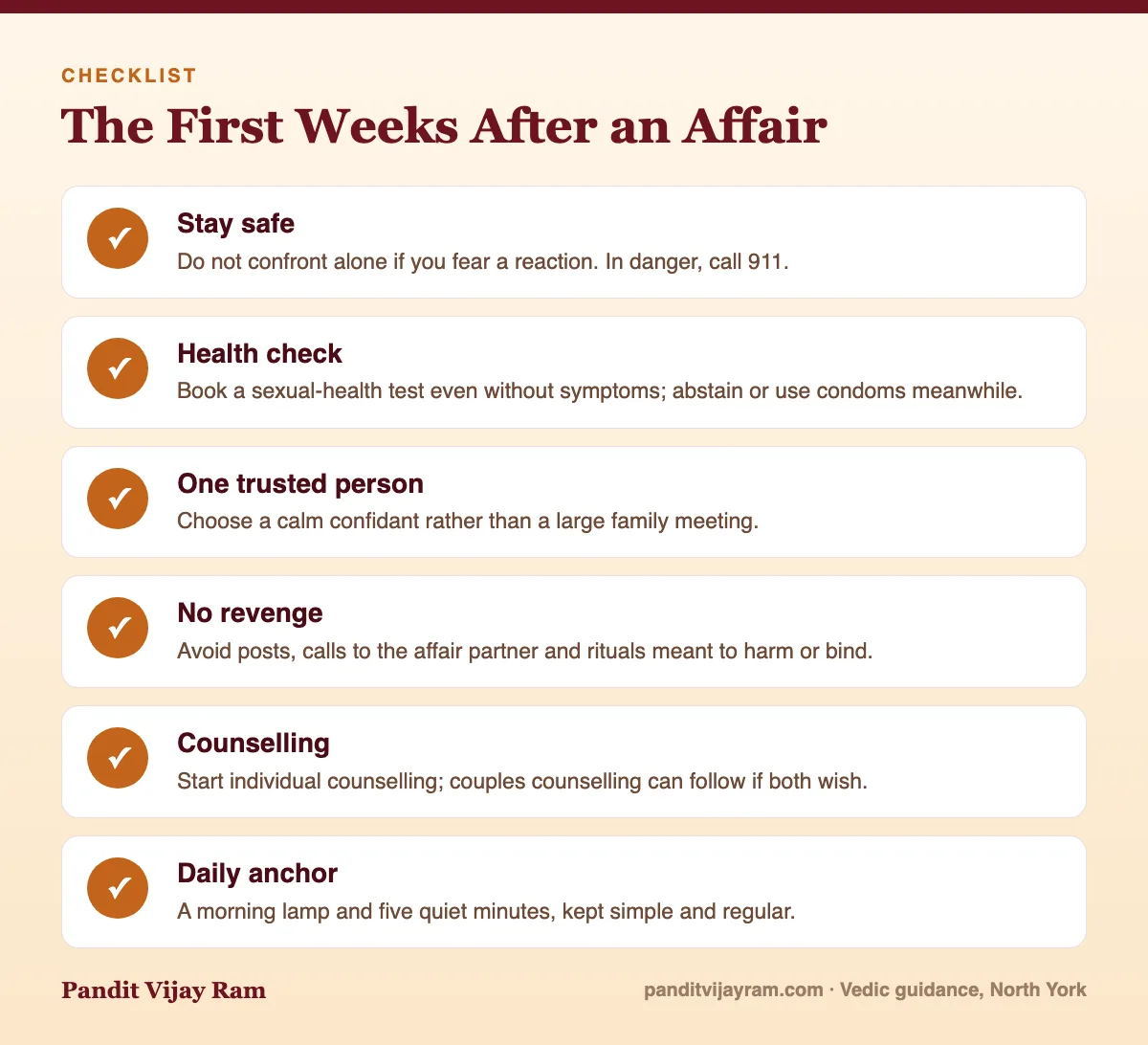
- Safety. If you fear your spouse's reaction, or there has been violence before, do not confront them alone. Have a friend nearby or speak with a family violence service first. In danger, call 911.
- One trusted person. Choose someone discreet who will listen rather than inflame. A large family discussion this early usually adds pressure.
- Basic care. Water, simple meals, and lying down at a regular time even if sleep is broken.
- Write rather than send. Put your anger and questions in a notebook. You can decide later which ones to ask.
- Keep daily routines. Work, school runs and meals give structure when everything else feels unstable.
You do not need to decide in the first week whether the marriage continues. Saying "I need time" to your spouse is enough.
If the shock brings thoughts of not wanting to live, please call or text 988 now. It is available across Canada at any hour.
When you are ready for spiritual guidance alongside this, the extra-marital affair guidance page explains how I support people at this stage, without rituals that interfere with anyone's will.

Should I get tested for STIs after my partner cheated?
Yes, it is a sensible precaution even without symptoms, because many sexually transmitted infections show no signs at first. See your family doctor or a public sexual-health clinic, explain the situation, and ask about timing for tests. Until results are clear, avoid sex or use condoms. This is self-care, not an accusation.
Many people feel embarrassed raising this, and some feel that getting tested means admitting how serious the betrayal was. Please do it anyway. Your health matters independently of whatever happens to the marriage.
A few practical points:
- No symptoms does not mean no infection. Chlamydia, gonorrhoea, HPV and others often cause no early symptoms in some people.
- Timing matters. Some tests need a window after possible exposure before they are reliable. A doctor or clinic nurse will tell you what to test now and what to repeat.
- Confidential options exist. Public health units across the GTA run sexual-health clinics, and your family doctor's discussion with you is confidential.
- Protect yourself meanwhile. Abstain or use condoms until you both have clear results.
In my conversations, women in particular sometimes delay this out of shame or because their spouse insists there is no need. A spouse who truly wants to repair trust will support testing, not resist it.
The same goes for mental health. The days after an affair discovery are a common time for panic attacks, insomnia and low mood. If these last more than a couple of weeks, or if you cannot work or care for children, see your family doctor. Our guide to telling negative energy apart from depression explains why medical care comes first.
Should I confront the person my spouse had an affair with?
Usually no, especially in the first weeks. Confronting the affair partner, contacting their family or exposing them online tends to escalate conflict, can create legal risk and rarely gives the answers you want. The conversation that matters is with your spouse, ideally with a counsellor present once emotions are steadier.
The urge to confront the other person is natural. You may want to see them, to understand what they had that you did not, or to make them feel some of your pain. I understand that urge, and I still advise against acting on it early.
Here is why:
- They are not the one who made vows to you. Your spouse chose to break trust; the answers belong in that conversation.
- It escalates. Calls to their workplace or family, or posts on social media, often lead to retaliation, harassment complaints and lasting community gossip that hurts your children too.
- It can create legal problems. Threats, repeated unwanted contact or sharing private images can be offences. Do not let anger put you on the wrong side of the law.
The same applies to revenge of a spiritual kind. Some people are offered rituals to harm the affair partner or to bind their spouse back. I do not perform them, because they seek to override another person's will and they keep you tied to anger. Our article on the side effects of love spells describes the emotional and financial damage these offers often cause.
If the affair partner is harassing you, keep records and report it to police. If you are thinking about where the marriage goes from here, the guide on whether a relationship is worth saving offers a calm way to think it through later.
Can astrology explain why my husband or wife cheated?
A chart may show restless periods, for example a Venus or Rahu dasha, or afflictions to the seventh or twelfth house, but it never excuses or causes a choice to deceive. Astrology can help you understand timing and temperament. Responsibility for an affair rests with the person who had it.
People often ask me to look at their spouse's chart soon after discovering an affair. I understand the wish to make sense of something senseless. I am careful with this request for two reasons.
First, a chart is never permission. If I say that Rahu was running a period that brings temptation, I am describing a pressure, not a decision. Many people run that same period and stay faithful. Responsibility stays with the person who chose.
Second, the person in shock sometimes uses astrology to blame themselves. "My seventh house is weak, so it was my fault." It was not. A weak seventh house does not cause anyone else to lie.
Where astrology can help, later on, is with these questions:
- Is the current period one of upheaval for either partner, which might pass?
- What does each person's chart say about honesty, restlessness and emotional needs?
- When might a calmer time for difficult decisions arrive?
I usually suggest waiting a few weeks before a detailed reading, so the information lands on a steadier mind. When you are ready, the kundli and horoscope reading can be done for you alone. Your spouse's chart should be read only with their knowledge and consent.
What spiritual practice helps after discovering infidelity?
Choose a short daily practice that steadies rather than stirs: a morning lamp with a few minutes of slow breathing, the Hanuman Chalisa for courage, or reading the Bhagavad Gita's verses on the steady mind. Keep it simple and regular. Prayer here is for your own peace, not to control anyone else.
In the first weeks, long rituals and fasting are usually a poor idea. You need energy, sleep and food. What helps is a small anchor you can return to each day.
- The morning lamp. Light a diya, sit for five minutes, and breathe slowly. Silently repeat a name of God that comforts you. This is not about feeling better instantly; it is about having one calm point in the day.
- Hanuman Chalisa. Many people find its rhythm grounding and its theme of courage fitting. One recitation a day is enough.
- The steady mind. The second chapter of the Gita describes the sthitaprajna, a person whose mind stays steady in joy and sorrow. Reading a verse or two each night gives the mind something other than replaying the betrayal.
- Writing a prayer. Some people find it easier to write their pain to God than to speak it.
- Avoid revenge prayers. Praying for harm to the spouse or the affair partner keeps the wound open.
Pair prayer with individual counselling. A counsellor can help you sort feelings from decisions, and later, if both of you wish, a couples counsellor can help you decide whether to rebuild. That longer path is covered in our guide to rebuilding trust after cheating.
The bottom line
The first weeks after discovering an affair call for safety, health and steadiness rather than verdicts. A sexual-health check, one trusted confidant, individual counselling and basic daily care protect you while the shock settles. Revenge, public confrontation and controlling rituals deepen the harm, and astrology describes pressures without excusing anyone's choice. A simple daily prayer gives you a calm place to stand, and that calm is the best foundation for any extra marital affair solution you later choose.
Key takeaways
- Take time before deciding anything about the marriage.
- Get a sexual-health check even without symptoms.
- Avoid confronting the affair partner or posting online.
- A chart can show restless periods but never excuses deception.
- Keep a short daily prayer for your own steadiness, not for control.