
Marriage Timing in a Kundli: How It Is Read
Parents ask it about their children, and young adults ask it about themselves, often with some embarrassment: when will the marriage happen? Families in North York and across the GTA have asked me this for decades, and many have already been given a confident year by someone else, sometimes more than once. This guide explains how marriage timing in kundli is actually read, step by step, so you can understand what an astrologer is doing and judge the answer you receive. It covers the natal promise, the Vimshottari dasha periods most often linked to marriage, how Jupiter and Saturn transits are used, how other schools approach the same question, and the honest limits that apply to every method. It deliberately gives no dates. In more than forty years of practice, I have learned that timing is the most requested and the most misused part of astrology. Used carefully, it points to seasons of opportunity. Used carelessly, it turns into pressure, fear or false hope.
How do astrologers predict marriage timing in a kundli?
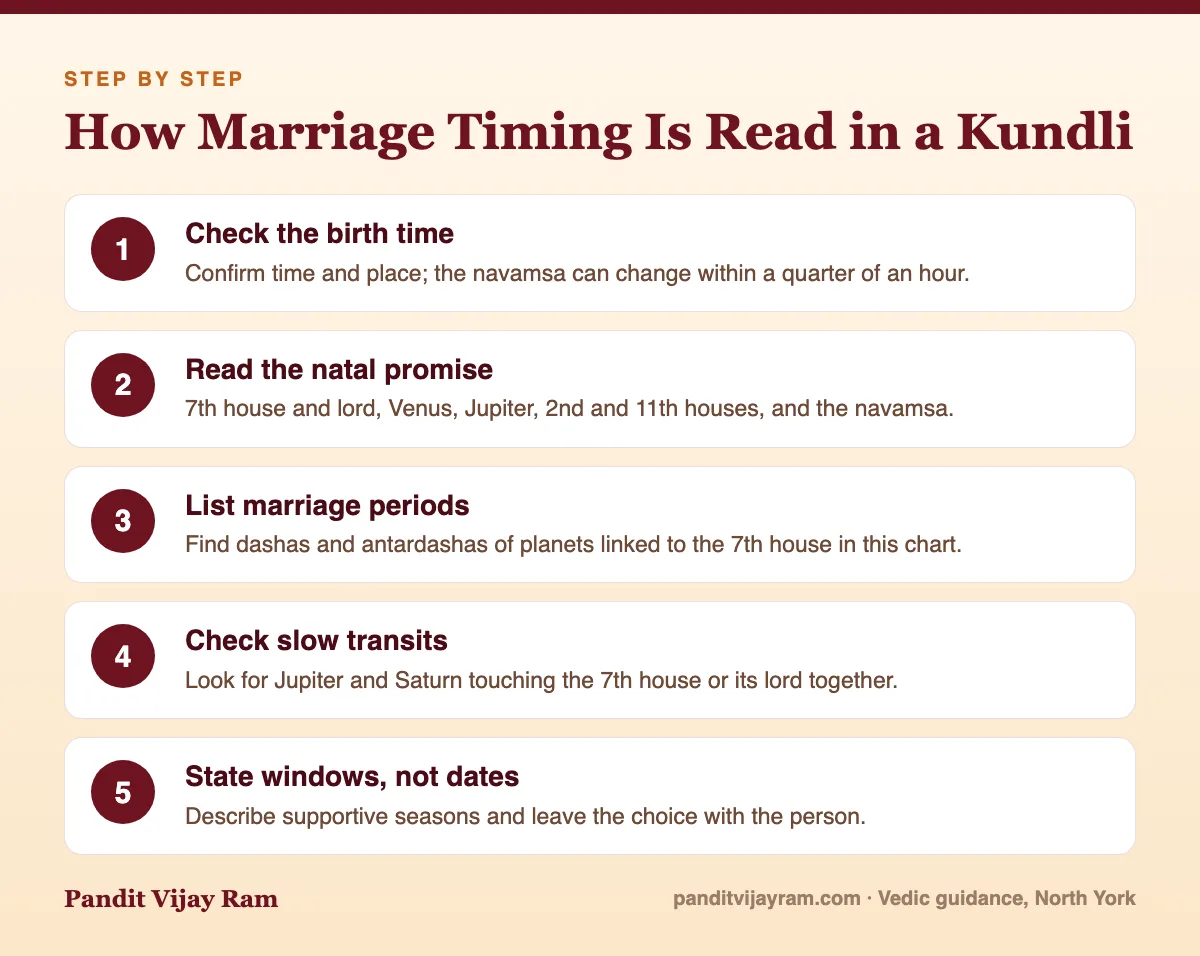
Astrologers usually work in three layers. First they assess the natal promise for marriage from the 7th house, its lord, Venus, Jupiter and the navamsa. Then they identify dasha and antardasha periods connected to those factors. Finally they check whether slow transits, especially Jupiter and Saturn, support the 7th house during those periods.
A simple way to remember the method is: promise, period, trigger.
- Promise. Does the birth chart support partnership, and what kind? This comes from the natal chart and navamsa.
- Period. Which planetary periods are linked to marriage factors in this particular chart? These come from the dasha system.
- Trigger. Within a supportive period, which months see helpful transits over the relevant houses?
Each layer narrows the picture, but none of them works alone. A transit without a supportive dasha is usually read as weak. A supportive dasha without a natal promise is read as limited.
Precision depends heavily on birth time. The ascendant moves through roughly one degree every four minutes. Since each navamsa division spans three degrees and twenty minutes, the navamsa ascendant can change in around a quarter of an hour. A rounded birth time can therefore change the answer.
If you are new to these terms, our guides to the Vimshottari dasha and to gochar, or transits explain the foundations. For a more personal question of love rather than a wedding date, see when will I find true love.

Which houses and planets show marriage in a birth chart?
The 7th house and its lord are central, along with any planets in or aspecting the 7th. Venus is the general significator of marriage, and Jupiter is traditionally read as the husband's significator in a woman's chart. The 2nd house of family and the 11th house of fulfilment support the picture, and the navamsa refines it.
Before any timing, an astrologer studies what the chart promises. The main factors are:
- The 7th house. Partnership and spouse. Its sign, occupants and aspects describe how marriage tends to unfold.
- The 7th lord. Its strength, house position and dignity matter as much as the house itself.
- Venus. The karaka of marriage and affection for everyone; in a man's chart it is also read as the significator of the wife.
- Jupiter. Traditionally the significator of the husband in a woman's chart, and of blessing and growth generally.
- The 2nd and 11th houses. Family addition and fulfilment of desires. In the Krishnamurti Paddhati school, significators of the 2nd, 7th and 11th houses are the core of marriage timing.
- The navamsa, or D9. Traditionally read for marriage and the inner strength of planets. Our guide to the navamsa chart explains how.
Jaimini astrology adds the upapada lagna and the darakaraka, the planet with the lowest degree among the chara karakas. The upapada lagna guide covers that method in detail.
Saturn's influence on these factors is commonly linked to marriage after a delay, and Rahu's to unconventional or sudden unions. These are classical tendencies. They describe style and timing pressure, not whether a marriage will be happy.
Which dasha brings marriage?
There is no single marriage dasha. Marriage is traditionally read in the mahadasha or antardasha of the 7th lord, planets placed in or aspecting the 7th house, Venus, or the lords of the 2nd and 11th houses, as well as Rahu or Ketu when they are linked to the 7th. Which applies depends entirely on the individual chart.
Vimshottari dasha divides a full cycle of 120 years among nine planets in a fixed order. The starting point is the Moon's nakshatra at birth, so two people born on the same day can be in different periods. Each mahadasha is divided into antardashas, and those into finer sub-periods.
For marriage, an astrologer lists the planets connected to marriage factors in this chart, then looks for periods ruled by them during the years when marriage is socially likely. Common candidates are:
- The 7th lord, or a planet in the 7th house.
- A planet aspecting the 7th house or its lord.
- Venus, especially if well placed or linked to the 7th.
- The lord of the nakshatra occupied by the 7th lord.
- The 2nd or 11th lords, when they connect to the 7th.
- Rahu or Ketu, when placed in the 7th or with its lord.
The antardasha often matters more than the mahadasha. A long Saturn mahadasha, for instance, may contain a Venus antardasha that is read as the most supportive window within it.
The sub-period rules are explained further in our guide to antardasha sub-periods. Remember that a supportive dasha signals an opening. It does not arrange a marriage on its own.
How are Jupiter and Saturn transits used for marriage timing?
Within a supportive dasha, astrologers look for transits that activate the 7th house or its lord. A common rule, the double transit, looks for Jupiter and Saturn both influencing the 7th house or its lord at once, by position or aspect, from the ascendant or the Moon. Transits refine timing; they never replace the dasha.
Transits, or gochar, describe where planets are moving now in relation to the birth chart. For marriage, the slow planets carry most weight.
- Jupiter takes about a year in each sign and about twelve years to circle the zodiac. Its aspects fall on the 5th, 7th and 9th houses from its position.
- Saturn spends roughly two and a half years in each sign. Its aspects fall on the 3rd, 7th and 10th houses from where it sits.
- Rahu and Ketu move backwards through the zodiac, spending about eighteen months in each sign, and are sometimes linked to sudden events.
The double transit idea, popularised by modern Indian astrologers, is that marriage becomes more likely when Jupiter and Saturn together touch the 7th house or its lord, provided the dasha also supports it. Some astrologers also check ashtakavarga scores to judge how helpful a transit is.
Because these planets move slowly, a double transit can last many months and may repeat. That is why transits produce windows, not dates.
Exact sign changes for any year should be checked in a current ephemeris or a Toronto panchang, not taken from a generic list. Our guide to the Jupiter transit explains how its yearly move is read for every house.
How accurate are marriage year predictions?
They are often less accurate than people expect. Timing techniques can point to supportive windows, but birth-time errors, competing schools, several overlapping windows and, above all, human choices mean that no method reliably names a wedding year. Treat any prediction as a possibility to consider, and be cautious of anyone who presents a date as certain.
Honest limits apply to every method in this article.
- Birth time. The navamsa and house cusps shift within minutes. A rounded or remembered time can move every window.
- Several windows. Most charts show more than one supportive period. Which one becomes a wedding depends on life, not on the chart alone.
- Different schools. Parashari, Jaimini, Krishnamurti Paddhati and others can point to different times for the same person.
- Social reality. Studies, immigration, finances, family readiness and whether a suitable partner exists all shape timing.
- Free will. Two people have to choose each other. No planet can make that choice for them.
Fixed predictions can also cause real harm. A young woman told she must marry before a certain age may rush into an unsuitable match. A man told marriage is far away may stop trying. A family may pay for expensive rituals to 'unblock' a delay that is simply ordinary life.
I prefer to describe the seasons that look more supportive, explain why, and leave room for the person's own judgment. If you would like your own chart read this way, the kundli and horoscope service explains what to bring and how readings work.
The bottom line
Marriage timing in kundli is read by checking the natal promise, then the dasha periods linked to marriage, then transits of Jupiter and Saturn that may trigger events within them. Schools such as Jaimini and Krishnamurti Paddhati add their own methods and can disagree. Birth-time accuracy, overlapping windows and human choice all limit precision. The honest result is a set of supportive seasons and tendencies, never a guaranteed year.
Key takeaways
- Timing is read as promise, period and trigger.
- The 7th house, its lord, Venus and the navamsa form the promise.
- No single dasha brings marriage; it depends on the chart.
- Jupiter and Saturn transits refine windows within a dasha.
- Birth-time errors and free will limit every prediction.