
Inter-Caste Marriage and Parents' Approval: Vedic and Practical Guidance

You have met someone kind and steady, your values match, and then the first family question is about surname or community. Inter caste marriage problems are still common in diaspora homes, even among parents who have lived in Canada for decades and work alongside every kind of person. Couples in North York, Brampton, Mississauga and across the GTA often reach me after months of silent dinners and tearful phone calls. This guide looks at why parents object, what Vedic astrology actually says about caste (very little), how to talk so that both families feel heard, and what the law in Canada protects. It also covers spiritual practices that support harmony without trying to control anyone's mind. In more than forty years of practice I have watched many families move from refusal to blessing, usually slowly and through respect on both sides. I have also seen pressure turn dangerous, so the safety section matters as much as any remedy.
Why do parents oppose inter-caste marriage?
Most parents who oppose an inter-caste match are afraid rather than hateful. They worry about what relatives will say, whether customs, food and festivals will clash, how grandchildren will be raised, and whether their child is rushing. Some carry old prejudice from back home. Understanding which fear is speaking makes a calmer conversation possible.
When I sit with parents, the objection rarely sounds like "caste" at first. It sounds like questions:
- "What will people say?" Community reputation matters deeply to families who built a social world from scratch in a new country.
- "Will they respect our ways?" Fear that a son-in-law will not join the Ganesh puja, or a daughter-in-law will not keep a fast.
- "Do we know this family?" Arranged introductions came with references. A partner from another community feels like a stranger.
- "Are you sure?" Parents often believe love fades and family structure is what lasts.
- Inherited prejudice. Some views on purity and status were learned in childhood and never questioned.
Caste-based discrimination is not only a South Asian story, and it continues in parts of the diaspora. Naming it honestly is fair. Naming your parents as villains rarely helps.
A useful exercise is to write down each objection you have heard, then mark which ones are about safety, which about customs and which about status. Customs can be discussed. Safety concerns can be answered with information. Status worries usually soften only with time and good experience of the person you love.
Couples from different religions face some extra layers, explored in our article on interfaith marriage and family disapproval.
Does a kundli show caste or forbid inter-caste marriage?
No. A birth chart is calculated from date, time and place of birth; it contains no record of anyone's family community. The Varna koota in guna milan sounds similar but assigns a temperament type to each Moon sign, worth only one of thirty-six points. It has nothing to do with the couple's actual caste.
This point surprises many parents. In ashtakoota matching, Varna is the first and lightest of the eight kootas. The twelve Moon signs are grouped by element into four types:
- water signs, Cancer, Scorpio and Pisces, as Brahmin;
- fire signs, Aries, Leo and Sagittarius, as Kshatriya;
- earth signs, Taurus, Virgo and Capricorn, as Vaishya;
- air signs, Gemini, Libra and Aquarius, as Shudra.
So a man from a Brahmin family can have an "air" Moon, and a woman from any background can have a "water" Moon. The koota is read as a hint about outlook and work style, and many astrologers barely weigh it. Missing that single point does not decide anything.
What a chart can do is open a different conversation. When a family values astrology, a careful kundli matching for a love marriage lets parents see the couple through a lens they trust, beyond surnames. If the match shows real strengths, that often carries weight with elders. If it shows challenges, they are about temperament and timing, which the couple can work on together.
I always tell families plainly that I will not twist a chart to support or block a marriage. The reading describes; it does not vote. The final decision belongs to the two adults who will live the marriage.
How can inter-caste couples win their parents' approval?
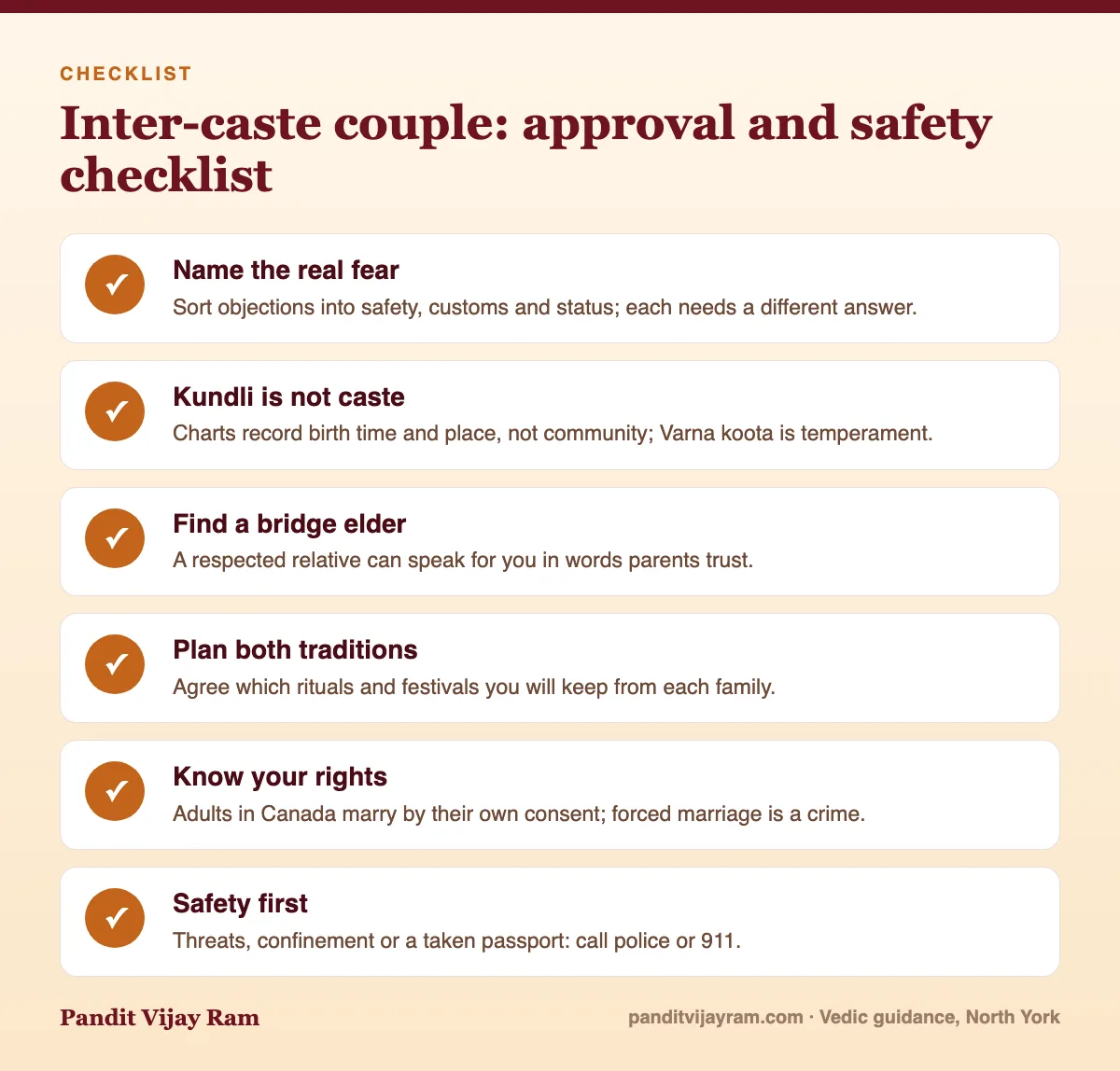
Approval usually grows from patience and familiarity. Introduce your partner as a person before announcing a decision, address specific worries about customs and grandchildren, find a respected relative who can speak for you, and show how both families' traditions will be honoured. Expect several conversations over months, not one dramatic evening.
A step-by-step conversation plan is set out in our companion guide on how to convince parents for a love marriage. Here are the points that matter most when caste is the sticking point:
- Answer the custom question concretely. Will there be a havan, a Gurdwara Anand Karaj, both? Which festivals will you keep? Vague promises worry parents more than clear plans.
- Let the families meet on neutral ground. A temple event, a festival dinner or a casual coffee lets parents see each other as people.
- Find your bridge. An uncle, a grandparent or a family friend from the same community who has seen mixed marriages succeed can speak in a way your parents will hear.
- Respect the timeline. Giving parents months, not days, is not weakness. Many families who first say no attend the wedding smiling.
- Hold your boundary kindly. "I hear you, and I am still choosing this person" can be said lovingly, again and again.
Sometimes a family meeting with a neutral elder present helps. Our family problem consultation is one place where both generations can speak without shouting. Counselling with a culturally aware therapist is another good option.
Do you need parents' permission to marry in Canada?
Adults who meet their province's age of marriage do not need parental permission to marry in Canada. Canadian law requires the free and enlightened consent of both people, and forcing someone into marriage is a criminal offence. If you face threats, confinement, a confiscated passport or pressure to travel abroad, call police or 911.
In Ontario, people aged eighteen and over can marry without anyone's consent. Rules for younger people differ by province and involve parental consent; no one under sixteen can marry anywhere in Canada.
Most family disagreements stay at the level of hurt words and long silences. Some do not. Please treat these as warning signs that a situation has moved from disapproval into coercion:
- your phone, money, ID or passport is taken from you;
- you are not allowed to leave the house, attend school or go to work;
- a sudden trip "back home" is arranged, with hints of a marriage there;
- threats of violence, disowning with menace, or harm to your partner;
- relatives watching or following you.
If you are in danger now, call 911. If you are under eighteen, Kids Help Phone is open day and night at 1-800-668-6868 or by texting 686868. Shelters, settlement agencies and legal clinics in the GTA can also help adults plan safely, and a family doctor can connect you to support.
No astrologer, priest or elder has the right to override your consent, and no puja can make a forced marriage acceptable. I will not perform rituals intended to pressure either partner or either set of parents. If you feel trapped, safety comes before any spiritual step.
What Vedic remedies help with inter-caste marriage approval?
Vedic support for an inter-caste marriage focuses on harmony and patience, not control. Couples often pray to Gauri-Shankar or Katyayani for a blessed union, begin family talks after a Ganesh prayer, and may hold a shared puja that both families attend. These practices steady the couple; they do not force anyone's mind.
Practices families commonly use:
- Ganesh prayer before important conversations, asking that obstacles of misunderstanding be removed.
- Gauri-Shankar or Uma-Maheshwar worship on Mondays, a traditional prayer for a harmonious marriage.
- The Katyayani mantra, long associated with women praying for a good marriage.
- Charity in both families' names, a gesture that softens hearts on both sides.
- A joint puja or havan once the families are talking, so that both traditions share one sacred space.
Some websites sell vashikaran to "make parents agree". I refuse that work. Trying to override a parent's will is not respect, and it undermines the very family bond you hope to build. Our love marriage guidance combines chart insight, counselling-style conversation and prayer for your own steadiness instead.
Many couples also find it helps to study each other's family traditions sincerely. Learning the aarti your partner's mother sings, or the meaning of a festival she keeps, speaks louder than any ritual. Couples who want local support in person can read about a love marriage specialist in Toronto and what to expect from that role.
The bottom line
Inter caste marriage problems are usually rooted in parents' fears about community, customs and the future, and those fears respond best to patience, concrete plans and trusted elders. A kundli does not record caste, and the Varna koota measures temperament, not birth community. Adults in Canada may marry by their own free consent, so any threats or coercion call for police and safety support, while prayer and counselling help the families heal around the couple's choice.
Key takeaways
- Parental objections are usually fear about status, customs and the future.
- A birth chart does not contain caste; Varna koota is about temperament.
- Approval grows through meetings, trusted elders and concrete plans.
- Canadian law requires free consent, and forced marriage is a crime.
- Vedic remedies support harmony; they never override anyone's will.