
Online Kundli Matching for Love: Using Calculators Wisely

A few minutes on a matching website now does what once took a family astrologer an afternoon. You enter two sets of birth details, press a button and receive a score out of thirty-six, a list of doshas and often a verdict in large letters. Many couples in North York and across the GTA arrive at my door holding exactly such a printout, sometimes reassured, often alarmed. Online kundli matching is genuinely useful when you know what it is doing. This guide explains what the calculator actually checks, the input mistakes that quietly change results, why two apps can disagree about the same couple, and the parts of a match that software usually leaves out. It also gives a simple rule for deciding when a score is good enough and when to ask for a full reading. In more than forty years of matching charts by hand and by computer, I have found the software reliable at arithmetic and far less reliable at judgment.
What does an online kundli matching calculator check?
Most calculators compute each person's Moon sign and nakshatra, then score the eight kootas of Ashtakoota guna milan, for a total out of 36. Many also flag Mangal dosha, nadi dosha and bhakoot dosha. Some add basic chart images. Few examine the 7th house, Venus, navamsa or dasha periods in any depth.
Behind the score is a standard table. Each koota compares a particular feature of the two Moon positions:
- Varna (1 point), vashya (2), tara (3), yoni (4), graha maitri (5), gana (6), bhakoot (7) and nadi (8).
- The total is out of 36. Many families treat 18 as the conventional minimum for proceeding, while higher scores are called good or excellent.
- Mangal dosha is usually checked separately by looking for Mars in certain houses.
Our own Kundli Matching Calculator works this way. It asks for date, time and place for both people, and an offset from UTC when a city is not listed, then returns an indicative guna milan.
What the table cannot do is notice context. Two couples with identical scores can have very different charts, because the score looks only at the Moon. That is why the detailed guides to a low guna milan score, nadi dosha and bhakoot dosha spend so much time on exceptions.
South Indian families may use a different system, often called porutham, with around ten checks including rajju and vedha. A North Indian calculator will not show these.

Why do different kundli matching apps give different results?
Apps differ in the ayanamsa they use, how they handle time zones and daylight saving, which cancellation rules they apply, how they define Mangal dosha and whether they follow North or South Indian matching. Near a nakshatra or sign boundary, even small differences change the score. Disagreement between apps is common and not a sign of bad luck.
If one site gives you 24 points and another 17, the usual causes are technical.
- Ayanamsa. Vedic charts subtract a correction from the tropical zodiac. Lahiri is the most common choice, but some apps use other values. The difference is small, yet enough to move a Moon near a boundary into the next nakshatra.
- Time zone handling. Daylight saving, historic time zone changes and the half-hour offset of Indian Standard Time all trip up software when city data is incomplete.
- Cancellation rules. Classical texts allow bhakoot and nadi doshas to be cancelled under specific conditions. Some apps apply them, some apply a few, many apply none.
- Mangal dosha definitions. Schools disagree on which houses count, whether to check from the ascendant, Moon or Venus, and which exceptions apply.
- Different systems. Ashtakoota and porutham simply measure different things.
A useful habit is to note which nakshatra and Moon sign each app gives for each person. If those differ between apps, the birth data or settings are the cause, not the couple.
Mangal dosha differences in particular cause needless fear. Our guide to manglik and non-manglik marriage explains the cancellation rules and the myths around them.
What birth details do I need for accurate online matching?
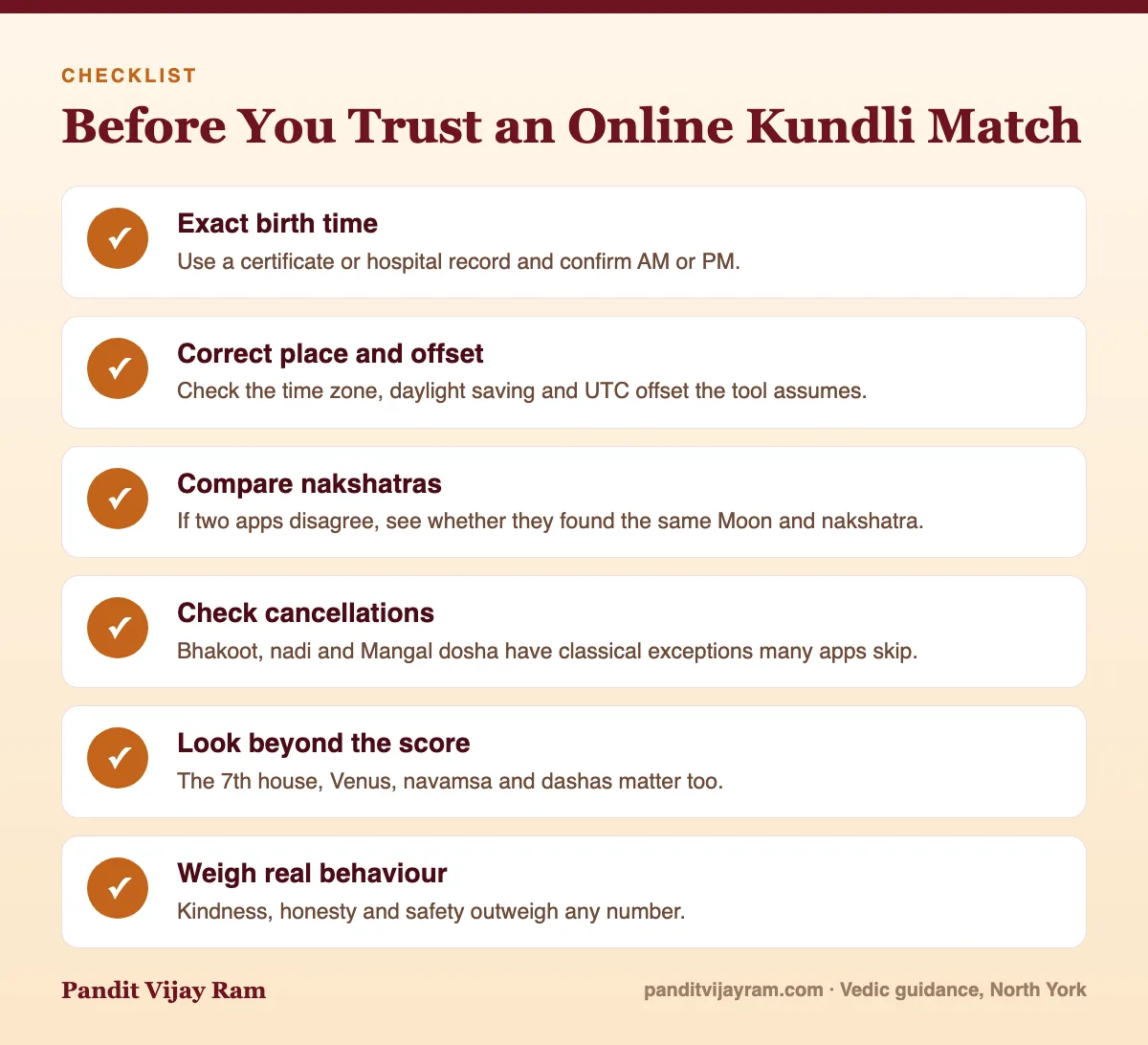
You need each person's exact date, time and place of birth. Time is the most sensitive: a mistake of even half an hour can change the ascendant and, near a boundary, the nakshatra. Use a birth certificate or hospital record where possible, confirm AM or PM, and check the time zone the software assumes.
Most matching errors begin with the data, not the astrology. A short checklist prevents most of them.
- Source the time. Birth certificates, hospital discharge notes or a horoscope made at birth are better than memory. 'Around lunchtime' is not a birth time.
- Check AM and PM. Twelve hours of difference changes almost everything.
- Pick the right place. Use the town of birth, not where the family lived later. If the town is not listed, choose the nearest city and confirm the time zone.
- Confirm the offset. Indian Standard Time is five and a half hours ahead of UTC. Births in Canada may fall in daylight saving time. A wrong offset shifts the whole chart.
- Look for boundaries. If the app shows the Moon in the last or first degree of a nakshatra, treat the result as uncertain.
If you truly cannot find a birth time, a calculator's precise-looking number is misleading. Astrologers use other approaches, such as Moon-sign estimates, naam matching or rectification, each with stated limits.
Remember too that birth details are personal information. Enter them only on sites you trust, and ask your partner's permission before you run their chart.
A date-only match is a different and far broader exercise, covered in our article on love compatibility by date of birth.
What does online kundli matching miss?
Software usually misses how the two whole charts work together: the 7th house and its lord, Venus and Mars in each chart, the navamsa, dasha periods running at the time of marriage, and the many classical cancellations. It also misses everything human, from character and values to how two people actually treat each other day to day.
Guna milan is a Moon-based comparison. It was never intended to stand alone. A traditional match also asks:
- Is the 7th house strong in each chart? Its lord, occupants and aspects describe how each person approaches partnership.
- What about Venus and Mars? Venus is read for affection and harmony, Mars for energy and temper.
- What does the navamsa show? The D9 chart is traditionally read for marriage in depth.
- Which dashas are running? A demanding period can explain strain without condemning a match.
- Do the charts support each other? One partner's strengths may balance the other's challenges.
Beyond the chart lies everything a calculator cannot know. A high score sits comfortably beside a partner who lies, controls money or frightens the other. A low score sits beside many long and loving marriages.
A decision rule I share with families:
- Score above the conventional minimum and no serious dosha: proceed on the basis of the people themselves.
- Low score or a flagged dosha: check cancellations with a qualified astrologer before worrying.
- Any concern about behaviour or safety: take it seriously whatever the score says.
When should I ask an astrologer instead of trusting the calculator?
Ask an astrologer when the score is low or borderline, when a dosha is flagged, when apps disagree, when birth times are uncertain, or when the families are making a serious decision based on the result. A good astrologer will check the inputs, apply the relevant cancellations, read both full charts and explain tendencies rather than issue a verdict.
There is nothing wrong with starting online. Many couples use a calculator to see whether there is anything to discuss, and that is sensible.
A personal reading adds value in specific ways:
- Checking the data. Confirming times, places and offsets before reading anything.
- Applying cancellations with the reasons explained, rather than a silent 'dosha present'.
- Reading both whole charts, including the 7th house, Venus, Mars, navamsa and current dashas.
- Explaining in plain words what each factor tends to show and where texts disagree.
- Suggesting simple support, such as prayer, a vrat or counselling, rather than fear-driven rituals.
Be careful of any website or person who turns a low score into an expensive emergency. A calculator result is never a reason for panic, and no reputable astrologer needs to frighten you to be useful.
For couples who want that fuller view, the relationship compatibility service explains how Vijay Ram ji compares charts, in person in North York or remotely.
The bottom line
Online kundli matching is a quick and convenient first look, built mainly on the 36-point Ashtakoota guna milan and a Mangal dosha check. Its accuracy depends on exact birth times, correct time zones and settings such as ayanamsa, and many apps skip classical cancellation rules. It also misses the 7th house, Venus, navamsa, dashas and every human quality that shapes a marriage. Use the calculator to start a conversation, and ask a qualified astrologer when a result worries you.
Key takeaways
- Calculators mostly score Moon-based guna milan out of 36.
- Birth time errors and time zones cause most mismatches.
- Many apps skip the classical cancellation rules for doshas.
- Apps that disagree usually differ in data or settings.
- No score outweighs how two people treat each other.