
Bhakoot Dosha Explained: The 6-8 and 2-12 Moon Sign Positions

A family receives a matching printout, sees a red cross beside bhakoot dosha, and the mood in the room changes. Sometimes a proposal is dropped on the strength of that single line. Couples who already love each other feel the ground shift. When people bring me these reports in North York, the first thing I do is slow everyone down, because bhakoot is one of the most misunderstood parts of guna milan. This guide explains what the bhakoot koota actually measures, how the 6-8, 2-12 and 5-9 positions are counted from Moon sign to Moon sign, and why the same lord or friendly lords often cancel the flag. You will also see how I weigh bhakoot against the rest of both charts, and what a practical remedy looks like when the dosha does stand. In more than forty years of matching horoscopes for families, I have learned that a printout counts points while a reading looks at people. Software is useful for arithmetic. It is not able to judge whether two adults are ready to build a life, and it often skips the cancellation rules entirely.
What is bhakoot dosha in kundli matching?
Bhakoot, also called rashi koota, is the seventh of the eight kootas in Ashtakoota matching and carries seven of the thirty-six points. It compares the Moon signs of both partners. When their positions are 6-8, 2-12 or 5-9 from each other, the koota scores zero, and that result is called bhakoot dosha.
North Indian matching uses eight kootas: varna, vashya, tara, yoni, graha maitri, gana, bhakoot and nadi. Their points rise from one to eight, so bhakoot, with seven, is the second heaviest after nadi. That weight explains why a missing seven points can drag a total below the familiar eighteen-point line and cause worry.
Bhakoot looks only at the Moon's sign, the rashi, in each chart. The Moon in Vedic astrology stands for the mind, emotional habits and daily temperament. Tradition reasoned that two Moons in a comfortable relationship make day-to-day living easier, while certain angles between them create friction in specific areas of life.
The koota is all or nothing. Favourable positions earn the full seven, unfavourable ones earn zero. There is no partial score, which is one reason a single result can look more dramatic on paper than it is in life.
Bhakoot is different from the separate graha maitri koota, which scores the friendship between the two Moon-sign lords. The two are linked, though, and that link is the source of the most important cancellation, covered below. If your report also shows low points elsewhere, our guide to a low guna milan score explains how the whole total should be read. You can run the basic arithmetic yourself with the love and marriage tools, then bring the result to a reading.
How do you calculate 6-8 and 2-12 bhakoot?
Count from the bride's Moon sign to the groom's, including the starting sign, then count back the other way. If one count is six and the other eight, it is shadashtak, a 6-8 position. If one is two and the other twelve, it is dwi-dwadash, a 2-12 position. Five and nine is nav-pancham.
The counting is simple once you see it. Number the signs from Aries as one through Pisces as twelve, then count inclusively.
- Find both Moon signs. These come from the sidereal chart, so they may differ from a newspaper sun sign.
- Count forward from the first Moon to the second. Aries to Virgo is one, two, three, four, five, six: a count of six.
- Count forward from the second Moon back to the first. Virgo to Aries gives eight. So this pair is 6-8.
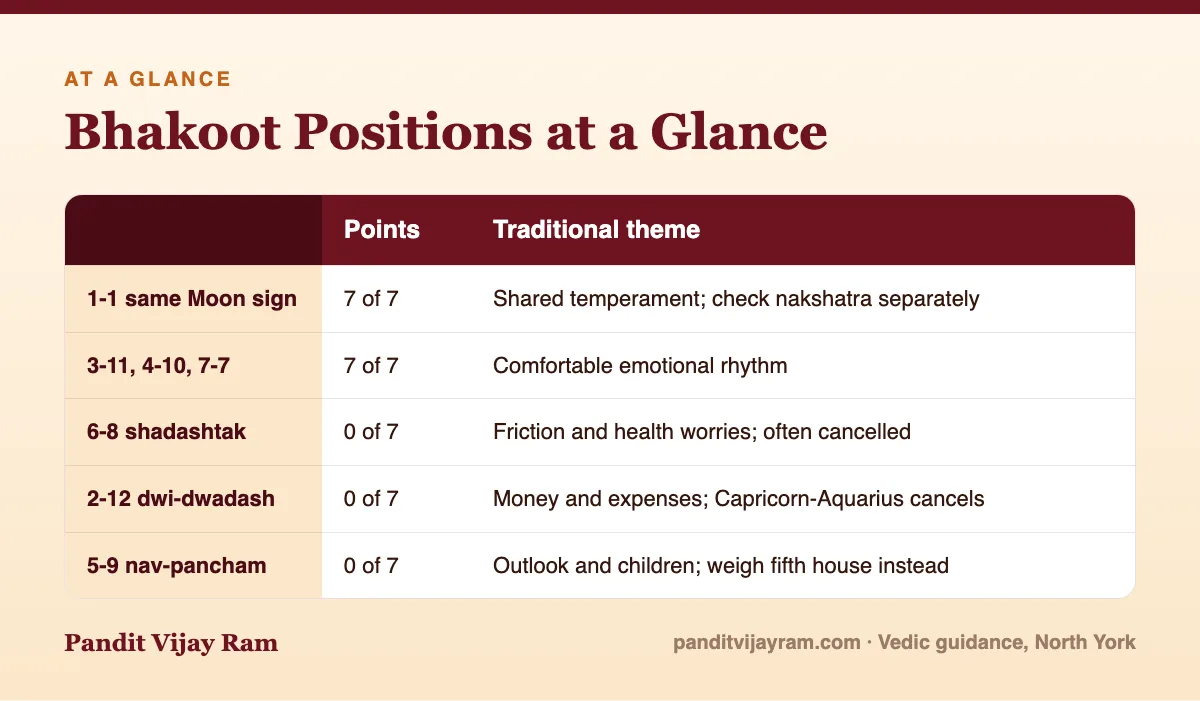
- Check the pattern. 1-1, 3-11, 4-10 and 7-7 are favourable and earn seven points. 2-12, 5-9 and 6-8 earn zero.
Tradition gives each difficult pattern its own theme. A 6-8 placement is associated with disagreements, health worries and a feeling of working against each other. A 2-12 placement is linked with money, family expenses and one partner feeling the other spends or drains resources. A 5-9 placement is associated with questions around children and differing outlooks. These are traditional themes for discussion, not predictions that will come true for every couple.
One caution matters a great deal. The Moon changes sign about every two and a quarter days, so a person born near a sign change needs an accurate birth time. If the time is uncertain, read our note on matching without a birth time before trusting any bhakoot verdict.
When is bhakoot dosha cancelled?
The most widely accepted cancellation applies when both Moon signs share the same ruling planet, or when the two ruling planets are natural friends. Aries with Scorpio, Taurus with Libra and Capricorn with Aquarius are classic same-lord pairs. Some traditions add cancellations through strong tara, nadi or navamsha agreement.
Bhakoot cancellation, often called bhakoot dosha parihara, is where software and a careful reader most often part ways. Many apps mark the zero and move on. A traditional reading asks a further set of questions.
- Same rashi lord. Aries and Scorpio are both ruled by Mars and sit 6-8 apart. Taurus and Libra, both ruled by Venus, also sit 6-8. Capricorn and Aquarius, both Saturn's signs, form a 2-12 pair. In each case the shared lord is said to remove the dosha.
- Friendly lords. When the two sign lords are natural friends, for example the Sun and Jupiter, or the Moon and Jupiter, many astrologers treat the flag as greatly weakened.
- Navamsha agreement. If the Moon-sign lords in the navamsha (D9) chart are the same or friendly, some schools consider bhakoot neutralised.
- Strong overall matching. A good tara and gana result alongside a clear nadi is often cited as softening the concern.
Regional schools disagree on the details, and South Indian porutham matching uses its own rasi check. I tell families this openly, because when an expert says a rule is absolute while another tradition says otherwise, the honest position is that the rule is weighted, not fixed.
For a fuller picture of how the strongest koota interacts with bhakoot, see the guide to nadi dosha meaning and remedies.
Is 6-8 bhakoot dosha really bad for marriage?
A 6-8 bhakoot on its own is not a verdict on a marriage. It is one seven-point factor out of thirty-six, and it is frequently cancelled. A reading weighs it against the seventh house, Venus, Jupiter, the dasha periods ahead and the couple's own maturity before drawing any conclusion.
I have watched families treat shadashtak as if it were a sentence. That approach skips most of the information astrology actually offers. When I read a 6-8 pair, I work through a short decision rule.
- Is the dosha cancelled? If the Moon-sign lords are the same or friendly, I note the flag and set it aside.
- If it stands, what does the rest of matching show? A total that remains healthy without bhakoot tells a different story from one that collapses.
- What do the individual charts say? The condition of each person's seventh house, its lord, Venus and Jupiter matters more than any single koota.
- What period is each person running? Mahadasha and antardasha timing often explains friction better than a fixed Moon angle.
- How do the two people actually handle conflict? This is not astrology, and it is the question that usually decides things.
The Moon describes temperament, so a 6-8 pair may simply have different emotional rhythms. One partner may want to talk immediately after a disagreement while the other needs a quiet evening first. Seeing this in advance is useful. It gives the couple language for something they would otherwise take personally.
Two adults who wish to marry have the right to choose, and astrology should never be used to pressure anyone into or out of a marriage. A couple who are honest with each other, have a fair way to settle money questions and respect each other's families will usually do better than a high-scoring pair who do none of that. Our guide to Moon sign compatibility looks at these temperament patterns in more depth.
What are the remedies for bhakoot dosha?
Where bhakoot dosha stands uncancelled, traditional remedies are prayer to the Moon-sign lords, worship of Shiva and Parvati for marital harmony, charity on the lords' weekdays and, in some families, a shared puja before the wedding. None of these replaces honest premarital conversation, and none requires expensive rituals bought out of fear.
Remedies in the Vedic tradition are meant to steady the mind and invite grace, not to rewrite a chart. I suggest only what fits the specific pair of signs and the family's own practice.
- Prayer to both sign lords. For a Mars and Mercury pair, for instance, a Tuesday Hanuman prayer and a Wednesday Ganesha prayer, kept simple and kept regular.
- Shiva-Parvati worship. Monday prayer or a Pradosh observance is the classic household remedy for harmony between spouses.
- Charity linked to the theme. For a 2-12 money theme, many families choose food donation; for 6-8, service at a hospital or care home.
- A pre-wedding puja. Some families hold a short Gauri-Shankar or Navagraha puja. Details are on the puja and anushthan page.
Equally important are the practical remedies. Agree on how household money will be handled before the wedding. Talk about where you will live, how often parents will visit and how you each calm down after an argument. These conversations address the very themes bhakoot points to.
Be cautious of anyone who says only a costly ritual can save the match, or who uses the word dosha to create panic. If you would like a careful look at both charts, the relationship compatibility reading explains how I approach matching, including bhakoot cancellations that reports often miss.
The bottom line
Bhakoot dosha is a seven-point flag that appears when Moon signs sit 6-8, 2-12 or 5-9 apart, and it is counted inclusively in both directions. Same-lord and friendly-lord pairs often cancel it, a check many software reports skip. Even where it stands, it should be weighed against both full charts and the couple's own character rather than read as a verdict. Use the result to start honest conversations about money, temperament and family, and keep the final decision with the two people who will share the marriage.
Key takeaways
- Bhakoot is the rashi koota and is worth seven of thirty-six points.
- Positions of 6-8, 2-12 and 5-9 score zero; all other pairings score seven.
- Same or friendly Moon-sign lords are the most accepted cancellation.
- A full reading of both charts outweighs any single koota.
- Use the theme as a conversation prompt, never as a reason for fear.