
Nadi Dosha in Kundli Matching: Meaning and Remedies
Of all the results in a matching report, "Nadi dosha present" tends to cause the most alarm. It costs eight points at once, and someone in the family has usually heard that it threatens children or health. Nadi dosha comes up often in the matchings I do for couples in North York, Etobicoke and across the GTA, and in many of those cases the dosha turns out to be cancelled. This guide explains what the three nadis are, how to work out your own from your birth nakshatra, the standard cancellation rules, what the dosha does and does not mean for health, and which remedies tradition offers when it truly applies. In more than forty years of practice I have learned to slow families down at this point. A same-nadi result is a reason to check the details carefully, not a reason to call off a wedding over the phone. I will also be clear about where the traditional claims end and where a doctor's advice should take over.
What is Nadi dosha in kundli matching?
Nadi is the eighth and heaviest koota in ashtakoota matching, worth eight of 36 points. Each of the 27 nakshatras belongs to one of three nadis: Aadi, Madhya or Antya. If the bride's and groom's Moon nakshatras share a nadi, the koota scores zero and the result is called Nadi dosha.
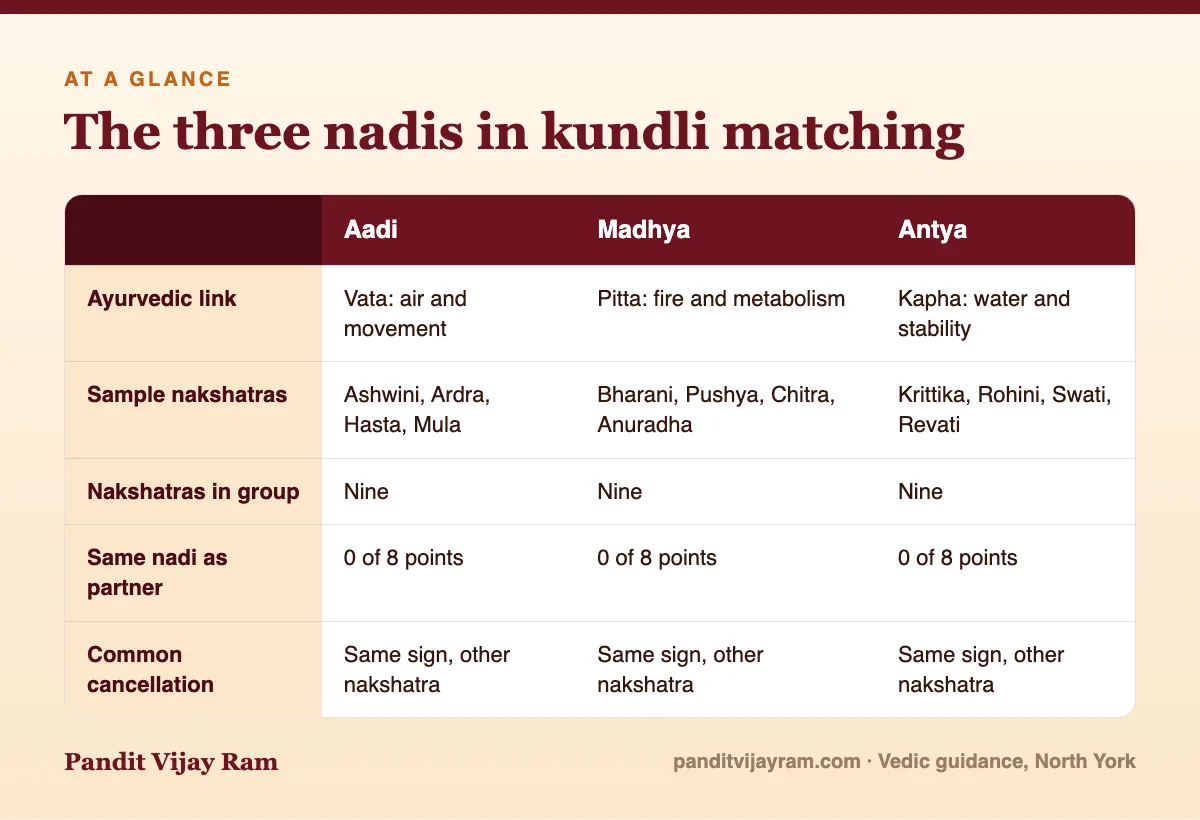
The three nadis borrow their names from Ayurveda's three doshas, the body's governing tendencies:
- Aadi nadi is associated with vata, air and movement.
- Madhya nadi is associated with pitta, fire and metabolism.
- Antya nadi is associated with kapha, water and stability.
The traditional reasoning is that two people of the same constitution reinforce each other's imbalance, while different nadis complement one another. That is why matching is all-or-nothing here: different nadis earn all eight points, the same nadi earns none.
Because roughly a third of all possible pairs share a nadi, Nadi dosha is common. It is not a rare or sinister finding. It simply removes a large block of points, which is why it so often drags a total below the popular threshold of 18.
Nadi is one of three heavy kootas, with Bhakoot and Gana. Together they shape most of a matching's meaning. For how the full score and its bands should be read, see our guide to a low guna milan score. For couples who are already committed and wondering how much weight to give any of this, kundli matching for love marriage offers a calmer frame.
How do I know my nadi from my nakshatra?
Find your Moon's nakshatra at birth, then look it up. The 27 nakshatras are assigned in a repeating zig-zag pattern: Aadi, Madhya, Antya, Antya, Madhya, Aadi, and so on. Nine nakshatras fall in each nadi. Your birth chart or a matching report will list your nakshatra; the table below gives the nadi.
Aadi nadi (vata): Ashwini, Ardra, Punarvasu, Uttara Phalguni, Hasta, Jyeshtha, Mula, Shatabhisha, Purva Bhadrapada.
Madhya nadi (pitta): Bharani, Mrigashira, Pushya, Purva Phalguni, Chitra, Anuradha, Purva Ashadha, Dhanishta, Uttara Bhadrapada.
Antya nadi (kapha): Krittika, Rohini, Ashlesha, Magha, Swati, Vishakha, Uttara Ashadha, Shravana, Revati.
Some practical cautions before you rely on the lookup:
- Use the Moon's nakshatra, not the ascendant's or the Sun's. People sometimes confuse their lagna nakshatra with their birth star.
- Check the birth time. The Moon moves through a nakshatra in roughly a day. If you were born near the change, a small error in the recorded time can move you into a different nadi.
- Confirm the place and time zone. Births abroad and daylight saving changes are common sources of mistakes.
- Note the pada. Each nakshatra has four quarters, and some cancellation rules depend on them.
If either partner has no reliable time, a reading can still estimate the nakshatra, with honest limits; see matching without a birth time.
When is Nadi dosha cancelled?
Nadi dosha is widely considered cancelled when both partners share a Moon sign but have different nakshatras, or share a nakshatra but have different Moon signs. Many astrologers also accept the same nakshatra in different padas. Some schools add further exceptions tied to the Moon-sign lords, so practice varies.
Here is how the main exceptions work in practice.
- Same rashi, different nakshatra. Suppose both Moons are in Taurus, one in Krittika and the other in Rohini. Both nakshatras are Antya nadi, but the shared sign is read as cancelling the dosha.
- Same nakshatra, different rashi. A few nakshatras straddle two signs, such as Krittika across Aries and Taurus. Two people born in Krittika but in different signs are usually considered free of the dosha.
- Same nakshatra, different pada. Several authorities accept this as a cancellation; others treat it with caution.
- Moon-sign lord relationships. Some regional schools treat a shared or friendly lord as softening the dosha. This is less universally accepted.
Two situations are generally read as the strongest form: the same nakshatra and the same pada, and the same nadi with no cancelling factor at all.
Because texts and lineages disagree on the finer points, two honest astrologers can reach slightly different conclusions. Ask whoever reads your match to tell you which rule they applied, and why. A relationship compatibility consultation sets these rules out openly, so the family can see the reasoning rather than just the verdict.
Does Nadi dosha affect health or children?
Tradition links uncancelled Nadi dosha to the couple's vitality and to concerns about children. Claims online that it reveals blood-group or genetic incompatibility are not supported by medical science. If you are worried about inherited conditions or fertility, speak to your family doctor, who can arrange carrier screening or referral where appropriate.
The classical concern grew from the Ayurvedic idea of constitution, not from genetics. Over time, some modern writers have claimed that same-nadi couples share "blood" or "genes" and therefore risk childlessness or ill children. Nadi is calculated from where the Moon stood at birth. It cannot read DNA, blood group or fertility, and no medical test measures it.
That does not make the worry silly. It usually points to a real, reasonable wish: healthy children and a healthy partner. Better ways to address it:
- Talk to your family doctor before or after marriage about family medical history on both sides.
- Ask about carrier screening if conditions run in the family. Thalassemia trait, for example, is relatively common among people of South Asian, Middle Eastern and Mediterranean heritage, and a simple blood test can identify it.
- Seek fertility advice early if you have concerns about conceiving; a doctor can explain what tests make sense.
Spiritual practice can sit alongside medical care, never in place of it. Couples hoping for a child can read our sensitive guide to santan prapti remedies, which keeps the fertility doctor first.
I tell families plainly: please do not refuse a match because someone claimed the nadis predict a sick child. If health is the concern, a doctor can give real answers.
What are the remedies for Nadi dosha?
Traditional remedies for uncancelled Nadi dosha include Mahamrityunjaya mantra jaap, a Nadi dosha nivaran puja, charity of grain, cloth or gold in both partners' names, and worship of Shiva or Vishnu. They are offered as blessing and support. A reasonable remedy fits the family's means and is never sold through fear.
The most commonly prescribed remedy is the Mahamrityunjaya mantra, the prayer to Shiva for health and long life. Families may chant it themselves daily, or arrange a priest-led jaap with a set count; very large counts, such as a lakh and a quarter, are traditional for formal anushthans.
Other remedies families use:
- Nadi dosha nivaran puja, usually done before the wedding with both families present.
- Daan, or charity. Grain, clothes, a gold item or a donation to a cow shelter in place of the old custom of gifting a cow. Giving to a food bank is in keeping with the spirit.
- Monday prayers to Shiva and Parvati, or Thursday worship of Vishnu, by the couple together.
- Personal health habits that honour the Ayurvedic idea behind nadi: regular sleep, good food and a check-up.
Be wary of anyone who says Nadi dosha means certain disaster unless you pay for an urgent and costly ritual. That is fear-selling, and the strongest sign of it is pressure to decide quickly. A genuine remedy is calm, explained and affordable. Our puja and anushthan page describes how a family puja is planned with you.
Finally, a remedy supports a decision; it does not make it. A couple with uncancelled Nadi dosha, strong individual charts and a healthy relationship may choose to marry with a remedy. That choice is theirs.
The bottom line
Nadi dosha arises when both partners' Moon nakshatras share a nadi, costing the full eight points of the heaviest koota. Recognised cancellations, such as the same sign with different nakshatras, apply often enough that every case deserves a careful recheck of birth data and rules. Health and fertility questions belong with a doctor, while mantra, puja and charity offer calm spiritual support for couples who choose to marry.
Key takeaways
- Nadi dosha means both Moon nakshatras share a nadi, scoring zero of eight.
- Nine nakshatras belong to each of Aadi, Madhya and Antya nadi.
- Same sign with different nakshatras, or the reverse, usually cancels it.
- Nadi says nothing about genetics; ask a doctor about carrier screening.
- Remedies like Mahamrityunjaya jaap support the couple; they should never be sold with fear.