
Love Compatibility by Date of Birth: What It Can Show

Typing two birthdays into a calculator is often the first thing people do when they fall for someone. The result appears in seconds, usually as a percentage, and it can feel strangely important. Readers in North York and across the GTA sometimes bring me screenshots of these scores, worried by a low number or delighted by a high one. This guide explains what love compatibility by date of birth actually measures. It walks through the three common methods, which are Western sun signs, numerology and an approximate Vedic Moon sign, and shows what each one can and cannot know from a date alone. It also explains why two websites can give the same couple very different results, and when it is worth adding a birth time for a proper chart comparison. In more than forty years of reading charts, I have found birthday matches useful as conversation starters. They become a problem only when people let a number speak louder than their own experience of each other.
How does love compatibility by date of birth work?
Date-of-birth compatibility uses only the day, month and year to place each person in a category, such as a sun sign, a numerology number or a likely Moon sign. The calculator then compares the two categories using a fixed table of good, neutral and difficult pairings, and turns the result into a score or short description.
Most birthday calculators, including the Love Compatibility Checker on our free love and marriage tools page, rely on one or more of these methods:
- Western sun sign. The date tells you which of twelve signs the Sun was in, using the tropical zodiac. Pairings are judged by element, such as fire with air.
- Numerology. The digits of the birth date are added and reduced to a life path number, usually from one to nine, with some systems keeping eleven, twenty-two and thirty-three. Numbers are then compared for harmony.
- Approximate Vedic Moon sign. Some tools estimate the sidereal Moon sign from the date. Because the Moon spends about two and a quarter days in each sign, this is right on most days but uncertain on others.
- Chinese zodiac. A few tools add the animal sign of the birth year, which is based on the lunar new year rather than the first of January.
Each method reduces a person to one of a small number of types. That simplicity is what makes it fast and fun. It is also why the result is broad.
To find your own number, the free numerology calculators work out a life path number, and our guide to the life path number explains how it is calculated and read.

What can a date of birth match actually tell you?
A date-of-birth match can point to broad temperament themes, such as a fiery and an earthy nature, or two people who both value independence. It can suggest where you may click easily and where patience may be needed. Used lightly, that can spark a useful talk about how each of you handles stress, affection and change.
Birthday methods are not empty. They describe tendencies that many people recognise in themselves.
Where they can be genuinely helpful:
- Starting a conversation. Reading a description together and asking 'is this true of you?' often reveals more than the description itself.
- Naming differences gently. 'Your sign is said to need space; mine is said to need closeness' is an easy way to discuss a real tension.
- Self-reflection. Some people find a numerology or sign profile helps them notice their own habits.
- Light fun. Comparing results with friends at a family gathering is harmless when nobody takes it as a verdict.
Vedic astrology adds one useful note. If a tool estimates your Moon sign correctly, it touches the part of the chart tradition links to the mind and emotions. That is closer to daily relationship life than a Western sun sign, which describes identity and drive. Our guide to Moon sign compatibility explains the element pairings and their limits in detail.
Even at its best, though, a birthday match describes two types meeting. It knows nothing about the two particular people.
What can't date of birth compatibility show?
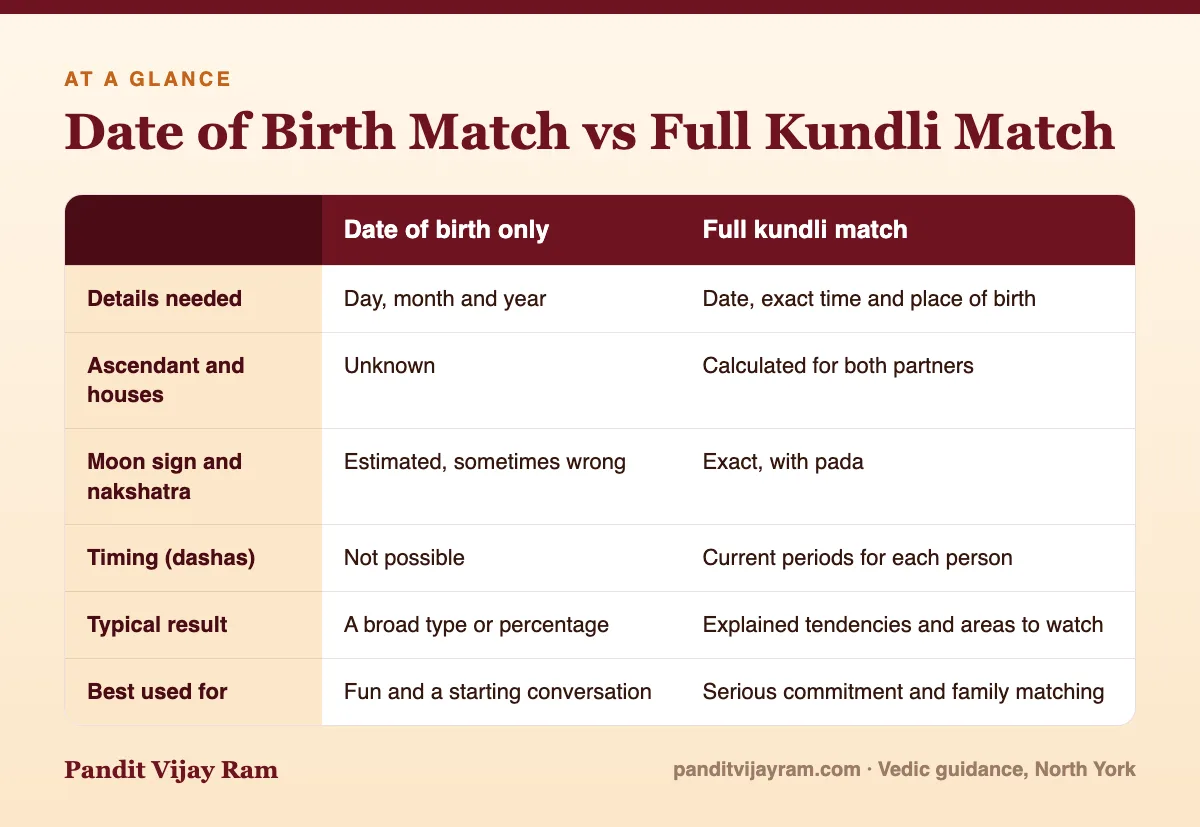
Without birth time and place, a calculator cannot find the ascendant, the 7th house, planetary house positions, the exact nakshatra on many days or the dasha periods. It also knows nothing about character, values, honesty, family or how you treat each other. A date-only score is therefore a broad sketch, never a judgment of a real relationship.
Consider how much is missing from a date alone.
- The ascendant, or lagna, changes roughly every two hours. It decides which house every planet falls in, including the 7th house of partnership.
- The nakshatra, which drives most of the thirty-six-point guna milan, changes about once a day. Anyone born near a change cannot be placed from the date alone.
- The Moon sign can be wrong on the two or so days each month when the Moon changes sign.
- Dasha periods, used for timing in Vedic astrology, start from the Moon's exact position.
- Everything human. Kindness, reliability, shared values, money habits, faith and family expectations never appear in a birth date.
This is why I do not accept a birthday percentage as a reason to end or begin a relationship. It simply does not hold enough information.
There is also a psychological trap. General descriptions often feel personally accurate because they are written broadly enough to fit most people, a tendency known as the Barnum effect. A high score can make every good moment seem confirmed, and a low score can make every argument seem predicted.
If neither of you knows your birth time, our article on kundli matching without birth time describes the more careful fallback methods astrologers use.
Why do different websites give different compatibility scores?
Calculators use different zodiacs, numerology systems, pairing tables and scoring formulas, and some add random or marketing-driven elements. Western tools use the tropical zodiac, while Vedic tools use the sidereal zodiac, so the same date can produce a different sign. There is no single agreed formula, which is why results rarely match across sites.
If you have tried three websites and received three different scores, nothing is wrong with you. The tools disagree for predictable reasons.
- Different zodiacs. The tropical and sidereal zodiacs now differ by about twenty-four degrees. Many people are one sign earlier in Vedic astrology than in a Western horoscope.
- Different numerology rules. Some systems add every digit at once; others reduce day, month and year first. With master numbers, the two approaches can give different answers.
- Different pairing tables. One site may call a pairing excellent while another calls it challenging, depending on the author's school.
- Different weighting. Some calculators blend several methods and invent their own percentage scale.
- Entertainment design. Some apps are built to keep you clicking, and a dramatic score helps.
A sensible rule: treat any single score as one opinion. If several tools agree on a theme, such as two strong-willed signs, that theme may be worth discussing. The exact percentage is not worth worrying about.
For the wider myths around sign matching, including the idea that some signs can never work together, see our guide to zodiac compatibility myths.
When should you move from a birthday match to a full chart reading?
Move to a full reading when the relationship is becoming serious, when families want a traditional match, or when a low score is causing real worry. You will need both partners' birth dates, times and places, and both people's consent. A full reading compares complete charts, explains tendencies and avoids reducing two people to a single number.
A simple decision rule helps here.
- Casual curiosity or early dating: a birthday tool is fine. Enjoy it and move on.
- A score that keeps worrying you: talk to your partner about the specific theme instead, and check whether it matches real experience.
- Engagement or family involvement: gather accurate birth details and compare full charts.
- Serious concerns about safety or respect: no chart is needed to take those seriously. Speak with someone you trust.
In a full comparison I look at both ascendants, the 7th house and its lord, Venus, Mars and the Moon, the navamsa, Ashtakoota guna milan with its cancellation rules, and the dasha periods each person is running. I explain what each factor tends to show and where classical texts disagree. I do not hand down verdicts.
Before any reading, check birth certificates or family records for the exact time; it changes more than people expect.
If you would like this comparison for your own relationship, the relationship compatibility service explains how consultations work, in person or remotely.
The bottom line
Love compatibility by date of birth sorts each person into a broad type, through sun signs, numerology or an estimated Moon sign, and compares the two. It can spark helpful conversations about temperament and emotional style. It cannot see the ascendant, houses, exact nakshatra, dashas or anything about character, so a date-only score is never a verdict. When a relationship becomes serious, use accurate birth details for a full comparison, and trust what you learn from each other.
Key takeaways
- Birthday tools compare broad types, not two real people.
- Without birth time, the ascendant and houses are unknown.
- Tropical and sidereal zodiacs can give different signs.
- Treat one score as an opinion, not a forecast.
- Use full birth details once the relationship turns serious.