
Navamsa Chart (D9): What It Shows About Marriage and Inner Strength

Most people who have a kundli printout notice a second, smaller chart beside the main one, labelled navamsa or D9. It looks like a duplicate, with the same planets scattered into different signs, and it rarely gets explained. Yet many Vedic astrologers treat the navamsa chart as the most important chart after the birth chart itself. Couples in North York sometimes come to me because a matchmaker mentioned the navamsa and they want to understand what was meant. This article explains how the D9 is built from the main chart, why it lines up neatly with the nakshatra padas, what a vargottama planet is, and how astrologers read the navamsa for marriage and for what tradition calls dharma, the moral and spiritual core of a life. It also covers its real limits. In more than forty years of reading charts, I have found the navamsa invaluable for judging how strong a planet truly is. I have also seen it misused to frighten people about their marriages.
What is the navamsa chart in Vedic astrology?
Navamsa means a ninth part. The navamsa chart takes each planet's exact degree in its sign, finds which of nine equal slices it falls in, and assigns it a new sign for that slice. The result is a full second chart, the D9, used to judge planetary strength, marriage and spiritual direction more finely than the birth chart.
The main birth chart, called the rashi chart or D1, shows which sign each planet occupies. Two people can both have Venus in Taurus and still differ greatly, because one Venus may sit at 2 degrees and the other at 28. The navamsa separates them.
Each sign spans 30 degrees. Divided by nine, every slice measures 3 degrees 20 minutes. That makes 108 navamsas around the zodiac, exactly matching the 108 padas, or quarters, of the 27 nakshatras. The first pada of Ashwini is the Aries navamsa, the second is Taurus, and so on in sequence round the zodiac. If you know a planet's nakshatra and pada, you already know its navamsa sign.
Tradition gives the navamsa several roles:
- Strength: a planet well placed in both D1 and D9 is considered reliably strong.
- Marriage: the D9 is the classical chart for the spouse and married life.
- Dharma: it is linked with one's inner values and later-life direction.
A saying often quoted by teachers calls the rashi chart the tree and the navamsa its fruit. It is a teaching image, not a classical rule, but it captures how many astrologers use the two together.
The navamsa is one of sixteen divisional charts. Our broader guide to divisional charts places it among the others.

How is the D9 navamsa chart calculated?
Find which ninth of its sign a planet occupies, then count that many signs from a fixed starting point. Movable signs start counting from themselves, fixed signs from the ninth sign onward, and dual signs from the fifth. An equivalent shortcut counts from Aries for fire signs, Capricorn for earth, Libra for air and Cancer for water.
Software does this automatically, but one worked example shows the logic.
Example: Moon at 15 degrees Taurus.
- Find the slice. The nine slices of Taurus run 0 to 3°20′, 3°20′ to 6°40′, 6°40′ to 10°, 10° to 13°20′, then 13°20′ to 16°40′. Fifteen degrees falls in the fifth slice.
- Find the starting sign. Taurus is a fixed sign, so counting starts from the ninth sign from Taurus, which is Capricorn. The element shortcut agrees, since Taurus is earth.
- Count forward. Capricorn, Aquarius, Pisces, Aries, Taurus. The fifth navamsa is Taurus.
- Place the planet. The Moon goes into Taurus in the D9 chart.
Repeat this for every planet and for the lagna degree, and the navamsa chart is complete. The navamsa ascendant, called the navamsa lagna, is found the same way from the exact rising degree.
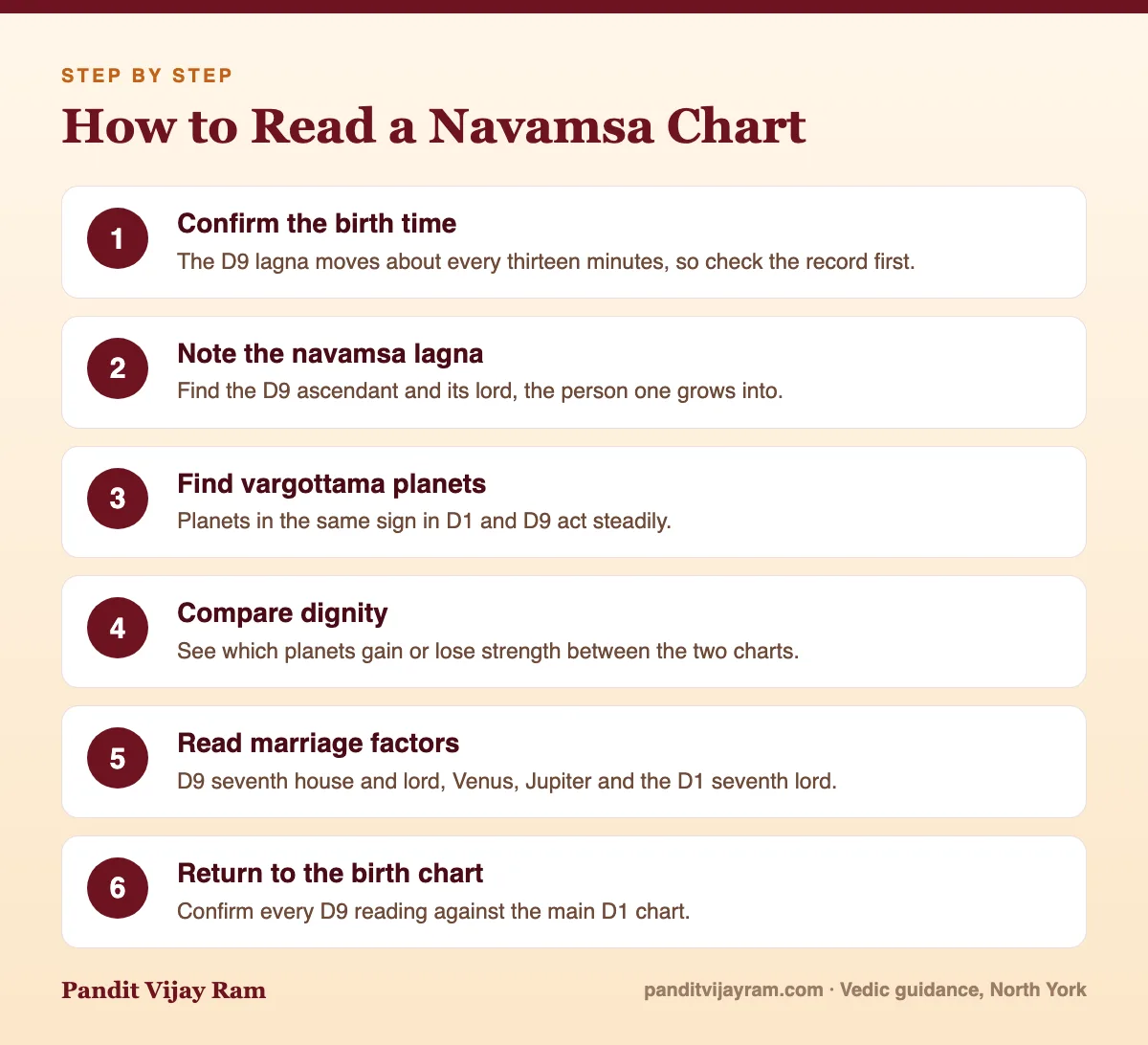
Because each slice is only 3°20′ wide, and the rising degree moves about one degree every four minutes on average, the navamsa lagna changes roughly every thirteen minutes. Planets other than the Moon move slowly enough that their navamsa signs are usually stable, unless they sit near a slice boundary.
If you want to check where your own planets fall, the free astrology checkers on this site can help you gather the degrees first.
What is a vargottama planet?
A planet is vargottama when it occupies the same sign in the birth chart and the navamsa chart. Tradition treats this as a mark of strength and consistency, a planet that acts the same way at both levels. It occurs in the first navamsa of movable signs, the fifth of fixed signs and the ninth of dual signs.
The word combines varga, division, with uttama, best. In the example above, the Moon at 15 degrees Taurus lands in Taurus in the navamsa too, so it is vargottama.
Where to look for vargottama positions:
- Movable signs (Aries, Cancer, Libra, Capricorn): the first 3°20′.
- Fixed signs (Taurus, Leo, Scorpio, Aquarius): from 13°20′ to 16°40′, the exact middle.
- Dual signs (Gemini, Virgo, Sagittarius, Pisces): the last 3°20′.
How astrologers read it:
- Extra steadiness. A vargottama planet is said to deliver its significations more consistently.
- Dignity still matters. A debilitated planet that is vargottama, such as Venus in Virgo in both charts, is consistent but not automatically strong. Teachers disagree on how much the status helps such a planet.
- Vargottama lagna. When the rising sign is the same in D1 and D9, the person is often described as having a stable sense of self.
Related ideas include a planet exalted in D9 while weak in D1, often read as strength that grows with maturity, and the reverse, read as early promise needing care. The classical exaltation and debilitation signs are listed in our guide to exalted and debilitated planets.
What does the navamsa chart show about marriage?
For marriage, astrologers look at the navamsa lagna, the seventh house of the D9 and its lord, and the D9 positions of Venus, Jupiter and the birth chart's seventh lord. Supportive placements are read as harmony and commitment; strained ones as areas needing patience. It describes tendencies in married life, never a verdict on a person.
A practical reading order for marriage in the D9:
- D9 seventh house and lord. Its sign, occupants and the lord's dignity describe the tone of partnership.
- Venus in D9. As the natural significator of the spouse, a dignified Venus is read as warmth and mutual enjoyment. Venus's longer period is discussed in our article on Venus mahadasha.
- Jupiter in D9. Traditionally weighed for the husband in a woman's chart, and for wisdom and ethics in any chart.
- D1 seventh lord in D9. Where the birth chart's seventh lord lands shows how the promise of marriage develops.
- Navamsa lagna and its lord. Some teachers read the D9 ascendant as the person one grows into within marriage.
The navamsa is also linked with dharma: values, conscience and spiritual direction. Its ninth house, Jupiter and the D9 lagna lord are read for this. Many astrologers say the navamsa becomes more noticeable as a person matures.
A caution about matchmaking: some people compare two navamsa charts and declare a marriage doomed. Classical guna milan uses Moon nakshatras, not navamsas, and no single chart should be used to veto a relationship. Vijay Ram ji's relationship compatibility readings look at both charts in full and at the two people involved. Families worried about a low score may find the article on a low guna milan score reassuring.
How accurate is the navamsa chart and what are its limits?
The navamsa is only as accurate as the birth time behind it. Its lagna shifts roughly every thirteen minutes, and planets near a boundary can change sign with a small error. Schools also differ on how independently to read it. Treat the D9 as a refinement of the birth chart, not a separate oracle.
Some honest limits worth knowing before anyone reads your D9:
- Time sensitivity. A birth time recorded to the nearest half hour can place the navamsa lagna in two or three different signs. Ask your astrologer to show what is firm and what is uncertain.
- Boundary planets. A planet within a few minutes of arc of a slice edge may fall in either of two navamsa signs depending on ayanamsa and time.
- Different methods. Most Parashari astrologers use the D9 to judge dignity and marriage. Some read it as a full chart with its own houses and aspects; others use only planetary signs. Both approaches have long lineages.
- Not a verdict. A difficult D9 seventh house describes areas that need care, communication and maturity. It does not decide whether a marriage will last.
When to ask for help: if a reading has left you anxious about your marriage, if a match has been rejected on navamsa grounds alone, or if two programs disagree about your D9 lagna. Bring whatever birth records you have to a reading; our page on how to prepare for a kundli reading lists them.
Relationship strain itself deserves practical support first: honest conversation, couples counselling and, where there is any abuse, safety and the police. Spiritual guidance sits alongside that, never in place of it.
The bottom line
The navamsa chart divides each sign into nine slices of 3 degrees 20 minutes, matching the 108 nakshatra padas, and assigns each planet a new sign. Vargottama planets, in the same sign in both charts, are read as steady and consistent. For marriage, astrologers weigh the D9 seventh house, Venus, Jupiter and the birth chart's seventh lord. Because the navamsa lagna changes every few minutes, treat the D9 as a refinement of the birth chart, not a verdict.
Key takeaways
- The navamsa splits every sign into nine parts of 3°20′.
- Each navamsa matches one of the 108 nakshatra padas.
- A vargottama planet holds the same sign in D1 and D9.
- Marriage is read from the D9 seventh house, Venus and Jupiter.
- The navamsa lagna needs an accurate birth time to be trusted.