
Venus Mahadasha: Twenty Years of Comfort, Love and Lessons
Of all the major periods, Venus's is the one people most hope to be in. Twenty years of romance, nice homes and good food sounds like a gift, and for many people the period is pleasant. Venus mahadasha also has quieter lessons, about spending, comfort-seeking and choosing well in love, and for some ascendants Venus rules houses that make its period more demanding. Couples and parents in North York often ask me whether Shukra's period means a wedding is coming. This article explains what Venus represents in Vedic astrology, how its period tends to touch relationships, which ascendants benefit most, where overindulgence becomes the real risk and which simple remedies suit it. It does not deal with the retrograde motion of Venus in the sky, which is a separate subject. In more than forty years of practice, I have seen the happiest Venus periods belong to people who enjoyed life generously and still kept an eye on the bill.
What is Venus mahadasha in Vedic astrology?
Venus mahadasha is the period ruled by Shukra, lasting twenty years, the longest of the nine mahadashas. It follows Ketu's seven years and precedes the Sun's six. Venus signifies love, marriage, beauty, art, music, comfort, vehicles and refinement. During its period these themes tend to grow more prominent, shaped by Venus's condition in your chart.
In Hindu tradition, Shukracharya is the teacher of the asuras, a learned sage associated with a life-restoring knowledge. In astrology, Venus is the planet of attraction, pleasure and agreement, the quality that makes life sweet.
Classical significations of Venus include:
- Partnership: Venus is the kalatrakaraka, the natural significator of the spouse, especially read for the wife in a man's chart by tradition.
- Beauty and art: music, dance, design, fashion, fragrance and the performing arts.
- Comfort: homes, vehicles, fine food, luxury goods and leisure.
- Diplomacy: charm, tact and the ability to make peace.
- Sensuality: pleasure in all its forms, which is where balance becomes the theme.
Venus is exalted in Pisces and debilitated in Virgo. It owns Taurus and Libra, with Libra as its moolatrikona sign. Venus in its own or exalted sign in a kendra forms Malavya yoga, one of the five classical yogas of great people, often linked with grace, taste and comfort.
Because the cycle begins at Ketu, people born in an Ashwini, Magha or Mula Moon reach Venus early in life. Those born in a Venus nakshatra start inside it. Either way, a twenty-year span covers a large stretch of adulthood. Our overview of the Vimshottari dasha shows how to find where your Venus period falls.
Does Venus mahadasha bring love and marriage?
Venus's period often brings relationships into focus, and many families notice engagements and weddings during it. Whether it supports marriage depends on Venus's strength, its link to the seventh house and the navamsa, and the running sub-periods. It describes a season when love matters more, not a promise that a particular relationship will happen.
Here is how astrologers usually judge relationship themes during the period:
- Venus's house and sign. Venus in the first, fourth, fifth, seventh or eleventh is commonly linked with an active social and romantic life.
- Connection to the seventh house. Venus ruling, occupying or aspecting the seventh is read as stronger support for commitment.
- The navamsa. Venus's condition in the D9 chart is weighed heavily for marriage; our article on the navamsa chart explains why.
- The sub-period. Venus–Jupiter or Venus–Moon sub-periods are often mentioned for weddings, though any can coincide with one.
- Real life. Readiness, values, family conversations and the free choice of both people.
Two clarifications are important. First, this article is about the twenty-year dasha period, not Venus appearing to move backwards in the sky. That separate topic is covered in our post on Venus retrograde and love. Second, no period can make a particular person love you. Vijay Ram ji does not perform rituals to override anyone's free will.
For married couples, a Venus period is often a good time to invest in the relationship itself: time together, shared hobbies, honest talk about money. For people seeking a partner, it can be a season to widen the circle rather than wait. Chart-based guidance for both appears in the article on Venus and the seventh house.
Is Shukra mahadasha good for every ascendant?
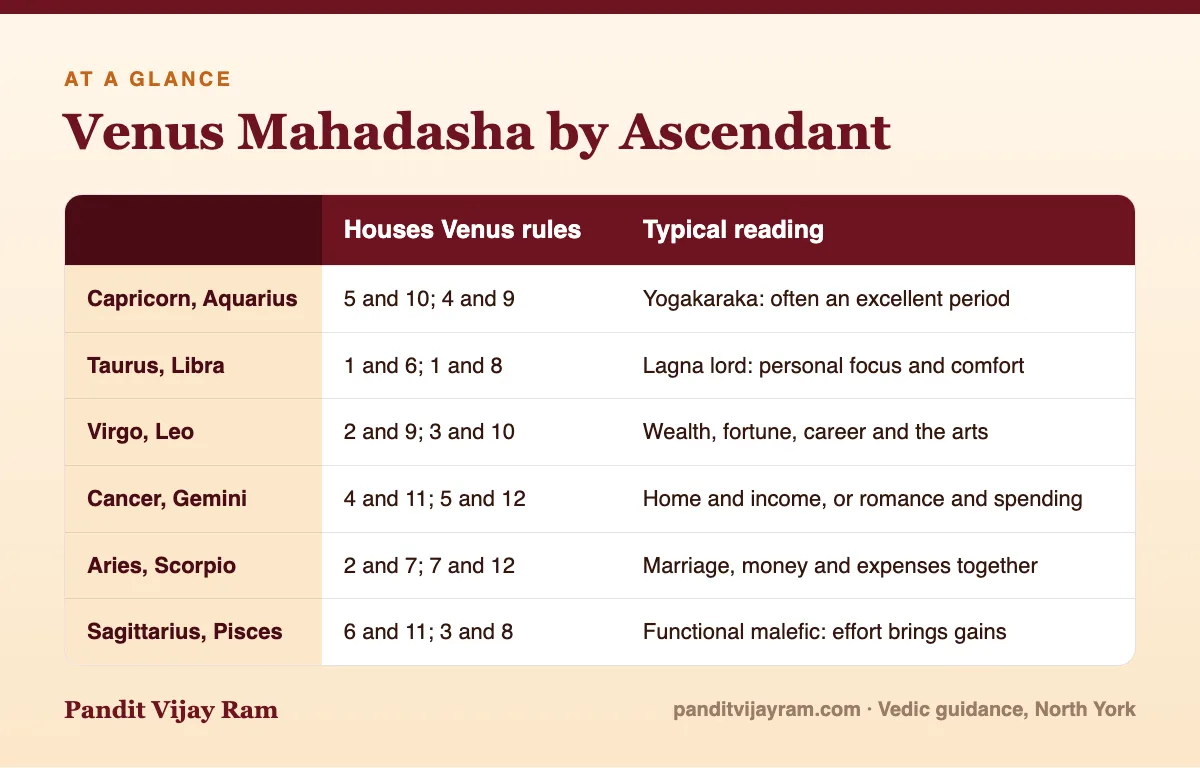
No. For Capricorn and Aquarius ascendants Venus rules a kendra and a trikona and is a yogakaraka, so its period is often excellent. For Taurus and Libra it is the lagna lord. For Sagittarius and Pisces it rules difficult houses and tends to act as a functional malefic, which makes its period more mixed.
The houses Venus rules from each rising sign:
- Aries: 2nd and 7th. Money and marriage, both linked; also a maraka role in longevity work.
- Taurus: 1st and 6th. The lagna lord, with work and health routines.
- Gemini: 5th and 12th. Romance and creativity alongside spending and leisure.
- Cancer: 4th and 11th. Home, vehicles and income.
- Leo: 3rd and 10th. Career, arts, media and communication.
- Virgo: 2nd and 9th. Wealth and fortune; usually welcome, though Venus is debilitated in Virgo itself.
- Libra: 1st and 8th. The lagna lord, with change and shared resources.
- Scorpio: 7th and 12th. Partnerships together with expenses and distance.
- Sagittarius: 6th and 11th. Gains through effort, sometimes competition.
- Capricorn: 5th and 10th. Yogakaraka; creativity joined to career.
- Aquarius: 4th and 9th. Yogakaraka; home, faith and fortune.
- Pisces: 3rd and 8th. Effort, research and change; Venus is exalted in Pisces, which helps.
A useful decision rule: start from rulership, then check dignity. An exalted or own-sign Venus softens difficult rulership, while a debilitated or combust Venus dampens even good rulership. Combustion for Venus is traditionally counted within about ten degrees of the Sun.
Gemstone advice follows the same logic, which is why the guide to which gemstone to wear starts from the lagna rather than from Venus's popularity.
What are the negative effects of Venus mahadasha?
The usual difficulties of a Venus period come from excess rather than lack: overspending on comfort, rich food, late nights, vanity, procrastination or relationships chosen for pleasure over values. A weak or afflicted Venus can bring disappointment in love or money. Noticing these patterns early is the most effective protection the chart offers.
Venus makes things enjoyable. Over twenty years, enjoyment can quietly turn into habit. Patterns astrologers and clients commonly describe:
- Spending. Cars, renovations, clothes and travel bought on credit because the period feels lucky.
- Comfort over effort. Postponing difficult work because life is pleasant enough.
- Food and late nights. Rich meals, sweets and irregular sleep becoming routine.
- Relationship choices. Attraction outrunning judgment, or temptation within a marriage.
- Image. Too much attention to appearance and status.
Chart factors that tend to make these more likely: Venus debilitated in Virgo without cancellation, Venus combust, Venus in the sixth, eighth or twelfth from the lagna, or Venus joined by Rahu, which can exaggerate desires.
Simple guardrails that suit the period:
- Keep a written budget and review it monthly.
- Set one creative or learning goal each year so comfort does not become drift.
- Protect sleep and see your family doctor for regular check-ups.
- In relationships, ask whether a choice fits your values, not only your feelings.
If a Venus period has brought strain into a marriage, counselling and honest conversation come first. Vijay Ram ji's marriage guidance can add a chart perspective and prayer alongside that work.
What are the remedies for Venus mahadasha?
Traditional Shukra remedies include a Venus mantra on Fridays, Lakshmi worship, charity of white foods such as rice, sugar or milk, respect toward women in the family, and keeping the home clean and beautiful. Creative practice is itself a fitting offering. Diamond, white sapphire or opal are considered only when Venus suits your lagna.
Venus is said to respond to beauty, gratitude and moderation. A steady routine might include:
- Mantra. Om Shum Shukraya Namah, or the longer Om Draam Dreem Draum Sah Shukraya Namah, recited calmly on Fridays, often 108 times.
- Lakshmi worship. A simple Friday lamp and prayer to Lakshmi, whose grace is linked with prosperity and harmony. Our guide to Lakshmi puja at home describes a short method.
- Charity. White rice, sugar, milk, curd or white cloth given to people in need, or support for a women's shelter or arts programme.
- Respect. Honouring the women of the household, and treating a spouse with courtesy, is considered a direct Venus remedy.
- Order and beauty. Fresh flowers, a tidy home and clean clothes are small daily offerings to Shukra.
- Moderation. One mindful limit, on spending, sweets or screen time, kept faithfully.
On gemstones: diamond is Venus's classical stone, with white sapphire and opal often suggested as alternatives. They suit only charts where Venus is a functional benefic, and a trial period is traditional. Vijay Ram ji's gemstone and numerology guidance starts with the lagna and the budget you are comfortable with, never with fear.
Remedies support good choices; they do not replace them.
The bottom line
Venus mahadasha is the longest period at twenty years, bringing love, comfort, art and material ease into focus. It is strongest for Capricorn and Aquarius ascendants, where Venus is a yogakaraka, and for Taurus and Libra, where it rules the lagna. Its common lessons come from excess, so budgeting, moderation and clear values matter. Simple Friday remedies, Lakshmi worship and generosity suit Shukra's period best.
Key takeaways
- Venus mahadasha lasts twenty years, the longest of all.
- Venus is a yogakaraka for Capricorn and Aquarius ascendants.
- Relationship themes rise, but no period guarantees marriage.
- The main risk is excess: spending, comfort and indulgence.
- Friday mantras, Lakshmi worship and moderation are classic remedies.