
What to Prepare Before a Kundli Reading

A kundli consultation can feel rushed when the first twenty minutes go on hunting for a birth time or trying to remember what you wanted to ask. A little homework beforehand changes that. When people in North York book a first reading with me, I send a short list of what to bring, and the sessions that follow are noticeably calmer and more useful. This guide shows how to prepare for kundli reading sessions of any kind: how to confirm your birth details, why a few minutes of difference matter, what to do if no one recorded the time, which documents are worth finding, and how to turn a cloud of worries into clear questions. It also covers practical points such as privacy, recording and consent when another person's data is involved. In more than forty years of practice, I have found that careful preparation does more for the quality of a reading than any amount of astrological technique. It is also the easiest part to get right, because it is entirely in your hands.
What birth details does an astrologer need for a kundli?
An astrologer needs your date of birth, the most exact birth time available, and the place of birth, ideally the city or town with its province, state or country. With these, the ascendant, house layout, planetary positions and the starting dasha can be calculated. Missing or rough data limits how much of the chart can be read with confidence.
Each piece of data does a different job.
- Date. This fixes the positions of the slower planets and roughly where the Moon was.
- Time. This sets the rising sign, which moves through all twelve signs in about a day. The rising sign shapes the whole house structure, and through the Moon's exact degree it also sets the balance of the first dasha.
- Place. Latitude and longitude change the ascendant, and the local time zone at that place converts clock time to astronomical time.
Write the time in a way that cannot be misread. Use the 24-hour clock, or clearly mark morning or evening. "Twelve o'clock" causes surprising confusion: midday and midnight produce entirely different charts.
For the place, give the actual town of birth, not where the family lived later. If you were born in a village, name the nearest larger town as well so the location can be checked on a map.
Once these are confirmed, you can also try the free calculators on the site's astrology tools page to see your basic chart before the session. Our guide to the lagna or ascendant explains why the rising sign depends so heavily on the time.

How accurate does my birth time need to be?
The closer the better. A difference of a few minutes rarely changes the main birth chart, but it can change divisional charts such as the navamsa and the exact timing of dasha periods. Around two hours moves the rising sign by one sign on average, which changes the house structure completely, so a rough guess has clear limits.
Here is a practical way to judge your data.
- Recorded to the minute in a hospital file or a janam patri written at birth: the strongest starting point.
- Remembered by a parent to the nearest quarter hour: usually fine for the main chart. Fine divisional charts need caution.
- Known only as a part of the day, such as "early morning": the rising sign may be uncertain. An astrologer may present two possible charts.
- Not known at all: the Moon sign and planetary signs can still be read, but houses cannot. Rectification or a question chart are the usual options.
Old records sometimes contain hidden traps. Some places used daylight saving or wartime time on certain dates, and some regions switched time zones over the years. A good astrologer checks the historical time zone for your birth place, but it helps if you mention where the record came from.
If the time is simply missing, there are two honest routes. Birth time rectification works backward from major life events, and it takes effort and gives an estimate rather than certainty. A prashna kundli, cast for the moment you ask a question, skips the birth chart entirely. Our article on divisional charts explains why fine charts need precise times.
Where can I find my exact birth time?
Start with family records: a janam patri prepared at birth, a baby book, letters or the hospital discharge papers. Then ask parents, grandparents or older relatives. Some hospitals and registry offices keep birth records that include the time, though rules on access vary. Record where each answer came from so the astrologer can judge it.
People are often surprised by how many places a birth time can hide.
- Janam patri or horoscope from childhood. Many families had one made by a priest soon after birth. Even if the chart style is old, the time written at the top is valuable.
- Hospital paperwork. Discharge summaries and maternity records sometimes note the delivery time.
- Birth registration. Requirements differ between countries and provinces. Some standard certificates do not show the time, while fuller registration records may. Contact the office that registered the birth to ask what exists and how to request it.
- Family memory. Ask more than one relative separately and compare. Gentle prompts help: "Was it before or after the morning prayer? Was the doctor on the night shift?"
- Religious records. Some temples, gurdwaras or churches recorded naming ceremonies that mention the birth.
If accounts conflict, bring all of them rather than choosing one. An astrologer can compare the options against your life events.
Be careful with official documents. Share only what is needed, and never send identity numbers or full certificates over unsecured channels. The birth time and place are enough; your other personal details stay private.
What questions should I ask an astrologer in a first reading?
Choose two or three focused questions about your own life, such as which areas of the chart are strong, what the current and next dasha periods emphasise, or how to approach a specific decision. Add a sentence of context to each. Avoid asking about other people's private choices, exact event dates or promised outcomes.
Good questions give the astrologer something to work with. Here are examples that tend to produce useful conversations.
- "What are the main strengths and challenges in my chart?"
- "Which dasha am I in now, and what themes does it usually bring?" Our dasha guide gives background.
- "I am choosing between two career paths. What does the chart suggest about my temperament for each?"
- "Which simple daily practice would suit my chart?"
- "Is there anything in the chart I should think about before marriage?"
Questions that rarely help include "When exactly will I get married?", "Will my ex come back?" and "Will I win my case?" A chart can describe tendencies and periods, but it cannot schedule events or decide another person's will. Legal, immigration, money and health questions belong first with a lawyer, a licensed consultant, a financial professional or your family doctor.
Write a line of context under each question. "I have been offered a transfer to Calgary and my parents live here" gives far more to discuss than "Should I move?"
Finally, put your questions in order of importance. Sessions have limited time, and the first question usually gets the most attention.
Should I bring old charts or a partner's birth details?
Bring any earlier charts or reports, because they help the astrologer spot differences in calculation, such as a different ayanamsa or time zone. Bring a partner's or child's details only with that person's knowledge and consent, and only when the question genuinely concerns them, for example marriage matching or a child's naming.
Old charts are useful even when you disagree with what they said. They show which positions were used, and differences often come down to settings rather than interpretation. Note the source of each report: a family priest, an app or another astrologer.
For matching, both people's birth data are needed. Our article on kundli matching for love marriage explains what a compatibility check involves. For children, a parent naturally provides the details.
For adult relatives or partners, consent matters. Reading someone's chart without their knowledge in order to judge or manage them is not respectful, and I will decline that kind of request. If a parent wants a reading for an adult son or daughter, it is better that the son or daughter knows and, ideally, takes part.
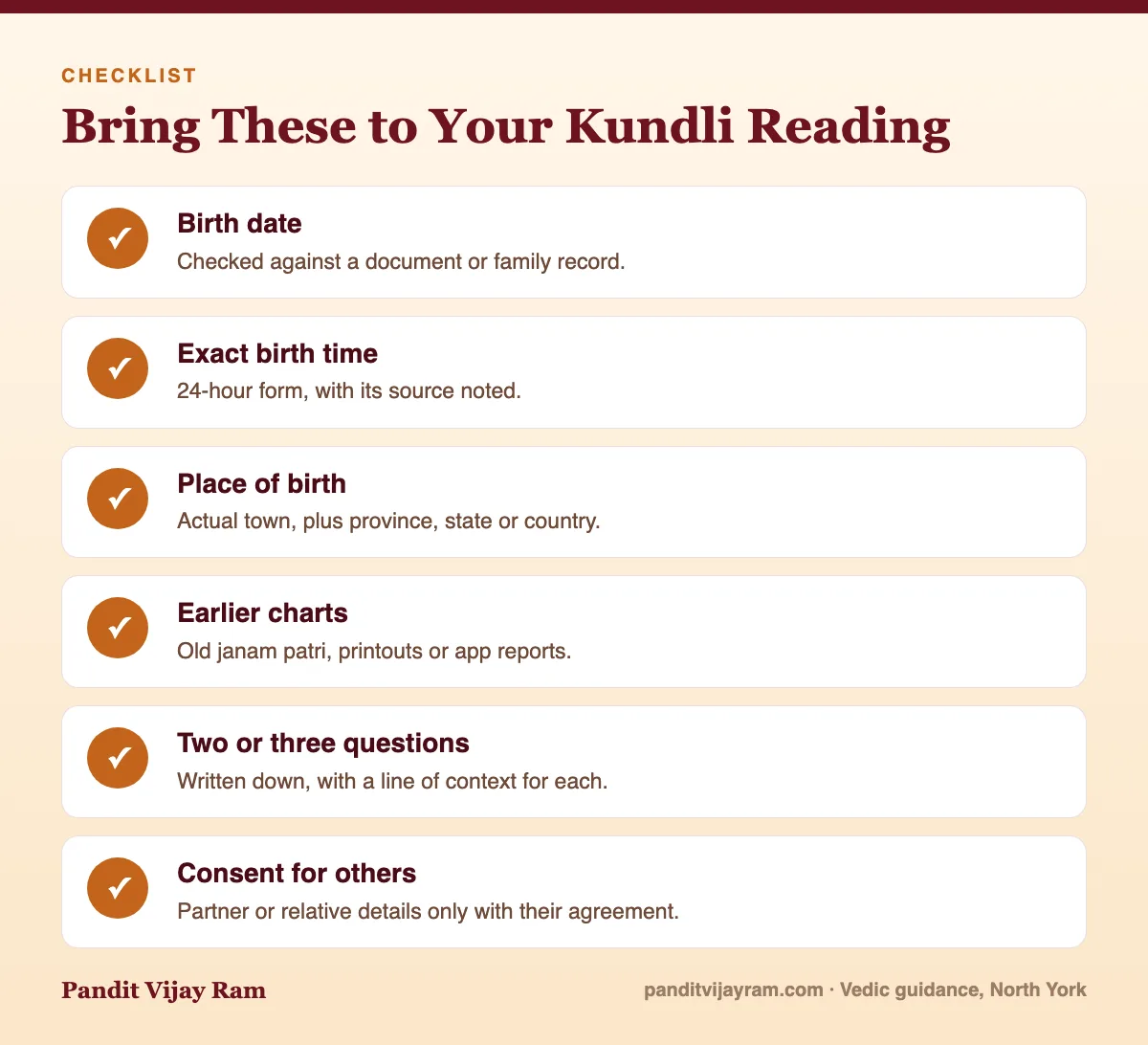
A short checklist of what to bring:
- Your confirmed date, time and place of birth, with the source noted.
- Any earlier charts or printouts.
- Your two or three written questions with context.
- Consenting partner or family details, only if relevant.
- A notebook, or permission to record for your own use.
Vijay Ram ji's kundli and horoscope readings page explains what different consultations cover.
The bottom line
Preparing well is the simplest way to improve any reading. Confirm your birth date, time and place, and note where each detail came from. Bring old charts and a few written questions with context, and include other people's data only with their consent. If you prepare for kundli reading sessions this way, the time with your astrologer goes on understanding rather than searching.
Key takeaways
- Exact birth time and place matter most, because they set the ascendant and houses.
- Write the time in 24-hour form or clearly mark morning or evening.
- Earlier charts help reveal calculation differences such as ayanamsa or time zone.
- Two or three focused, written questions lead to the most useful sessions.
- Share a partner's or adult relative's details only with their consent.