
Lagna in Vedic Astrology: Why Your Ascendant Matters More Than Your Sun Sign
Ask a Vedic astrologer for your sign and the first reply is often a question back: do you know your exact time of birth? That is because the answer that matters most is not your sun sign but your lagna. Lagna in Vedic astrology is the sign climbing over the eastern horizon when you took your first breath, and it changes every couple of hours. Clients in North York sometimes arrive surprised that their newspaper sign barely features in the reading. This article explains what the lagna is, how software works it out from your birth time and place, what the lagna lord is, and why so much of Parashari astrology hangs on it. It also covers what to do when the time on record is uncertain. In more than forty years of practice, I have learned to check the lagna before anything else. A reading built on the wrong rising sign can be confident, detailed and almost entirely beside the point.
What is lagna in Vedic astrology?
The lagna, or ascendant, is the point of the zodiac rising in the east at your birth. The sign holding that point becomes your first house, called tanu bhava. In Vedic astrology it describes your body, temperament and life direction, and it serves as the reference point from which every other house is counted.
Picture the eastern horizon at the moment you were born. The sky turns through all twelve signs in roughly a day, so one sign at a time is climbing into view. Whichever sign was rising, and the precise degree within it, is your lagna.
The word comes from a Sanskrit root meaning to attach or meet. A common teaching image is that the lagna is where the person meets the sky. Three things are read from it:
- The lagna sign: for example Scorpio rising, which gives a first house ruled by Mars.
- The lagna degree: the exact point, which falls in one of the twenty-seven nakshatras, or birth stars, and in one quarter, or pada, of it.
- Planets in or aspecting the first house: these colour the personality and physical constitution in the traditional reading.
In the North Indian chart the lagna is always the top centre diamond. In the South Indian chart it is marked in whichever sign box it falls. Either way, everything else on the page is laid out in relation to it.
The lagna is not a planet, and it does not have a dasha of its own in the Vimshottari system. Its power comes from position: it fixes the frame through which every planet is seen. For a walk through the remaining eleven houses, see how to read your kundli.

How is the ascendant calculated from birth time and place?
Software converts your local clock time to universal time, applies your birthplace's latitude and longitude, and finds the local sidereal time. From that it calculates which degree of the ecliptic was rising. Vedic charts then subtract the ayanamsa to place that degree in the sidereal zodiac. Wrong time, place or time zone gives a wrong lagna.
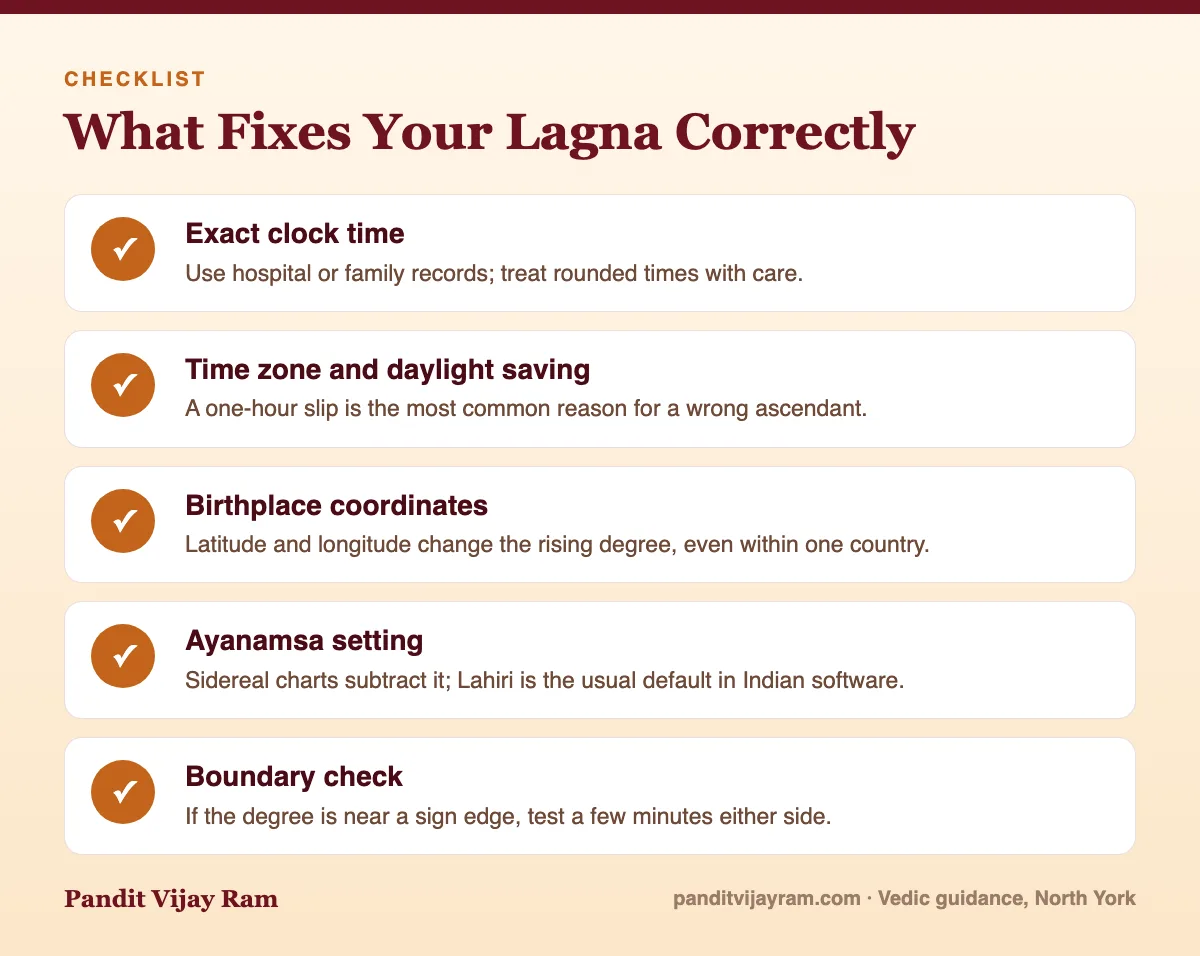
You do not need to do the arithmetic yourself, but knowing the inputs helps you spot errors. A rising degree depends on four things:
- Clock time of birth. Hospital records are usually more reliable than memory. Rounded times such as exactly noon deserve a gentle question.
- Time zone and daylight saving. A one-hour slip here is the most common cause of a wrong chart. Older records from some countries also used local or wartime clocks.
- Latitude and longitude. A birth in Toronto and one in Vancouver at the same clock moment produce different ascendants.
- Ayanamsa. This correction converts the tropical position into the sidereal zodiac. Most Indian software defaults to Lahiri; some astrologers use Raman or Krishnamurti values, which differ by a fraction of a degree.
Signs do not rise at an even pace. Away from the equator, some signs clear the horizon in well under two hours and others take noticeably longer. At Canadian latitudes the difference is marked, so the old rule that each lagna lasts two hours is only an average.
If your rising degree sits within a degree or two of a sign boundary, ask your astrologer to show what changes if the time is a few minutes off. You can also run your details through the free zodiac and sign tools to compare the result with a printout you already have.
What is the lagna lord and why does it matter?
The lagna lord is the planet that rules your rising sign, such as Mars for an Aries or Scorpio ascendant. Traditionally it represents you as the chart's main character. Its house, sign, strength and associations show where your attention and energy tend to flow, and whether you get support for your efforts.
Each sign has one ruler in the classical scheme. Rahu and Ketu are not given sign rulership by most Parashari astrologers.
- Mars: Aries and Scorpio lagnas.
- Venus: Taurus and Libra.
- Mercury: Gemini and Virgo.
- Moon: Cancer.
- Sun: Leo.
- Jupiter: Sagittarius and Pisces.
- Saturn: Capricorn and Aquarius.
A simple reading rule follows: wherever the lagna lord sits, your life tends to orient toward that house. A lagna lord in the tenth often points to someone defined by work. In the fourth it suggests home and roots carry great weight. In the twelfth it may show a life lived partly abroad or inwardly.
Strength matters too. A lagna lord in its own or exalted sign, in a kendra or trikona, and free of heavy affliction, is read as steady support. A weak or afflicted one does not doom anyone. It suggests that effort, health habits and good company count for more.
The lagna also sets each planet's functional role. For a Taurus or Libra ascendant, Saturn rules both a kendra and a trikona and is treated as a yogakaraka, a strongly helpful planet. For a Leo ascendant, Saturn rules the sixth and seventh, a very different job. This is why gemstone advice must start from the lagna, as our guide to choosing a gemstone explains.
Why does the ascendant matter more than the sun sign in Vedic astrology?
Your sun sign is shared by everyone born in the same month, but your lagna changes every couple of hours. It fixes your houses, decides which planets help or hinder you, and personalises the chart. The Sun's sign still matters, especially for vitality and the father, but it cannot structure a reading the way the lagna does.
Think of the planets as actors and the houses as stages. The Sun's sign tells you how one actor plays. The lagna decides which stage every actor stands on and what role each is cast in. Change the lagna and the same planets end up running different departments of life.
Three practical consequences:
- House placements. Two siblings born on the same day hours apart share a Sun sign but may have Jupiter in the fifth for one and the tenth for the other.
- Timing. A dasha period is read according to the houses its planet rules from your lagna. A Venus period means one thing for a Capricorn ascendant and another for a Scorpio one.
- Remedies. Advice on mantras, gemstones and charity depends on functional roles, which come from the lagna.
Vedic astrologers also read the chart from the Moon, called Chandra lagna, and sometimes from the Sun, Surya lagna. When all three frames agree on a theme, that theme is given more weight. The Moon frame is especially important for transits and for many family conversations about rashi, which our article on Moon sign vs Sun sign covers.
So the honest summary is not that the Sun is unimportant. It is that the ascendant is the frame, and the Sun is one picture inside it.
What if my birth time is not known exactly?
If your time is uncertain, the lagna may be uncertain too. An astrologer can check whether the rising sign changes across your likely window, rely more on the Moon chart, or attempt rectification by testing major life events against candidate times. Rectification is an estimate, so readings built on it should be held loosely.
Many adults in Canada were born where times were recorded loosely, or rely on a parent's recollection. That is common and nothing to feel embarrassed about. Here is a sensible order of steps:
- Look for documents first. Hospital discharge papers, baby books, a grandparent's diary or a priest's original handwritten kundli can narrow the window.
- Test the range. Cast charts at the earliest and latest plausible times. If both give the same lagna sign, much of the reading still stands.
- Lean on the Moon. The Moon stays in one sign for about two and a quarter days, so your rashi is usually safe even when the lagna is not.
- Consider rectification. An astrologer compares dates of marriage, moves, births and bereavements against charts for candidate minutes. Different methods can reach different answers.
Where no usable time exists at all, some astrologers turn to a chart cast for the moment a question is asked, the horary method described in our article on prashna kundli. Marriage matching has its own fallbacks too.
If you would like the birth data checked before any interpretation, Vijay Ram ji's kundli and horoscope service begins there. Bring whatever records you have, even if they seem incomplete.
The bottom line
Lagna in Vedic astrology is the sign and degree rising in the east at your birth, and it becomes the first house from which every other house is counted. It is calculated from your exact clock time, time zone and birthplace, so small errors can shift it. Its ruler, the lagna lord, shows where your energy flows and decides which planets help you. That is why the ascendant, not the sun sign, frames every Parashari reading.
Key takeaways
- The lagna is the sign rising in the east at your birth.
- Birth time, time zone and place together fix the ascendant.
- The lagna lord's house shows where life tends to focus.
- Functional benefics and gemstone advice depend on the lagna.
- With an uncertain time, the Moon chart is the safer guide.